American Council of Learned Societies
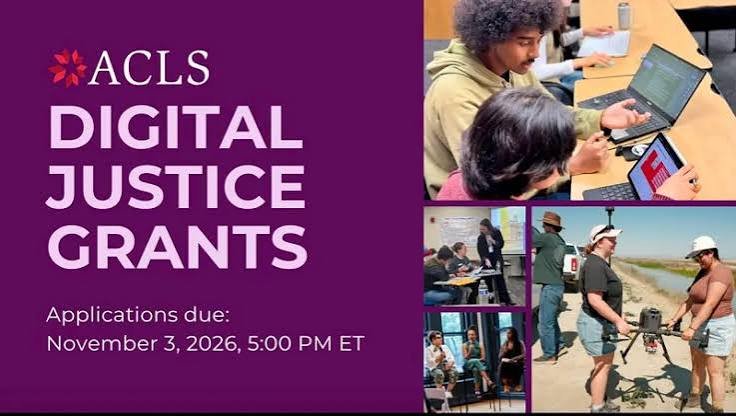
The ACLS Digital Justice Seed and Development Grants 2026-27 provide funding for scholars and project teams developing digital projects in the humanities and interpretive social sciences. The programme is offered by the American Council of Learned Societies (ACLS) with support from the Mellon Foundation.
The grants are designed for projects that use digital tools and methods to explore questions of justice, equity, representation, and access. A particular focus is placed on projects that engage with the histories and interests of people of color and other historically marginalized communities.
The programme has two funding categories. Digital Justice Seed Grants support projects that are still in the early stages, including projects involving planning, experimentation, prototyping, or testing. Digital Justice Development Grants are intended for projects that have moved beyond the early development stage and need support to expand their intellectual, technical, institutional, or community impact.
The ACLS Digital Justice Grants programme supports digital scholarship that seeks to make the digital humanities more diverse, accessible, and equitable. The programme recognizes that digital research can create new opportunities for scholarship while also reproducing existing inequalities if questions of access, representation, and ownership are not considered.
Projects supported through the programme can use digital technologies to develop new research methods, preserve and interpret cultural materials, create digital resources, strengthen community partnerships, or make scholarly work more accessible to wider audiences.
The programme is funded by the Mellon Foundation and is administered by ACLS, a nonprofit federation of scholarly organizations that supports research and scholarship in the humanities and related social sciences. ACLS has awarded Digital Justice grants to projects working across different disciplines and communities.
The programme provides funding according to the development stage of the proposed project.
The benefits include:
The amount available depends on the category selected and the scope of the proposed project. Seed Grants are intended for earlier-stage projects, while Development Grants are intended for projects that have already progressed beyond prototyping or proof of concept.
An eligible institution of higher education in the United States must administer the grant funds. This means applicants need an appropriate institutional arrangement before submitting an application.
Projects should:
ACLS grants do not support projects whose sole or primary purpose is the production of creative works such as novels or films, textbooks, straightforward translations, or purely pedagogical projects. Institutional indirect costs are also not covered.
The grants are open to projects across the humanities and interpretive social sciences. The programme is not restricted to one academic discipline.
Potential areas may include:
Applicants should select the grant category that matches the current stage of their project.
Digital Justice Seed Grants are intended for projects at an early stage. This can include projects that are exploring new research materials, testing digital methods, organizing planning workshops, developing prototypes, or experimenting with potential products.
Seed Grants range from $10,000 to $25,000 and have a 12-18 month project period.
Digital Justice Development Grants are intended for projects that have already moved beyond the startup, prototyping, or proof-of-concept stage. Applicants should be able to demonstrate significant preliminary work and evidence of engagement or impact with scholarly and/or public audiences.
Development Grants range from $50,000 to $100,000.
Applicants should check the official ACLS competition guidelines for the complete list of materials required for the 2026-27 competition.
The application is expected to provide information about:
Applicants for Development Grants should be prepared to demonstrate the preliminary work already completed and explain how the new funding will allow the project to move to its next stage.
The selection process considers the quality and relevance of the proposed project as well as its potential contribution to digital justice.
Applicants should demonstrate:
For Development Grants, applicants should also show that substantial work has already been completed and that the project has engaged scholarly or public audiences.
Interested applicants should follow these steps:
Applications for both grant categories are submitted through the ACLS online application system. ACLS advises applicants to review the programme information and eligibility requirements before registering for the application system.
 American Council of Learned Societies





Be the first to comment on this opportunity.