CDC · Atlanta, Georgia
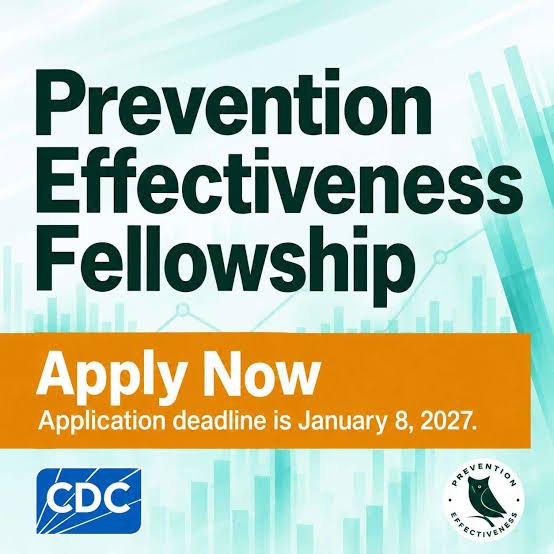
The U.S. Centers for Disease Control and Prevention (CDC) is accepting applications for the Steven M. Teutsch Prevention Effectiveness (PE) Fellowship 2027. This paid, two year postdoctoral programme trains researchers to apply quantitative methods, health economics, disease modelling, and decision science to real world public health challenges.
The fellowship provides hands on experience working with public health experts and decision makers. Fellows conduct analyses that help identify effective interventions, evaluate programme costs, improve resource allocation, and inform public health policy.
The programme offers two tracks: the Traditional Track for economists and health services researchers, and the Analytics and Modeling Track for professionals with quantitative and modelling backgrounds.
The PE Fellowship was established to strengthen the use of evidence and quantitative analysis in public health decision making. Since 1995, the programme has trained scientists whose research helps government agencies and other organisations determine how to use limited resources to achieve better health outcomes.
Fellows work on applied projects involving issues such as the economic burden of disease, the cost effectiveness of preventive interventions, health programme evaluation, and mathematical modelling of infectious diseases.
Most assignments are based at CDC headquarters in Atlanta, Georgia, although some fellows may be placed with other public health agencies or in other locations. The programme is full time and requires fellows to relocate to their assigned workplace.
Selected fellows receive the following benefits:
• Paid employment: Salary at the federal General Schedule GS 12, Step 3 level.
• Medical insurance: Access to federal employee health benefits.
• Paid leave: Leave benefits available under applicable federal employment rules.
• Practical research experience: Work on public health questions with direct relevance to policy and programme decisions.
• Expert mentorship: Learn from experienced economists, epidemiologists, disease modellers, and public health specialists.
• Technical development: Strengthen quantitative analysis, decision science, modelling, and communication skills.
• Professional collaboration: Work with multidisciplinary teams and public health partners.
• Career development: Build experience in applied public health research and evidence based policy.
Fellows may be eligible for a salary increase after the first year, subject to performance and a written recommendation from appropriate management officials. Relocation expenses are the fellow's responsibility.
Applicants must select the track that best matches their academic training and professional interests.
The Traditional Track focuses on health economics, economic evaluation, health services research, and public health policy analysis.
Fellows use economic and quantitative methods to answer practical questions about the costs, benefits, and effectiveness of public health programmes.
Relevant activities may include:
• Conducting cost effectiveness and cost benefit analyses.
• Estimating the economic burden of diseases.
• Evaluating preventive health interventions.
• Analysing health services and programme performance.
• Supporting decisions about the allocation of public health resources.
This track is particularly suitable for applicants trained in economics, agricultural economics, health services research, public health, or another relevant quantitative discipline.
The Analytics and Modeling Track focuses on mathematical modelling, disease dynamics, quantitative analysis, and decision support.
Fellows may work with complex datasets and models to understand disease transmission, assess interventions, and support public health planning.
Relevant areas include:
• Infectious disease modelling and epidemiology.
• Mathematical and statistical modelling.
• Simulation and microsimulation.
• Operations research and decision analysis.
• Disease ecology and applied biological sciences.
• Data science and quantitative methods.
This track is suitable for applicants with backgrounds in epidemiology, applied mathematics, operations research, industrial engineering, data science, biological science, or related fields.
Applicants must meet the academic, employment authorisation, and relocation requirements.
• Doctoral degree: Applicants must hold a PhD or equivalent qualification, with all degree requirements completed before the fellowship begins in August 2027.
• Relevant discipline: The degree must be relevant to the selected track.
• Work authorisation: Applicants must be U.S. citizens, U.S. permanent residents, or qualify under an accepted visa or work authorisation category.
• Relocation: Applicants must be willing to relocate to their assigned workplace for the full two year programme.
• Full time commitment: Candidates must be able to participate in the fellowship on a full time basis.
Applicants with degrees earned outside the United States may need to provide a course by course credential evaluation. Degree documents must be translated into English where necessary.
Applicants should prepare the following documents and information before beginning the online application.
1. Resume or CV
Include your education, research experience, employment history, technical skills, publications, presentations, grants, awards, and relevant volunteer experience.
2. Personal statement
Answer the questions provided by the CDC. These cover your motivation for public health service, professional challenges, experience with economic or decision analytic methods, data analysis skills, reasons for applying, and career goals.
3. Academic transcripts
Provide unofficial transcripts for all earned and in progress college or university degrees. Applicants with qualifications from outside the United States may need a course by course credential evaluation.
4. Three to five recommendations
At least three recommendations are required, and up to five may be submitted. At least two recommenders must not be CDC employees. Suitable referees include supervisors, colleagues, professors, and faculty members familiar with your work.
5. Skills and experience information
Be prepared to describe your experience with data management, statistical software, economic datasets, modelling, and analytical methods.
Atlanta, Georgia
 CDC





Be the first to comment on this opportunity.