
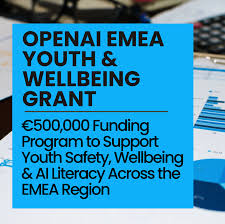
The EMEA Youth Safety and Wellbeing Funding Program 2026 is a strategic grant initiative designed to support organisations working to enhance the safety, wellbeing, and developmental opportunities of young people within the Europe, Middle East, and Africa (EMEA) region in the context of advancing artificial intelligence (AI). The programme’s overarching mission is to enable practical, research-driven, and scalable interventions that address current and future challenges related to youth engagement with AI technologies.
With a total funding pool of €500,000, this programme invites eligible stakeholders to submit proposals that demonstrate meaningful impact, innovative approaches, and strong alignment with the goals of youth protection, empowerment, and ethical AI practice. The initiative recognises that as AI becomes increasingly embedded in education, social interaction, and digital environments, specialised efforts are needed to ensure these technologies contribute positively to young people’s lives while minimising harm.
Programme Objectives
The primary purpose of the EMEA Youth Safety and Wellbeing Funding Program 2026 is to expand organisational capacity and evidence generation around youth safety and wellbeing in an AI-driven world. Specific objectives include:
- Supporting research and evidence production that improves understanding of how AI affects children and adolescents.
- Funding practical interventions that promote safe AI use, reduce risk, and strengthen protective environments for young people.
- Promoting AI literacy education for youth, caregivers, educators, and community stakeholders.
- Encouraging development of actionable tools, frameworks, and insights that inform youth-focused policy and organisational practice.
These priorities reflect an emphasis on both evaluative research and hands-on implementation of youth safety strategies, ensuring that funded projects produce tangible benefits for communities and end users.
Who Can Apply
The EMEA Youth Safety and Wellbeing Funding Program 2026 is open to legally registered organisations operating in countries within the Europe, Middle East, and Africa region. Eligible applicants include:
- Non-governmental organisations (NGOs) that work directly with young people, families, educators, or community groups.
- Research institutions and universities engaged in independent investigation of youth-related issues or AI impacts.
- Collaboration that integrate practical service delivery with research and evaluation components.
Applicants should demonstrate a track record of ethical, responsible work with youth populations and a clear capacity to complete proposed activities within the programme timeline. While the primary focus is on non-profit and research entities, consortia or coalitions with combined expertise may also be considered where they present strong alignment with the programme’s aims.
Funding Details
The total fund available for EMEA Youth Safety and Wellbeing Funding Program 2026 is €500,000. Individual awards are expected to range between €25,000 and €100,000, with consideration given to multi-year funding for larger initiatives or strategic partnerships demonstrating exceptional impact potential.
Funding may cover both direct and reasonable indirect costs, so long as they align with institutional policies and contribute meaningfully to project objectives. Award amounts will be determined based on the scale, scope, and defined outcomes of proposed work, with larger awards reserved for projects that promise significant contributions to youth safety research, policy development, or practical implementation.
Recipients will enter into funding agreements that outline deliverables, reporting expectations, ethical compliance requirements, and timelines for execution. Projects are expected to generate outputs such as research reports, policy briefs, educational toolkits, or validated intervention models that can be shared with broader stakeholder communities.
Focus Areas and Themes
Proposals may address one or more of the following priority areas:
1. Youth Safety and Protection:
Initiatives that strengthen protective measures for children and adolescents in digital and physical spaces influenced by AI, including harm-prevention programmes, risk assessment tools, and community-based safety strategies.
2. AI Literacy for Youth and Educators:
Programs designed to build awareness, understanding, and critical thinking around AI technologies among young people, parents, caregivers, and frontline youth workers. This includes curriculum development, workshops, and outreach materials tailored to different age groups and contexts.
3. Independent Research on AI Impacts:
Research that explores the implications of AI on youth development, learning processes, social behaviour, and emotional wellbeing. Studies may evaluate current safeguards or propose new methodologies for ensuring youth-centred AI design and governance.
4. Practical Tools, Guidelines, and Frameworks:
Projects that produce scalable and usable resources such as instructional toolkits, policy recommendations, evaluation frameworks, and tested intervention models that help organisations and policymakers implement safe AI practices.
These thematic areas reflect an interdisciplinary approach, recognising that effective youth support strategies often combine educational, sociological, technological, and ethical perspectives.
Application Process
The application period opened on January 28, 2026 and closes on February 27, 2026. Prospective applicants are required to submit an online application form along with several supporting documents, including:
- A concise project title and narrative proposal (up to 500 words) outlining goals, methodology, timeline, and expected deliverables.
- A detailed budget with justification of costs.
- Curriculum vitae or biographies of key project team members.
- Institutional affiliation documentation and proof of legal registration.
- Ethical and data governance statements where relevant.
- Letters of support or partnership confirmations, if applicable.
All proposals are subject to a review process that assesses eligibility, alignment with programme objectives, feasibility, and potential impact. Selected projects will be notified following committee evaluation and contracting procedures.
Selection Criteria
Applications will be evaluated on several weighted criteria, including:
- Legal and Operational Presence in EMEA: Organisations must be registered and operational within the EMEA region to qualify.
- Relevance to Youth Safety and Wellbeing: Clear alignment of the project with programme goals related to youth empowerment and responsible AI engagement.
- Impact Potential: Likelihood of producing measurable outcomes that contribute to improved youth safety or understanding of AI impacts.
- Methodological Rigor and Ethical Standards: Sound research design, strong data governance, and appropriate safeguards for working with minors.
- Feasibility and Capacity: Demonstrated ability to execute the project within the proposed timeline and budget.
- Sustainability and Scalability: Potential for project outputs to endure beyond the funding period or to be adopted by other organisations.
Implementation Timeline
EMEA Youth Safety and Wellbeing Funding Program 2026 funding decisions are expected to be announced shortly after the closing date, with successful applicants beginning project implementation between the second and third quarters of 2026. Funded activities may run across multiple months, with periodic check-ins and reporting requirements to ensure alignment with programme expectations.
Overall, the EMEA Youth Safety and Wellbeing Funding Program 2026 represents a significant opportunity for organisations committed to advancing youth-focused AI safety, research, educational literacy, and strategic innovation across the region.
