
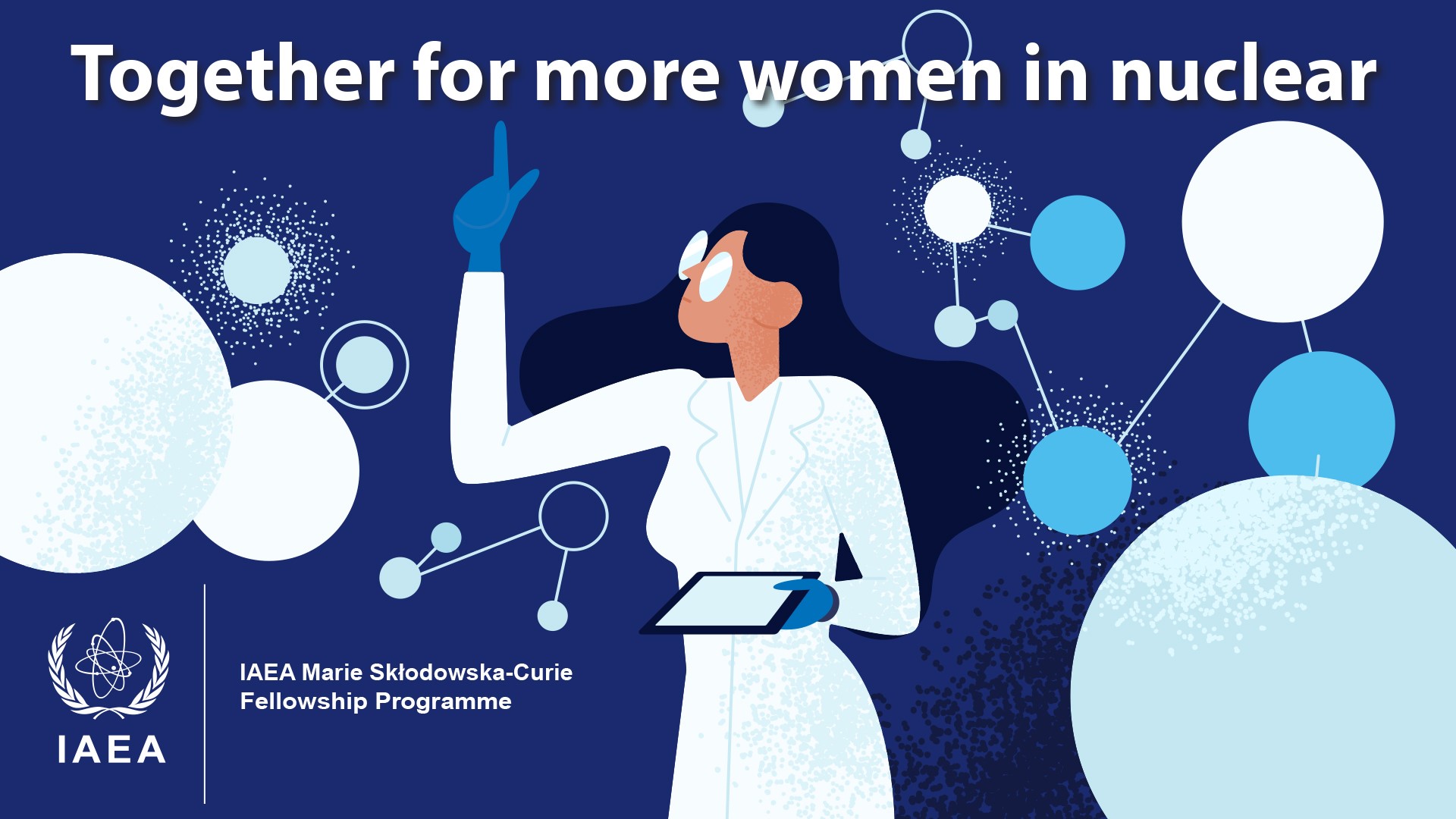
The International Atomic Energy Agency (IAEA) established the Marie Sklodowska-Curie Fellowship Programme (MSCFP) to inspire and empower young women around the world to pursue advanced studies and careers in the nuclear field. Named after the pioneering physicist and chemist Marie Curie, the programme aims to close the gender gap in science, technology, engineering, and mathematics (STEM), particularly within nuclear science and its applications.
Launched in 2020, this fellowship provides financial assistance to women pursuing a Master’s degree in nuclear-related fields. In addition to funding, selected candidates may benefit from an internship opportunity facilitated by the IAEA, helping them gain valuable practical experience and build a global professional network.
Programme Objectives
The fellowship seeks to encourage more women to engage in nuclear science and technology and contribute to solving pressing global challenges such as climate change, energy security, food sustainability, and public health. By investing in women’s education, the IAEA aims to promote equal representation and diversity within the nuclear sector, ensuring that women have an equal voice in shaping the future of science and innovation.
Eligible Fields of Study
The MSCFP covers a wide range of disciplines relevant to the IAEA’s mission. Eligible areas include:
- Nuclear engineering and physics
- Nuclear chemistry and materials science
- Radiation medicine and radiopharmacy
- Radiation biology and protection
- Isotopic techniques and applications in agriculture or hydrology
- Nuclear safety, security, and safeguards
- Nuclear policy, law, and non-proliferation
Applicants must be pursuing or accepted into a Master’s degree in one of these or closely related fields at an accredited university.
Eligibility Criteria
To qualify for the fellowship, applicants must:
- Be female nationals of an IAEA Member State.
- Have been accepted or be enrolled in a Master’s programme in a nuclear-related discipline.
- Demonstrate strong academic performance and a clear commitment to contributing to the nuclear sector.
- Provide supporting documents such as proof of admission, academic transcripts, identification, and references.
Preference is given to candidates who show academic excellence, leadership potential, and a clear vision for advancing the peaceful use of nuclear technologies in their home countries.
Fellowship Benefits
Each selected fellow receives financial support covering both tuition and living expenses for the entire duration of the Master’s programme. The fellowship provides:
- Up to €20,000 for tuition fees
- Up to €20,000 for living costs
- An optional internship opportunity of up to 12 months at the IAEA or partner institutions
The internship component offers fellows hands-on experience in nuclear projects, policy implementation, and research, enhancing their career prospects and helping them build a foundation for future leadership roles in science and technology.
Application Process
Applicants must complete the online application form provided by the IAEA and submit all required documentation in English. Documents in other languages must be accompanied by certified English translations. Required materials typically include:
- A copy of passport or national ID
- University admission letter for a relevant Master’s programme
- Proof of tuition fees or cost estimates
- Copies of previous academic records
- Two recommendation letters, with at least one from an academic referee
Incomplete or late submissions are not considered. Applicants are encouraged to apply early to allow time for document preparation and review.
Selection Criteria
Applications are evaluated by a panel of IAEA experts based on several factors, including academic performance, relevance of study field, quality of motivation statement, and potential to contribute to the nuclear sector. The selection committee also ensures geographical diversity among recipients, providing opportunities for women from all regions.
Programme Impact
Since its inception, the Marie Sklodowska-Curie Fellowship has supported hundreds of women from more than 100 countries. Many fellows have gone on to work in research, academia, and international organizations, contributing to the peaceful and sustainable application of nuclear technologies.
This initiative plays a vital role in strengthening global scientific capacity while promoting gender equality. It not only provides financial assistance but also helps create a network of skilled women scientists and leaders dedicated to advancing innovation, safety, and sustainability in the nuclear field.
Conclusion
The IAEA Marie Sklodowska-Curie Fellowship stands as a testament to the power of education and inclusion. By opening doors for women in nuclear science, the programme honors Marie Curie’s legacy and builds a more balanced, innovative, and equitable scientific community. For aspiring female scientists seeking to make a meaningful impact, this fellowship offers both the resources and the recognition needed to shape the future of nuclear technology for the benefit of all.
Deadline: October 30, 2025.
