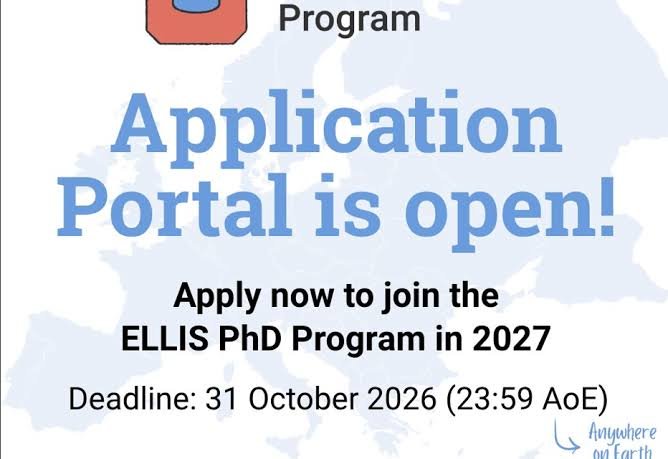
European Laboratory for Learning and Intelligent Systems (ELLIS).
The ELLIS PhD Programme 2027 is inviting applications from talented researchers interested in pursuing doctoral studies in artificial intelligence, machine learning and related fields at leading research institutions across Europe. The programme connects promising PhD candidates with established researchers, creating opportunities for advanced research, international collaboration and interdisciplinary learning.
The programme is part of the European Laboratory for Learning and Intelligent Systems, known as ELLIS, a pan European network focused on strengthening European research excellence in artificial intelligence. Through its network of academic researchers, research institutions and industry partners, ELLIS supports the development of the next generation of AI researchers and promotes collaboration across national and disciplinary boundaries.
Selected candidates undertake doctoral research under joint supervision from researchers based in different European countries, with opportunities to participate in research workshops, summer schools, networking activities and international exchanges. The programme is designed for researchers who want to contribute to the development of machine learning and AI while working with leading experts in their chosen fields.
The ELLIS PhD Programme brings together researchers working on artificial intelligence and machine learning through a network of academic institutions and industry partners. Its central objective is to help outstanding doctoral candidates develop their research expertise while benefiting from international supervision and access to a wider scientific community.
Candidates apply through a central application portal, where they can indicate their preferred research areas and potential supervisors participating in the current recruitment round. The programme places particular importance on matching applicants with a suitable primary advisor and research opportunity.
Students can pursue one of three tracks, depending on their research interests and the type of collaboration available.
• Academic Track: Research collaboration between academic partners in different European countries.
• Industry Track: Collaboration between a European academic institution and an industry partner, combining academic research with an industrial research environment.
• Interdisciplinary Track: Research that connects artificial intelligence or machine learning with another discipline, such as biology, law or finance.
The programme includes an international exchange component. Depending on the selected track, students must spend at least six months working with their secondary advisor or partner institution. Specific requirements differ between tracks.
Successful candidates can benefit from the following opportunities.
• Joint supervision by experienced researchers in artificial intelligence and related fields.
• Access to a broad European research network spanning universities, research centres and industry.
• Opportunities to collaborate across institutions and countries.
• Participation in research workshops, summer schools, winter schools and other academic events.
• Opportunities to develop expertise in machine learning, AI systems and related research areas.
• Research and conference travel support where provided by the relevant advisor or host institution.
• Access to an international community of doctoral researchers and established scientists.
• Opportunities to pursue interdisciplinary research addressing challenges in science, technology and society.
• ELLIS Certificate and membership upon completion, subject to programme requirements.
Funding note: ELLIS is a research network rather than a direct employer or funding body for every PhD student. Salary, tuition coverage and other financial support depend on the host institution, the advertised doctoral position and any applicable scholarship. Applicants should confirm the financial terms of each position before accepting an offer.
The programme covers a wide range of machine learning and AI research fields. Applicants should review the current list of participating advisors and available positions to identify opportunities that match their interests.
Relevant research areas include:
• Artificial intelligence and machine learning algorithms.
• Deep learning and machine learning theory.
• Computer vision and computer graphics.
• Natural language processing and information retrieval.
• Robotics and human robot interaction.
• Reinforcement learning and control.
• Bayesian and probabilistic learning.
• Bioinformatics and computational neuroscience.
• Earth and climate sciences.
• Machine learning for health, chemistry and materials science.
• Machine learning for sustainability.
• Human behaviour, psychology and emotion.
• Interpretability, fairness and trustworthy AI.
• AI safety, privacy, security and ethics.
• Multi agent systems and game theory.
• Social sciences, humanities, entrepreneurship and technology transfer.
The available research topics and supervisors may vary by recruitment round. Applicants should therefore select advisors who are explicitly listed as recruiting for the 2027 intake.
Applicants should demonstrate strong academic preparation, research potential and a clear interest in doctoral research in artificial intelligence, machine learning or a related discipline.
• Applicants should have a relevant academic background and qualifications suitable for admission to a PhD programme at the host institution.
• Applicants should demonstrate academic excellence and the potential to conduct independent research.
• Applicants should have research interests that align with the participating advisor and an available doctoral position.
• Applicants should be prepared to undertake joint supervision and the international collaboration required by their selected track.
• Applicants should be able to provide academic transcripts and supporting documentation in English or with English translations.
• Applicants should identify suitable referees who can assess their academic performance and research abilities.
• Applicants must complete all required application sections and submit reference requests before the main application deadline.
The programme is highly competitive. ELLIS reports that, in a typical recruitment round, fewer than five percent of all registered applicants and approximately five to ten percent of eligible applicants are accepted. Women and people living with disabilities are explicitly encouraged to apply.
Applicants should prepare the following materials for the online application.
• Motivational letter and research statement: A document of up to two pages explaining why the applicant wants to pursue a PhD within the ELLIS network, summarising previous research projects and describing future research interests.
• Current curriculum vitae: Include educational background, relevant work experience, publications with full citations, research presentations and awards.
• Academic transcripts: Unofficial transcripts covering university studies, including bachelor’s and master’s studies where applicable.
• English translations: Provide English translations of academic transcripts where the original documents are in another language.
• Referee details: Contact details for at least two and no more than three referees who have agreed to provide recommendations.
• Optional research material: Applicants may submit a thesis, published paper, research project or portfolio as one PDF file of less than 20 MB.
At least two referees should be established researchers, such as independent investigators, principal scientists, group leaders or lecturers. A maximum of one referee may be a postdoctoral researcher. Referees must be able to assess the applicant’s academic or research abilities. References from PhD students or classmates are not accepted.
Applications are assessed with particular attention to the suitability of the applicant for an available doctoral research position and the potential for a productive match with a primary advisor.
Relevant considerations include:
• Academic preparation and research potential.
• Clarity and quality of the motivational letter and research statement.
• Alignment between the applicant’s interests and the research areas of participating advisors.
• Evidence of previous research experience, where available.
• Strength and relevance of academic or professional references.
• Suitability for the chosen programme track and its international collaboration requirements.
Applicants should review advisor profiles carefully before applying. Only researchers participating in the current recruitment round can recruit candidates through this call.
Interested candidates should follow these steps to submit an application.
 European Laboratory for Learning and Intelligent Systems (ELLIS).





Be the first to comment on this opportunity.