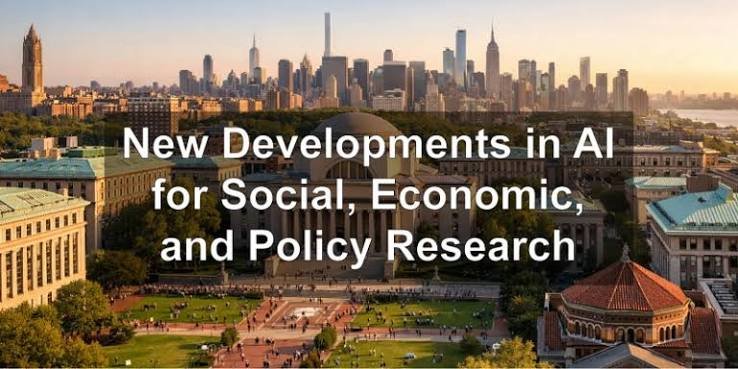
Columbia University's Department of Sociology · Lee C. Bollinger Forum, Columbia University, New York City.
Researchers, industry professionals and policymakers are invited to submit their work for the New Developments in AI for Social, Economic, and Policy Research Conference 2027, an interdisciplinary conference organised by Columbia University. The event will bring together experts to examine how artificial intelligence is transforming employment, occupations, workplaces, labour markets and the relationship between people and technology.
The conference is centred on the theme AI and the Future of Work. It will explore how artificial intelligence is changing the way work is organised, performed, valued and governed, including the opportunities and inequalities associated with these developments.
The event will take place on 29 January 2027 at the Lee C. Bollinger Forum, Columbia University, in New York City. The organisers are inviting submissions presenting ongoing or completed research, policy analysis and practice based insights. Interested applicants must submit an extended abstract of approximately 1,000 words by 30 November 2026.
The New Developments in AI for Social, Economic, and Policy Research Conference aims to advance understanding of the social, economic and policy implications of artificial intelligence.
AI is influencing far more than the tools people use at work. It is changing how organisations recruit and evaluate employees, how professional tasks are performed, how workers develop their careers and how employers manage their workforce. These developments also raise questions about job security, worker autonomy, compensation, workplace surveillance and inequality.
The conference will provide a platform for researchers and practitioners to examine these changes from different disciplinary perspectives. It will encourage discussions that connect academic research with industry experience and public policy, helping participants understand the implications of AI for workers, employers and society.
The conference is organised with support from the Institute for Social and Economic Research and Policy and the Columbia Population Research Center.
The organisers welcome research and policy contributions addressing a broad range of subjects related to artificial intelligence and the future of work.
Key themes include:
1. Labour Markets and Employment
Research examining how AI affects hiring, employee evaluation, career mobility, job displacement, job creation and emerging forms of employment.
2. Occupations, Skills and Career Pathways
Studies exploring how artificial intelligence changes professional identities, occupational responsibilities, expertise, skill requirements and career development.
3. AI and Inequality
Research investigating whether AI reproduces, reduces or creates inequalities based on race, gender, class, immigration status, disability, age and geographical location.
4. Human and AI Collaboration
Contributions examining how people and AI systems work together, including the substitution or augmentation of human tasks and changing divisions of labour between people and machines.
5. Organisations, Management and Algorithmic Control
Research on how AI influences organisational structures, management practices, workplace decision making and algorithmic coordination or control.
6. Job Quality and Worker Wellbeing
Studies examining the effects of AI on worker autonomy, workplace surveillance, compensation, working conditions, job security and employee wellbeing.
7. Worker Voice, Education and Governance
Research addressing workers' opinions about AI, trade unions, collective action, social protection, education, professional training and institutional approaches to governing artificial intelligence in the workplace.
Submissions may address other relevant topics as long as they contribute to understanding AI and the future of work.
Accepted submissions will provide participants with opportunities to present their work and engage with an interdisciplinary community of researchers, professionals and policymakers.
Benefits include:
The conference welcomes submissions from individuals and professionals working on issues related to artificial intelligence and the future of work.
Eligible contributors include:
Applicants are invited to submit an extended abstract of approximately 1,000 words.
Submissions should present ongoing or completed research, policy analysis or practice based insights relating to AI and the future of work.
A strong submission should clearly communicate the research question or issue being examined, its relevance to the conference theme and the main findings, arguments or insights.
Applicants should ensure that their work addresses one or more of the conference themes and provides a meaningful contribution to discussions about the changing relationship between artificial intelligence and work.
The call welcomes both academic research and contributions based on professional or organisational experience. This provides an opportunity for practitioners and policymakers to share evidence and insights that may not necessarily come from traditional academic research.
Interested researchers, practitioners and policymakers should submit their extended abstracts through the official Columbia University submission portal.
Follow these steps:
Lee C. Bollinger Forum, Columbia University, New York City.
 Columbia University's Department of Sociology





Be the first to comment on this opportunity.