Hertie School Centre for International Security · Berlin, Germany.
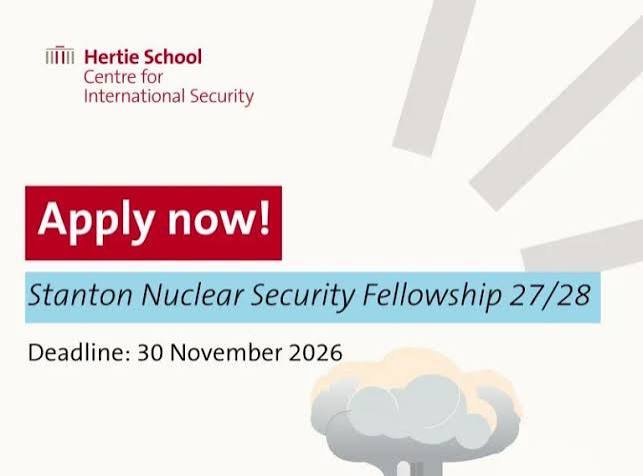
The Stanton Nuclear Security Fellows Program 2027 to 2028 is inviting applications from qualified researchers and early career academics interested in advancing research on nuclear security and international policy. Funded by the Stanton Foundation and hosted by the Hertie School’s Centre for International Security in Berlin, Germany, the fellowship provides dedicated time and institutional support for independent research on issues affecting international security.
The programme aims to develop the next generation of thought leaders who can contribute rigorous, policy relevant research to discussions about nuclear weapons, nuclear proliferation, nuclear terrorism, nuclear deterrence, and related security challenges. It is intended for researchers who can connect scholarly investigation with practical questions facing policymakers and security institutions.
Fellows will undertake a year long period of independent research beginning in September 2027. The programme is particularly relevant to postdoctoral researchers and tenure track junior faculty members with backgrounds in nuclear policy, international relations, security studies, engineering, physics, law, or related disciplines.
The Stanton Nuclear Security Fellows Program is supported by the Stanton Foundation, which works to advance understanding of nuclear security and related policy challenges. The fellowship provides researchers with an opportunity to focus on an independent project while being based at the Hertie School’s Centre for International Security.
Nuclear security is a broad field that encompasses the risks associated with nuclear weapons, nuclear proliferation, nuclear terrorism, deterrence, and the security implications of nuclear energy. Research in this area can involve technical analysis, international relations, strategic studies, law, political science, and public policy.
The programme encourages interdisciplinary work that can improve understanding of these issues and inform policy discussions. Fellows are expected to develop research that makes a meaningful contribution to the field, rather than simply reviewing existing literature.
Selected fellows can expect the following benefits:
• Postdoctoral stipend: €87,575 for a postdoctoral researcher.
• Junior faculty stipend: €118,790 for an eligible junior faculty member.
• One year of independent research: Dedicated time to develop a substantial research project.
• Institutional affiliation: Placement at the Hertie School’s Centre for International Security in Berlin, Germany.
• Academic and professional engagement: Opportunities to exchange ideas with researchers and experts working on international security.
• Research development: Time and an institutional setting to produce policy relevant scholarly work.
The fellowship supports interdisciplinary research that advances understanding of nuclear security and its implications for international policy. Potential research themes include the following areas.
Nuclear weapons and deterrence
Research may examine nuclear strategy, deterrence policy, strategic stability, nuclear force posture, and the risks associated with nuclear conflict.
Nuclear proliferation
Projects may investigate the spread of nuclear weapons capabilities, international nonproliferation frameworks, safeguards, and the political or technical factors that influence proliferation risks.
Nuclear terrorism
Researchers may explore the threat of nuclear terrorism, measures to prevent the unauthorized acquisition or use of nuclear materials, and policies designed to strengthen international nuclear security.
Nuclear energy and security
Relevant research may consider security challenges associated with nuclear energy, including nuclear materials, emerging technologies, and the relationship between civilian nuclear programmes and wider security concerns.
International relations and security policy
Applicants from international relations, political science, law, and related disciplines may examine diplomatic strategies, international institutions, security cooperation, and the development of policies intended to reduce nuclear risks.
These are examples of relevant topics, not a prescribed list of projects. Applicants should demonstrate that their proposed research aligns with the programme's focus and can produce meaningful findings for academic or policy audiences.
The official Hertie School programme identifies the following groups as eligible to apply:
• Postdoctoral researchers with relevant experience in nuclear security or a related field.
• Tenure track junior faculty members working in relevant academic disciplines.
• Junior faculty members at law schools.
• Applicants whose terminal degree is a law degree, subject to the programme's eligibility requirements.
• Researchers with backgrounds in nuclear policy, security studies, international relations, engineering, physics, or related disciplines.
According to the official programme information, applicants should prepare the following materials:
1. Current curriculum vitae
Provide an updated CV showing your academic qualifications, professional appointments, research experience, publications, and relevant achievements.
2. Two letters of recommendation
Arrange two recommendations from individuals who can speak knowledgeably about your research ability, academic background, professional contributions, and suitability for the fellowship.
3. Personal statement
Prepare a statement explaining your research interests, professional background, motivation for applying, and the contribution you hope to make through the fellowship.
4. Research project proposal
Develop a clear proposal describing your intended research project. Explain the central question, its relevance to nuclear security, the methods you expect to use, and the anticipated contribution to academic or policy discussions.
5. Academic transcripts, if requested
The programme may request official undergraduate and graduate transcripts from all institutions attended since completing high school. Applicants should be ready to provide these documents if required during the application process.
Follow these steps to prepare and submit your application.
Berlin, Germany.
 Hertie School Centre for International Security





Be the first to comment on this opportunity.