The World Academy of Sciences (TWAS) · Italy
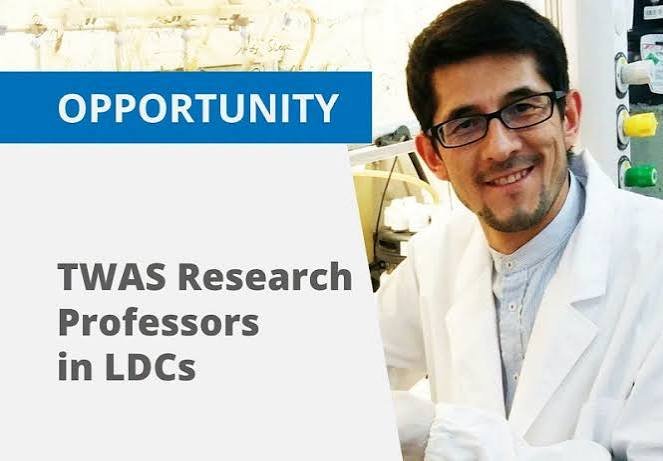
Applications are invited for the TWAS Research Professors in Least Developed Countries Programme 2026/2027, an initiative designed to strengthen scientific research and institutional capacity in countries facing significant development challenges. The programme provides research groups and scientific institutions in least developed countries with an opportunity to establish long term collaborations with experienced scientists affiliated with The World Academy of Sciences (TWAS).
The programme supports visiting appointments for TWAS Fellows, TWAS Young Affiliates and TWAS Alumni. Through these appointments, selected scientists contribute their expertise to research activities, advanced training and the development of scientific capacity at host institutions. The initiative aims to encourage lasting professional relationships between visiting researchers and local scientific communities.
Each appointment lasts one year, during which the appointed Research Professor is expected to visit the host institution for a period of two to four weeks. During the visit, the professor works closely with local researchers, supports existing research activities or helps establish new research directions. Visiting professors may also be invited to deliver lectures and seminars for research students.
The TWAS Research Professors in LDCs Programme seeks to help institutions in least developed countries build stronger scientific capabilities through collaboration with established members of the TWAS network.
The programme focuses on the natural sciences and encourages visiting professors to contribute to research, knowledge exchange and advanced academic training. Rather than supporting an ordinary individual study visit, it creates an opportunity for institutions to benefit from specialist expertise and develop relationships that can continue beyond the visit itself.
Selected professors are expected to engage actively with researchers at the host institution. Depending on institutional needs and the agreed activities, this may involve contributing to ongoing research, exploring new scientific questions, sharing research methods or supporting postgraduate researchers through lectures and seminars.
Both the visiting professor and the host institution are required to provide a comprehensive report after the visit, documenting the work undertaken and the outcomes of the collaboration.
• One year appointment: Selected scientists receive an appointment as a TWAS Research Professor.
• International travel support: TWAS provides round trip economy class travel to the host institution.
• Additional travel expenses: TWAS covers additional travel expenses incurred by the visiting professor under the programme.
• Honorarium: The appointed Research Professor receives an honorarium from TWAS.
• Local expense support: The host institution is expected to cover local expenses during the visit.
• Research collaboration: Visiting professors can work with local researchers on existing projects or help establish new research activities.
• Advanced training: Professors may contribute to the development of local scientific expertise through lectures, seminars and research guidance.
• Institutional capacity building: Host institutions can strengthen research activities and develop longer term scientific connections.
• Knowledge exchange: The programme facilitates the exchange of scientific knowledge and experience between visiting experts and researchers in least developed countries.
The programme supports activities within the natural sciences. Proposed collaborations should reflect the scientific expertise of the visiting professor and the research needs of the host institution.
Relevant activities may include:
• Collaborative scientific research.
• Strengthening existing research projects.
• Establishing new lines of scientific investigation.
• Advanced research training and knowledge exchange.
• Lectures and seminars for research students.
• Sharing scientific methods and specialist expertise.
The programme has specific requirements for both visiting scientists and host institutions.
• The proposed visiting professor must be a TWAS Fellow, TWAS Young Affiliate or TWAS Alumnus.
• The visiting scientist must hold a PhD.
• The host institution must be a research group or scientific institution located in a country classified as a least developed country.
• Requests must be submitted by the eligible host research group or scientific institution, rather than as an independent application by the visiting scientist.
• The proposed visit must support scientific research, advanced training or the development of local scientific capacity.
• The visiting professor and host institution must be prepared to provide a comprehensive report after the visit.
• Applicants should note that only one programme within the TWAS and OWSD portfolio may generally be applied for per calendar year. An exception applies to the head of an institution inviting an external scholar under the TWAS Visiting Professor programmes.
The official programme information specifies no age limit. The programme is intended for eligible members of the TWAS network who can contribute scientific expertise to institutions in least developed countries.
Because requests are submitted by host institutions, research groups should consult the official TWAS application instructions to confirm the information and supporting documents required for their proposal.
Applicants and host institutions should be prepared to establish the purpose and value of the proposed visit, including:
• Information identifying the host research group or scientific institution.
• Details of the proposed visiting professor and their TWAS affiliation.
• An explanation of the scientific collaboration or research activities to be undertaken.
• A description of the proposed advanced training, lectures or seminars, where relevant.
• Information needed to coordinate the visit and meet the host institution's responsibilities.
• Arrangements for reporting on the results of the visit.
These points are useful for planning a collaboration, but the official online application instructions should be treated as the authoritative checklist of required submissions.
Italy
 The World Academy of Sciences (TWAS)




Be the first to comment on this opportunity.