Office of the United Nations High Commissioner for Human Rights (OHCHR). · New York and Geneva, Switzerland
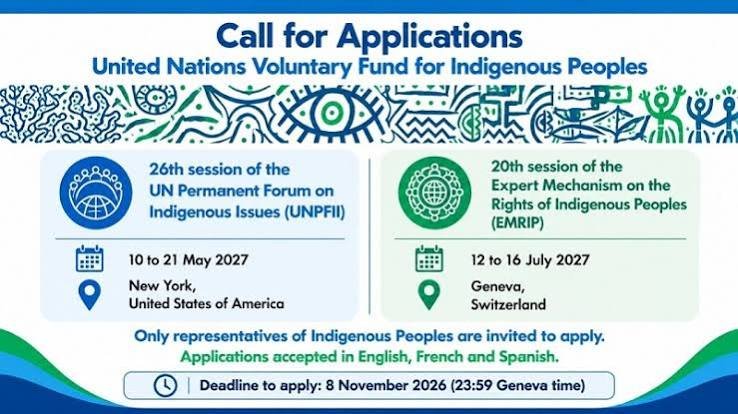
The United Nations Voluntary Fund for Indigenous Peoples is accepting applications from Indigenous individuals and representatives of Indigenous Peoples’ organizations who need financial assistance to participate in major United Nations human rights meetings in 2027. The initiative aims to help Indigenous representatives bring the concerns, experiences and priorities of their communities directly to international discussions on Indigenous rights.
The fund supports participation in two important United Nations processes: the 26th session of the United Nations Permanent Forum on Indigenous Issues and the 20th session of the Expert Mechanism on the Rights of Indigenous Peoples. These meetings provide opportunities for Indigenous representatives to engage with international human rights mechanisms, raise issues affecting their communities and contribute to discussions that may influence policy and advocacy.
The 26th session of the United Nations Permanent Forum on Indigenous Issues is scheduled for May 10 to 21, 2027, in New York, United States. The 20th session of the Expert Mechanism on the Rights of Indigenous Peoples will take place from July 12 to 16, 2027, in Geneva, Switzerland.
The United Nations Voluntary Fund for Indigenous Peoples helps address financial barriers that prevent Indigenous representatives from participating in relevant United Nations meetings. By supporting their attendance, the fund seeks to improve the representation of Indigenous communities in international human rights discussions.
The programme is particularly relevant to community advocates, Indigenous organization representatives and human rights defenders whose work connects directly with the issues addressed by the Permanent Forum or the Expert Mechanism.
Applicants should select the meeting most closely related to their work and explain how their participation would contribute to advocacy on behalf of their community or organization. Previous engagement with consultations, submissions, community initiatives and other advocacy processes may strengthen an application.
Selected Indigenous representatives may receive:
• Financial assistance for travel to the relevant United Nations meeting.
• A stipend to cover accommodation and related expenses, subject to United Nations rules and procedures.
• An opportunity to represent community concerns in international human rights discussions.
• Direct engagement with United Nations mechanisms working on Indigenous Peoples’ rights.
• Opportunities to strengthen advocacy, policy engagement and international representation.
• Greater visibility for human rights issues affecting Indigenous communities.
• Opportunities to connect community priorities with international discussions and recommendations.
Funding is awarded to selected applicants according to the fund’s procedures. Applicants should review the official application information carefully and should not assume that expenses outside the approved support will be covered.
Applicants may seek support to attend one of the following meetings.
1. United Nations Permanent Forum on Indigenous Issues
The 26th session will take place from May 10 to 21, 2027, in New York, United States. The Permanent Forum provides a United Nations platform for discussion of Indigenous issues, including human rights, economic and social development, culture, the environment, education, health and other matters affecting Indigenous Peoples.
Representatives whose community advocacy connects with the Forum’s work should explain the issues they intend to raise and how participation could benefit their communities or organizations.
2. Expert Mechanism on the Rights of Indigenous Peoples
The 20th session is scheduled for July 12 to 16, 2027, in Geneva, Switzerland. The Expert Mechanism provides expertise and advice on the rights of Indigenous Peoples and supports efforts to advance those rights.
Applicants should demonstrate their involvement in relevant human rights issues and explain how attending the session could contribute to advocacy, engagement with United Nations mechanisms or policy influence.
Applications are open to Indigenous individuals and representatives of Indigenous Peoples’ organizations who meet the following conditions:
• Are actively engaged in promoting and protecting the rights of Indigenous Peoples.
• Can explain how their participation would contribute to advocacy on behalf of their community or organization.
• Require financial assistance for travel, accommodation and related participation expenses.
• Have relevant experience or engagement with the human rights issues addressed by the selected United Nations meeting.
• Can demonstrate a clear connection between their community representation and the meeting they intend to attend.
• Can provide the required supporting documents, including a recommendation letter from the community or organization they represent.
Applications from Indigenous persons with disabilities and Indigenous 2SLGBTQ+ persons are particularly encouraged.
Applicants should ensure that their application accurately describes their community or organizational role, their relevant advocacy activities and their financial need.
Applicants are required to upload the following documents:
• A recent curriculum vitae.
• A copy of a valid passport.
• A recommendation letter from the Indigenous organization, community, nongovernmental organization or nonprofit institution they represent.
The recommendation letter does not have to follow a prescribed template. Applicants may use a format appropriate to their community or organization. The letter should clearly support the applicant’s representation and connection to the work described in the application.
Applicants should also prepare clear responses explaining their advocacy experience, the relevance of the chosen meeting and the expected contribution of their participation.
Applications will be assessed according to the following considerations:
• Representation: Priority will be given to applicants with a clear mandate from their communities or organizations.
• Relevance: Applicants should demonstrate engagement with Indigenous human rights issues and the work of the selected United Nations mechanism.
• Potential impact: Applications should explain how participation could strengthen community advocacy, international engagement or policy influence.
• Previous engagement and preparedness: Relevant experience in advocacy processes, consultations, submissions, caucuses or community initiatives may be considered.
• Financial need: Applicants should demonstrate that they need financial assistance and lack alternative sources of funding for participation.
A strong application will clearly connect the applicant’s responsibilities, community priorities and previous work with the objectives of the meeting they wish to attend.
New York and Geneva, Switzerland
 Office of the United Nations High Commissioner for Human Rights (OHCHR).





Be the first to comment on this opportunity.