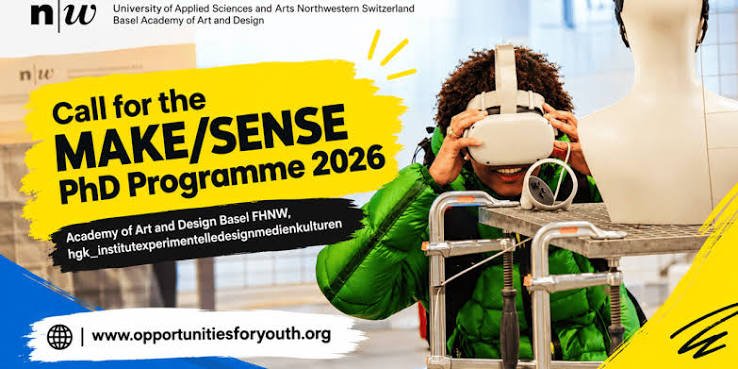
MAKE/SENSE · Basel Academy of Art and Design FHNW in Switzerland,
The MAKE/SENSE PhD Programme 2026 at the Basel Academy of Art and Design FHNW in Switzerland offers an opportunity for artists, curators, publishers, designers and cultural organisers to pursue doctoral research through interdisciplinary and practice based approaches. The programme is organised in collaboration with the University of Arts Linz in Austria and is hosted by the Critical Media Lab at the Institute Experimental Design and Media Cultures in Basel.
The three year doctoral programme is designed for researchers whose work engages with artistic research, critical media, experimental design, publishing, cultural production, technology, society and infrastructures. Rather than requiring projects to fit within a conventional academic discipline, MAKE/SENSE encourages research that crosses disciplinary boundaries and develops new approaches to how knowledge is produced, communicated and shared.
The programme combines individualised mentoring with joint supervision from faculty in Basel and Linz. Doctoral researchers participate in monthly colloquia, an annual assembly, public events and collaborations with external partners. Research outcomes may include artistic interventions, publications, exhibitions, performances, installations, fieldwork, software critique and other practice based forms of research.
MAKE/SENSE is a three year practice based PhD programme developed jointly by the Basel Academy of Art and Design FHNW and the University of Arts Linz. It is hosted by the Critical Media Lab in Basel and brings together research in art, design, media and technology.
The programme is grounded in critical, experimental and transdisciplinary research. Candidates are encouraged to develop research projects that respond to contemporary social, technological, political and infrastructural questions through situated and experimental approaches.
The programme supports doctoral researchers through:
• Individualised mentoring
• Joint supervision from Basel and Linz
• Monthly research colloquia
• An annual assembly
• Public events
• Collaborations with external partners
• Interdisciplinary research and exchange
• Practice based forms of reading and writing
Applicants should develop projects that connect with at least one of the programme's principal areas of concern.
Situated Artistic Research explores forms of knowledge that emerge through artistic practice, embodied experience, experimentation and situated perspectives.
Projects may examine how artistic practices can become methods of inquiry and knowledge production. Applicants may also investigate alternative forms of knowledge and question conventional assumptions about how research is conducted and whose knowledge is recognised.
Infrastructural Critique examines infrastructures as spaces where power, knowledge, institutions, technology and social relations are produced and contested.
Projects may address technological infrastructures, institutional systems, research environments, organisational structures and the social consequences of technologies.
Research may also explore possibilities for transforming, reimagining or developing alternative infrastructures.
Critical Media focuses on how knowledge is read, written, mediated, published, circulated and interpreted.
Applicants may explore publishing, experimental writing, expanded media, cultural circulation and alternative methods of communicating knowledge.
The area is particularly relevant to projects interested in the relationship between media formats and the production, interpretation and circulation of knowledge.
Applicants should meet the following requirements:
• Be an artist, curator, publisher, designer or cultural organiser
• Hold a Master of Arts degree equivalent to 120 ECTS or an equivalent qualification
• Have a research project that aligns with at least one of the programme areas
• Be prepared to undertake practice based and interdisciplinary doctoral research
• Demonstrate an appropriate academic, creative, professional or research background
• Be able to communicate the proposed research clearly in the application materials
The programme welcomes applicants whose research crosses conventional disciplinary boundaries.
• Three year practice based PhD programme
• Joint supervision between Basel and Linz
• Individualised mentoring
• Monthly colloquia
• Annual research assembly
• Public events
• Collaboration with external partners
• Interdisciplinary research environment
• Access to a research community connecting art, design, media and technology
• Opportunities to develop practice based research outputs
• Research outcomes can include exhibitions, performances, installations and publications
For the first round, applicants must prepare the following:
• Motivation letter of two A4 pages
• Two preferred supervisors
• Rationale for selecting the preferred supervisors
• Plans for financing the PhD
• Information about external funding applications or grants the applicant intends to pursue
• Project outline of two to three A4 pages excluding references
• Research question
• Short state of the art
• Explanation of relevance and topicality
• Connection to at least one programme area
• Proposed research methods
• Proposed outcomes
• Curriculum Vitae
• Portfolio containing relevant art, design, curatorial or writing samples
• Master degree diploma and transcript
• Bachelor degree diploma and transcript
The project outline is a central component of the pre proposal application.
Applicants should formulate a clear research question that establishes what the project intends to investigate. The proposal should also demonstrate awareness of existing research and practices through a concise state of the art section.
The proposal must explain why the research is relevant and timely in relation to at least one of the programme's areas of concern. Applicants should then describe the proposed methods and explain how their practice based approach will contribute to answering the research question.
The expected outcomes should also be clearly stated. Depending on the project, these could involve publications, exhibitions, performances, installations, artistic interventions, experimental media or other research outputs.
Applicants must identify two preferred supervisors in their motivation letter and explain the rationale for their choices.
The current supervision environment includes faculty members across several areas of the Basel Academy of Art and Design FHNW. Listed supervisors include Prof. Dr. Dr. Aylin Yildirim Tschoepe, Prof. Dr. Chus Martínez, Prof. Dr. Dorothée King, Prof. Dr. Helen V. Pritchard, Prof. Dr. Ines Kleesattel, Prof. Dr. Lucie Kolb, Prof. Matthias Böttger, Prof. Dr. Sarah Owens and Dr. Yvonne Volkart.
Applicants should review the current research interests of potential supervisors before selecting their preferred two. The connection between the proposed project and the supervisors' expertise should be clearly explained in the motivation letter.
Basel Academy of Art and Design FHNW in Switzerland,
 MAKE/SENSE




Be the first to comment on this opportunity.