ETH Zurich · Zurich, Switzerland
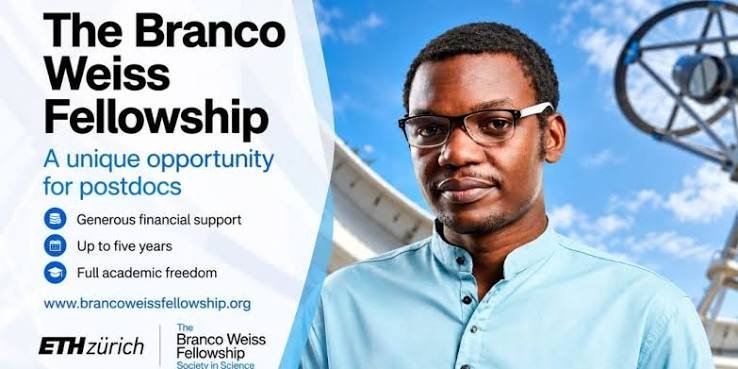
Applications are open for the Branco Weiss Fellowship Society in Science 2027, an international research fellowship supporting exceptional early career scientists who want to pursue original research beyond the mainstream. Based at ETH Zurich in Switzerland, the programme gives outstanding postdoctoral researchers the opportunity to develop their own scientific projects with considerable independence and pursue research in suitable locations around the world.
The fellowship was established by Swiss entrepreneur Dr. Branco Weiss and is administered by ETH Zurich. It supports researchers who combine scientific excellence with intellectual curiosity, independent thinking and a willingness to explore questions that challenge conventional approaches in their fields. The programme welcomes applications from researchers across the natural sciences, engineering, social sciences and humanities.
Unlike many traditional research grants, the Branco Weiss Fellowship is designed for researchers whose ideas may not fit easily within established research agendas. Applicants are expected to propose projects that open new avenues of investigation and demonstrate how their work could contribute to broader discussions involving science and society.
The Branco Weiss Fellowship supports exceptional postdoctoral researchers who want to pursue a personal scientific vision with substantial independence. Its central purpose is to encourage research that departs significantly from mainstream approaches and benefits from the freedom to explore unconventional ideas.
The programme aims to award up to ten fellowships annually, although the final number depends on the quality of the applicants and their performance during the selection process.
Research projects are generally designed to last five years. The first two and a half years form the pioneer phase, during which fellows develop their research and demonstrate its originality and progress. Before the end of the second year, the programme conducts a site visit and evaluates the project. Fellows who receive a satisfactory assessment may proceed into the remaining two and a half years, known as the exploitation phase.
Fellows can pursue research at suitable host institutions and may accept a faculty position during the fellowship without automatically losing their fellowship support, subject to programme conditions.
Selected researchers can receive the following support:
• Funding of up to CHF 600,000 over a period of five years.
• Financial support for legitimate research expenses, including salary costs, equipment, research materials, personnel and travel.
• Freedom to pursue an independent research project beyond conventional disciplinary boundaries.
• The opportunity to conduct research at suitable institutions and locations around the world.
• Access to an international community of researchers and fellowship alumni.
• Opportunities to develop research that connects scientific questions with broader social, cultural, political and economic issues.
• Participation in the annual fellowship symposium in the Greater Zurich Area.
• The possibility of continuing fellowship support after promotion to a faculty position, subject to programme requirements.
The fellowship is structured as a research project grant rather than an unrestricted personal cash award. Funding is administered through the host institution under an agreement involving the fellow, the host institution and ETH Zurich.
The fellowship is open to researchers from all scientific disciplines. Applicants should focus on the originality and potential significance of their proposed research rather than attempting to fit their projects into a narrow list of priority subjects.
Potential fields include:
• Natural sciences, including biology, chemistry and physics.
• Engineering and technology.
• Computer science and other quantitative disciplines.
• Social sciences, including economics, sociology and political science.
• Humanities and related interdisciplinary fields.
• Research combining methods or perspectives from multiple disciplines.
Projects should demonstrate a clear departure from mainstream research in the applicant’s discipline. The programme generally does not support conventional projects that could readily receive funding from other scientific organisations.
Applicants for the 2027 fellowship intake must meet the following requirements:
• Hold a PhD by January 15, 2027, meaning the doctoral examination must have been successfully completed by that date.
• Have obtained their PhD no more than five years before the application deadline.
• Not hold or have previously held a faculty equivalent position, such as an assistant professor or lecturer.
• Not hold a permanent employment position that makes them ineligible under the fellowship guidelines.
• Demonstrate a record of outstanding scientific achievement.
• Propose an original research project that departs significantly from mainstream research in their field.
• Demonstrate a willingness to engage with social, cultural, political or economic issues beyond their own discipline.
• Be willing and able to travel to the Greater Zurich Area to attend the annual symposium in person.
• Ensure that their chosen mentor is not supporting another candidate during the same application round.
The fellowship is open to researchers of all nationalities, with no restriction based on biological age. Applicants who previously applied unsuccessfully may apply again.
Periods of interruption after the PhD are considered only under specified circumstances, including parental leave or inability to work because of illness or an accident. Applicants seeking an extension must provide official confirmation to the fellowship administration before submitting their application.
Applicants should prepare the following documents in PDF format:
• Letter of motivation: A maximum of one page, including an explanation of how the proposed research differs from mainstream work in the discipline.
• Research project proposal: A maximum of five pages, including the project timeline, tentative milestones and references.
• Curriculum vitae: A maximum of four pages.
• Invitation letter from the prospective host: This should explain why the applicant is invited to join the host group and why the proposed project is supported by the host institution.
• Three best publications: Submit copies of three strong publications. Eligible materials include peer reviewed journal articles and individual book chapters. Doctoral theses and books are not accepted for this requirement.
• Five reviewer suggestions: These are entered directly into the online application system.
• PhD certificate or examination confirmation: Provide a scan of the doctoral certificate or confirmation that the examination has been successfully completed.
Reference letters are not required at the initial application stage. The official PhD certificate may be requested later, and a research budget does not need to be submitted with the application.
Each uploaded document must comply with the programme’s file size limits. Applications must be written in English.
Applications are assessed on scientific quality, originality and the applicant’s potential to pursue independent research. The programme looks for researchers with an outstanding record who can explain why their proposed project deserves support beyond conventional funding opportunities.
Important considerations include:
• Originality and ambition of the proposed research.
• Evidence of outstanding scientific achievement.
• A clear explanation of how the project departs from mainstream research.
• The quality and feasibility of the proposed research approach.
• Potential contributions to the applicant’s discipline and other fields.
• Willingness to engage in dialogue about the wider implications of science for society.
• Suitability of the proposed host institution and research environment.
Shortlisted candidates will be invited to interviews in Zurich, Switzerland. The fellowship directorate, selected ETH Zurich faculty members and external reviewers participate in the assessment process.
Zurich, Switzerland
 ETH Zurich





Be the first to comment on this opportunity.