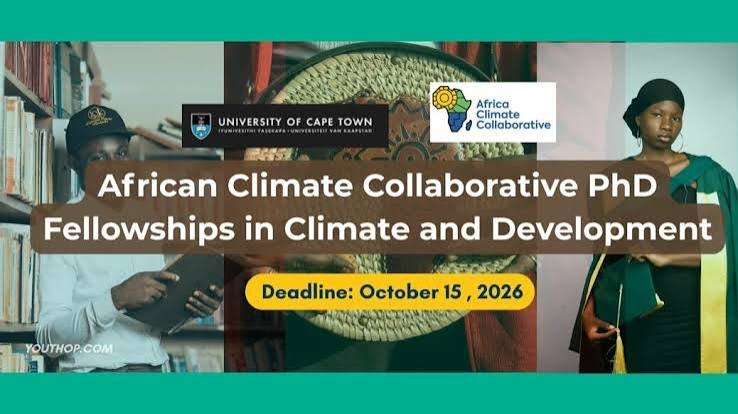
African Climate Collaborative PhD · University of Cape Town in South Africa.
Applications are open for the African Climate Collaborative PhD Fellowships in Climate and Development 2026, offering 12 fully funded doctoral opportunities for African researchers interested in addressing climate change and development challenges across the continent. The programme is hosted by the University of Cape Town (UCT) in South Africa through its African Climate and Development Initiative.
The fellowship supports a four year doctoral training programme designed to prepare a new generation of African scholars to contribute to climate research, public policy, innovation and sustainable development. Fellows will combine structured academic training with independent research under the guidance of experienced supervisors.
The programme begins with one year of structured predoctoral coursework, followed by three years of thesis research and doctoral skills development. Each fellowship is linked to a specific research topic and supervisory team, allowing candidates to pursue work aligned with their academic background and research interests.
The African Climate Collaborative brings together climate expertise and research initiatives to strengthen African capacity in climate and development. Through its doctoral training programme, the initiative aims to develop researchers who can produce evidence, generate practical solutions and contribute to more climate resilient societies.
Climate change affects many interconnected areas of African life, including agriculture, biodiversity, urban infrastructure, energy systems, public health, education and livelihoods. Addressing these challenges requires researchers who can work across disciplines and connect scientific evidence with social, economic and policy considerations.
The programme offers doctoral candidates the opportunity to undertake original research with academic supervision at the University of Cape Town. Applicants can choose from 19 research topics covering a range of climate and development questions. Each topic has specific academic requirements, so candidates must ensure their qualifications match the discipline required by their preferred project.
Successful fellowship applicants will also need to apply for and secure admission to a PhD programme at UCT. The fellowship team indicates that assistance with the university admission process will be provided to successful candidates.
Selected fellows will receive financial support with a total stated value of R390,000 for 2027, allocated as follows:
• R315,000 for stipend and academic fees.
• Up to R75,000 for relocation, medical insurance, research and other eligible costs.
• Four years of doctoral training in climate and development.
• Structured coursework during the first year of the programme.
• Three years of independent thesis research under academic supervision.
• Doctoral skills training to support academic and professional development.
• Access to research supervision connected to the selected project topic.
• Opportunities to develop research that can inform climate policy, development practice and sustainable futures.
The overall fellowship value includes support for several cost categories. Applicants should consult the official programme information for the applicable funding arrangements and conditions.
The 19 available research topics span different disciplines and climate related challenges. Examples published by the programme include:
• Urban flooding, health risks and the organisation of care in vulnerable communities.
• Climate change and the management of locust outbreaks.
• Energy transitions, electricity governance and implementation of the Paris Agreement.
• Climate resilient water infrastructure and inequality in African cities.
• Urban climate adaptation, governance and the use of different forms of knowledge.
• Sustainable concrete technology for African urban development.
• Climate change impacts on energy demand and renewable energy systems.
• Biodiversity monitoring through remote sensing and ecological modelling.
• Innovation systems and the transition to electric cooking.
• Climate and development education relevant to African contexts.
• Climate resilience, fisheries management and coastal livelihoods.
• Remote sensing approaches to smallholder farming resilience.
Candidates should consult the official research topic descriptions because each project has its own academic background requirements, supervisor and research focus.
Applicants must meet the following general requirements:
• Be a citizen of an African country. African citizens living outside the continent may also apply.
• Be under 35 years of age as of 1 February 2027.
• Hold a completed master’s degree in a discipline relevant to climate and development in Africa.
• Meet the specific disciplinary requirements for the selected research topic.
• Demonstrate an academic background and research interests suitable for the chosen project.
• Be prepared to apply for and secure PhD admission at the University of Cape Town if selected.
• Apply for only one of the 19 available research topics.
Women and applicants with lived experience of displacement or disability are particularly encouraged to apply.
Applicants should prepare the following documents:
• Curriculum vitae of no more than five pages, including names and contact details for three referees. One referee must have supervised the applicant’s master’s dissertation.
• A writing sample demonstrating previous academic or research writing, preferably from the master’s dissertation.
• Academic transcripts for bachelor’s and master’s degrees.
• A letter of motivation explaining the applicant’s interest in the selected topic and programme, and how their education and experience prepare them for the research.
• A copy of a national identity document or passport.
Successful applicants may be asked to provide certified academic documents before the fellowship is confirmed.
Applicants should demonstrate a strong match between their academic qualifications and the chosen research topic. The programme’s topic descriptions outline the required disciplinary background and, where relevant, particular research skills.
The strength and relevance of the applicant’s academic preparation, motivation and ability to undertake the proposed research will be important considerations. Candidates should explain clearly why the selected topic fits their interests and experience.
Because each fellowship is connected to a particular supervisory team, applicants should read the topic requirements carefully before applying. A strong application should present a clear connection between previous training and the proposed area of doctoral research.
University of Cape Town in South Africa.
 African Climate Collaborative PhD





Be the first to comment on this opportunity.