The Earth Journalism Network
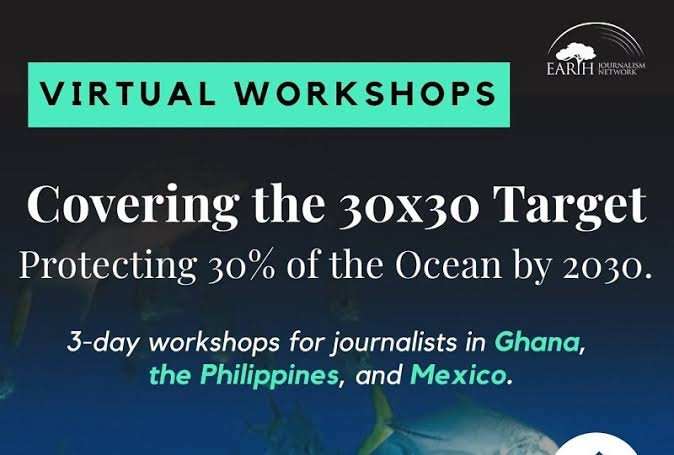
Applications are open for the Earth Journalism Network (EJN) Virtual Media Workshops on the 30×30 Target and Marine Protected Areas 2027. This professional development opportunity is designed for journalists, media practitioners and digital content creators in Ghana, Mexico and the Philippines who want to improve their knowledge of marine conservation and strengthen their reporting on environmental issues.
The Earth Journalism Network is organising three day virtual workshops scheduled for February and March 2027. The sessions will explore the global commitment to protect at least 30 percent of the world's land, inland waters and oceans by 2030, with particular attention to marine conservation and the policies and initiatives countries are implementing to achieve this goal.
The workshops will bring together journalists and experts working on ocean conservation, including researchers, policymakers, civil society representatives and local communities. Participants will examine how Marine Protected Areas are established and managed, how governments implement conservation commitments, and how journalists can report on the scientific, political and social dimensions of marine protection.
The Earth Journalism Network is a global initiative that supports environmental journalism by providing training, professional resources and opportunities for journalists to improve public understanding of environmental challenges.
The 30×30 target forms part of the global biodiversity conservation agenda. It aims to ensure that at least 30 percent of the world's land, inland waters, coastal areas and oceans are effectively conserved and managed by 2030.
Marine Protected Areas are an important tool for reaching this goal. They can help safeguard marine biodiversity, protect habitats, support ecosystem services and contribute to the sustainability of coastal resources. However, their effectiveness depends on how they are designed, managed, monitored and governed.
Through these workshops, EJN seeks to help media professionals understand the complexities behind marine protection commitments and report on whether governments and other stakeholders are making meaningful progress.
The workshops will take place virtually over three consecutive days. The Ghana workshop is scheduled for the week of February 15, 2027, the Mexico workshop for the week of February 22, 2027, and the Philippines workshop for the week of March 1, 2027.
• Three days of specialised virtual training in marine conservation journalism.
• A stronger understanding of the 30×30 target and national conservation commitments.
• Practical knowledge of Marine Protected Areas and their management.
• Exposure to researchers, policymakers, civil society organisations and community representatives.
• Training in accountability, data and solutions journalism.
• Guidance on developing engaging environmental stories for different audiences.
• A certificate of completion for participants who attend all workshop sessions.
• Special consideration when applying for subsequent EJN story grants related to marine conservation reporting.
• A limited number of communications stipends for participants experiencing unstable internet connectivity in remote areas.
The communications stipends are limited and are intended to improve access for applicants facing connectivity challenges. They should not be interpreted as a general participation stipend.
EJN also plans to offer story grants to support in depth reporting on government commitments and initiatives related to the 30×30 target. Workshop participants will receive special consideration if they subsequently apply, but a grant is not guaranteed by participation.
Participants will explore several connected areas of marine conservation and environmental reporting.
• The 30×30 Target: Understanding the global conservation commitment, its significance and the responsibilities of participating countries.
• Marine Protected Areas: Learning how protected areas are designated, regulated, managed and monitored.
• Science and Marine Biodiversity: Examining the scientific benefits of marine protection and the different levels of protection needed to safeguard marine ecosystems.
• Policy and Governance: Exploring national and international policies, negotiations and regulatory processes that support marine conservation.
• Community Rights and Participation: Understanding the role and rights of Indigenous peoples and local communities in designing, implementing and monitoring conservation initiatives.
• Conservation Accountability: Learning how journalists can investigate government commitments, assess progress and report on gaps in implementation.
• Data and Technology: Exploring marine spatial planning, satellite imagery, remote sensing, environmental DNA and artificial intelligence in marine protection.
• Solutions Journalism: Identifying evidence based responses to conservation challenges and reporting on their effectiveness.
• Multimedia Storytelling: Developing accessible and engaging content, including short form video, to reach wider audiences.
• Risk Management: Learning how to prepare for potential risks when reporting on Marine Protected Areas and conservation policies.
The programme will also address debates about the effectiveness of protected areas, including concerns about green colonialism and the role of Marine Protected Areas in international waters.
Applicants should meet the following requirements:
• Be based in Ghana, Mexico or the Philippines.
• Work as a journalist in print, online, television, radio or another recognised media format, or be a journalistic content creator with an active presence on a prominent social media platform.
• Have experience covering ocean issues if applying as another type of media practitioner.
• Demonstrate a working understanding of English for the Ghana and Philippines workshops.
• Demonstrate a working understanding of Spanish for the Mexico workshop.
• Submit the application in English, except applicants for the Mexico workshop, who may apply in Spanish.
The opportunity is open to freelance reporters, content creators and staff working with community based, local, national or international media organisations.
EJN particularly encourages applications from women, rural journalists, Indigenous journalists and early career media professionals.
Applicants should prepare the information requested in the official application form. They should be ready to provide:
• Personal and professional information.
• Details of their current journalism or media work.
• Information about their experience covering ocean issues or related environmental topics.
• A clear explanation of their interest in the 30×30 target and Marine Protected Areas.
• Relevant examples of reporting or content creation, where requested by the application form.
• Any additional information specifically requested by EJN.
Applicants can strengthen their submissions by clearly explaining their interest in marine conservation reporting and how the training could improve their work.
Relevant considerations include:
• Experience in journalism, environmental reporting or media content creation.
• Interest in ocean conservation and the 30×30 target.
• Ability to participate in the relevant workshop in the required language.
• Potential to communicate environmental issues to public audiences.
• Commitment to ethical, accurate and responsible journalism.
• Interest in investigating conservation commitments and producing evidence based stories.
Women, rural journalists, Indigenous journalists and early career professionals are particularly encouraged to apply. Applicants should nevertheless review the official criteria and provide complete, truthful information.
Interested applicants can follow these steps:
• Application deadline: November 2, 2026.
• Ghana workshop: Week of February 15, 2027.
• Mexico workshop: Week of February 22, 2027.
• Philippines workshop: Week of March 1, 2027.
• Format: Three consecutive days of virtual sessions.
 The Earth Journalism Network




Be the first to comment on this opportunity.