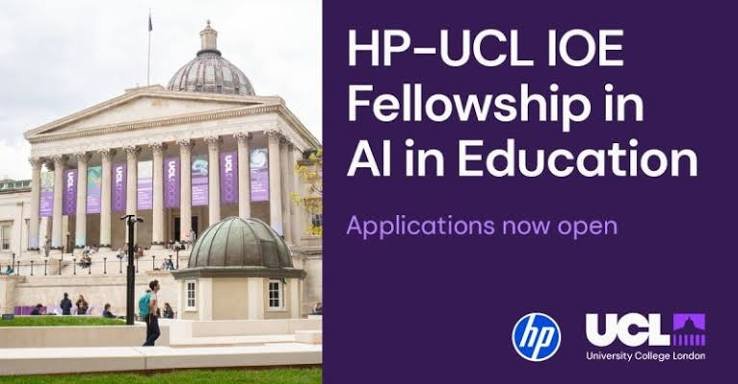
UCL Institute of Education and HP · London, United Kingdom
Applications are open for the HP UCL IOE Fellowship in AI in Education 2027, a global executive leadership programme designed for senior education policymakers and organisational leaders who are shaping the future of education in an era of rapid artificial intelligence transformation.
Delivered by the UCL Institute of Education and HP and housed within the UCL Knowledge Lab, the fellowship equips experienced leaders with the knowledge, governance capabilities and strategic leadership skills needed to guide responsible, equitable and learning centred use of AI in education. The programme brings together expertise from artificial intelligence, learning sciences, ethics, policy and human computer interaction.
The fellowship is designed to help leaders move beyond the hype surrounding AI and make informed decisions about how artificial intelligence can affect teaching, learning, institutional governance, inclusion and public education systems. Fellows engage with international experts, researchers and peers while examining real challenges from their own professional contexts.
The HP UCL IOE Fellowship in AI in Education responds to the growing need for education leaders who can evaluate AI technologies critically and develop strategies that protect learning quality, inclusion, equity and institutional trust.
Participants will explore how different forms of AI are influencing education and public institutions. They will examine practical issues including responsible AI, governance, procurement, evidence, implementation, scaling, learner inclusion and teacher agency.
A major feature of the programme is the opportunity to apply learning directly to a real challenge within the fellow's organisation or education system. Each participant develops a capstone or leadership project with guidance from mentors and facilitators throughout the programme.
The fellowship combines expert led teaching, collaborative discussions, applied activities, leadership clinics, peer learning and strategic reflection. It is intended for experienced leaders who have the authority or influence to contribute to AI transformation within education systems and organisations.
• Programme costs are fully covered upon acceptance, excluding airfare and visa expenses
• Access to UCL Institute of Education expertise in AI and education
• Learning from academics and experts working across AI, education, policy, ethics and learning sciences
• Nine months of facilitated mentoring for a practical capstone project
• Opportunity to develop an AI strategy or implementation project connected to the participant's professional context
• International peer learning with senior leaders from different professional and geographical backgrounds
• Leadership clinics and strategic reflection activities
• Exposure to global policy frameworks, case studies and emerging evidence on AI in education
• Membership of a global network of fellowship alumni
The fellowship covers a broad range of topics connected to responsible AI transformation in education.
Participants examine global AI trends, governance challenges and the implications of artificial intelligence at education system level.
The programme introduces foundational concepts in AI, learning sciences and human centred approaches to technology design.
Fellows explore fairness, accountability, responsible use and ethical approaches to AI implementation.
Participants develop a stronger understanding of AI governance frameworks, policy development and procurement decisions.
The programme examines learner agency, wellbeing, inclusion and approaches to ensuring that AI enabled education benefits diverse communities.
Fellows consider how AI interacts with teacher expertise, professional judgement and decision making.
Participants learn to assess evidence surrounding AI initiatives and consider how effective approaches can be implemented and scaled.
Leadership clinics help fellows identify strategic challenges and develop practical projects that respond to their organisational or policy environments.
The fellowship begins with three months of weekly live online sessions supported by independent study and coaching. The first phase covers the foundations, opportunities and challenges of AI in education.
The programme then includes a one week residential experience in London, providing an opportunity for intensive collaboration, innovation and policy discussion.
Following the residential component, fellows spend nine months developing a capstone project with mentorship, peer learning and strategic feedback. The project is intended to address a genuine policy, leadership or implementation challenge connected to the fellow's work.
The programme is expected to require full commitment from participants across all components.
The fellowship is particularly suited to experienced leaders working in education, government, public institutions and related organisations.
Applicants may include:
• Senior education policymakers working in ministries, government departments or national agencies
• Regulators and inspectorate leaders responsible for education quality, assessment or data
• Senior executives and leaders of international education technology companies
• Senior officials working for international organisations on education and AI policy
• Regional and local education leaders, including Directors of Education and Children's Services
• Leaders of school systems, including multi academy trust and school group chief executives and directors
• Leaders of education non profits, foundations and professional bodies
• Leaders of teacher and school leader unions
The programme is designed for applicants whose roles are relevant to AI and education transformation and who can demonstrate meaningful leadership experience or potential.
The current cohort scope covers Europe, Asia and Africa. UCL notes that future cohorts may have different geographical scopes.
Applicants should also demonstrate:
• Capacity to participate fully in the fellowship
• Commitment to responsible, equitable and human centred approaches to AI
• A clear and relevant project idea
• Interest in international collaboration and peer learning
• Professional experience that enables them to influence AI transformation in their organisation or education system
Applicants are asked to submit a personal statement of up to four pages.
The statement should include:
• Professional background and current role
• Current professional responsibilities
• Leadership experience and areas of influence
• Organisation, institution or education system context
• Relevant experience in digital transformation, AI, education, innovation or policy
• Motivation for joining the fellowship
• Alignment between the fellowship and future professional goals
• Perspectives, expertise or experience the applicant would contribute to the fellowship community
• Demonstrated capacity and commitment to participate throughout the programme
• An outline of a potential capstone or leadership project
• Explanation of why the proposed project is important in the applicant's context
• Explanation of how the fellowship could support development or implementation of the project
Applications will be reviewed competitively by the programme team.
Selection will consider:
• Relevance of the applicant's role to AI and education transformation
• Demonstrated leadership experience and potential for impact
• Capacity to participate fully in programme activities
• Commitment to responsible, equitable and human centred AI
• Strength and clarity of the proposed project idea
• Potential contribution to peer learning and international collaboration
The programme aims to create a diverse international cohort representing different professional, institutional and geographical contexts.
London, United Kingdom
 UCL Institute of Education and HP





Be the first to comment on this opportunity.