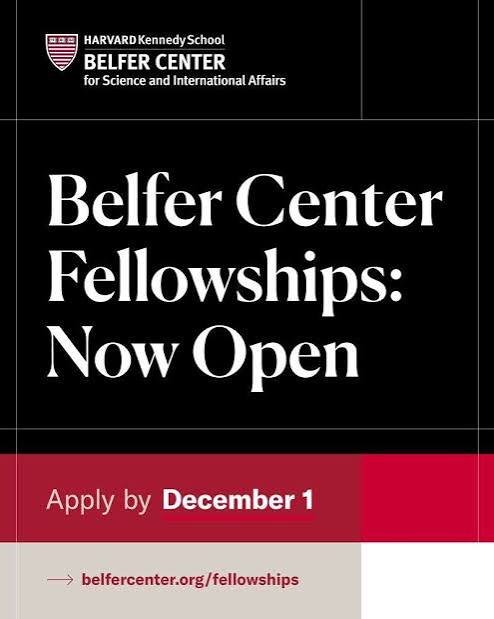
The Kuwait Program Research Fellowship · Harvard Kennedy School campus, Cambridge, MA.
Applications are open for the Kuwait Program Research Fellowship 2027 2028 at the Harvard Kennedy School Belfer Center for Science and International Affairs. The fellowship is designed for promising junior and mid career policy oriented scholars and faculty from Kuwait who want to conduct independent research on important public policy issues affecting Kuwait and the Gulf region.
The fellowship is hosted through the Middle East Initiative at the Harvard Kennedy School and is supported by the Kuwait Foundation for the Advancement of Sciences. It provides fellows with a ten month appointment at Harvard, access to university libraries and research resources, faculty mentorship, and financial support to advance a substantial research project toward publication in a peer reviewed, internationally ranked journal.
The programme is particularly interested in emerging scholars and social scientists whose research has clear policy relevance and potential to contribute to evidence based solutions. Priority is given to research related to health, education, energy, environment, water and food security, and digital transformation and artificial intelligence.
The Kuwait Program Research Fellowship provides junior and mid career policy oriented scholars with the opportunity to spend an academic year at Harvard Kennedy School developing an independent research project relevant to Kuwait and the Gulf region.
Fellows are expected to advance the research project presented in their application with the goal of producing a publication suitable for a peer reviewed, internationally ranked journal. Open Access publication is particularly encouraged.
Each fellow is matched with a Harvard faculty member whose expertise aligns with the proposed research. The faculty mentor provides academic guidance, holds regular progress meetings, and may collaborate with the fellow where appropriate.
Fellows may also participate in the wider intellectual life of the Middle East Initiative. This can include collaborations with other Harvard fellows and faculty as well as organising or speaking at public events.
• Ten month fellowship appointment from September 1, 2027 to June 30, 2028
• US$65,000 stipend for postdoctoral fellows who received their doctoral degree less than five years before the fellowship begins
• US$75,000 stipend for fellows who received their doctoral degree more than five years before the fellowship begins
• Access to Harvard University libraries and other research resources
• Designated Harvard faculty mentorship
• Opportunities to collaborate with Harvard faculty and other fellows
• Opportunity to develop research for peer reviewed international publication
• Potential opportunities to contribute to Middle East Initiative public events
• Harvard University health benefits for eligible postdoctoral fellows within five years of receiving their doctoral degree
The fellowship also accepts applicants seeking partial funding and non stipend appointments. Applicants seeking funding must indicate whether they require full or partial funding and identify other potential funding sources.
Applicants are particularly encouraged to propose research addressing one or more of the following areas in relation to Kuwait and the Gulf region:
• Health
• Education
• Energy
• Environment
• Water and food security
• Digital transformation and artificial intelligence
Proposals should demonstrate clear policy relevance and should aim to contribute to academic and policy discussions through rigorous research.
• Applicants must be from Kuwait, currently residing and working in Kuwait, or formally affiliated with a Kuwait based academic or research institution
• Applicants should be junior or mid career policy oriented scholars or faculty
• Emerging scholars and social scientists are particularly encouraged to apply
• Proposed research should be policy relevant
• Research should have the potential to appear in a peer reviewed, internationally ranked journal
• Applicants should have a research project relevant to Kuwait and the Gulf region
• Applicants must be able to undertake the fellowship physically at Harvard University
• Applicants who require institutional leave or sabbatical approval should indicate this in their application
The programme is particularly interested in researchers whose work can contribute to evidence based and scientifically rigorous approaches to public policy challenges.
Kuwait Program Research Fellows are expected to make substantial progress on the research project described in their application throughout the fellowship.
The proposed research should have clearly defined questions, challenges or knowledge gaps. Fellows should establish a realistic timeline for completing the research and preparing it for publication.
Fellows are encouraged to collaborate with Harvard faculty and other researchers where appropriate. They may also be asked to contribute to the intellectual and public activities of the Middle East Initiative.
• CV or resume including all degrees earned and dates of completion
• Expected completion dates for degrees that are still in progress
• Research proposal of 3 to 5 pages
• Timeline for completing and publishing the proposed research
• Names of 2 to 3 Harvard faculty members the applicant would like to collaborate with
• Explanation of how the selected Harvard faculty members relate to the proposed research
• Statement indicating whether full or partial funding is requested
• Information about other potential funding sources
• Unofficial transcript for applicants who have not earned a PhD
• Contact information for 3 recommenders
• Writing sample of fewer than 50 pages
• Abstract of 300 words or less for the writing sample
• English language writing sample
The writing sample may be a policy brief, journal article, book chapter, dissertation chapter, white paper, or another substantial piece of academic or policy writing. It may be published or unpublished and is preferably single authored. The writing sample must have been produced without the use of generative artificial intelligence.
Applications are expected to demonstrate strong research potential, policy relevance, academic quality, and a clear connection to the priorities of the Kuwait Program.
Particular attention is given to the importance of the proposed research questions, the strength of the research agenda, the feasibility of completing the project during the fellowship, its potential contribution to policy discussions, and its prospects for publication in a peer reviewed international journal.
The proposed relationship with Harvard faculty members is also important because fellows will be matched with a designated Harvard faculty mentor whose expertise aligns with their research.
Harvard Kennedy School campus, Cambridge, MA.
 The Kuwait Program Research Fellowship





Be the first to comment on this opportunity.