

The International Physics Competition IPhyC 2026 is a global online physics competition designed for students who want to challenge their scientific knowledge, analytical thinking, mathematical skills, and problem solving abilities. The competition gives students an opportunity to explore physics beyond the standard school curriculum while competing with participants from different countries and educational backgrounds. IPhyC is designed to make international physics challenges accessible to students regardless of where they live. Participants can take part online using a computer and internet connection, with a pen and paper also required for working through problems. The competition encourages students to focus on understanding scientific situations, identifying relevant principles, applying mathematical reasoning, and developing logical solutions rather than simply memorizing formulas. The 2026 competition features a Qualification Round followed by further stages for students who meet the required performance level. The Qualification Round is free to enter, while qualified students who proceed to the Semi Final Round may be required to pay a registration fee. Limited financial assistance is available for participants who cannot afford the later round fee. About the Competition The International Physics Competition provides an international platform for students to test their understanding of physics through carefully designed problems. The competition is intended to encourage curiosity, scientific exploration, critical thinking, and deeper engagement with physics. Participants receive problems that can require a combination of physics knowledge, mathematical calculations, interpretation, research, and structured reasoning. The same general problem set is provided across the different participant groups, while qualification requirements can vary according to the student’s age or academic level. The competition is organized online, allowing students to participate without travelling internationally. Students may participate independently or through their schools and educational institutions. Teachers and mentors can support students during preparation, although students are able to enter the initial round independently. Competition Benefits • Participate in an international physics competition with students from different countries. • Test physics knowledge through challenging and unfamiliar problems. • Develop analytical thinking and scientific problem solving skills. • Explore physics concepts beyond the regular school curriculum. • Gain exposure to interdisciplinary scientific topics. • Receive certificates and recognition based on competition performance. • Compete for cash prizes and additional honours in the later stages. • Participate online without the need for international travel. • Access an international community of students interested in physics and scientific learning. Competition Structure The 2026 competition is organized through progressive stages: • Qualification Round • Semi Final Round • Final Round The Qualification Round is the open entry stage. Students who achieve the required score can progress to the next stage. Later rounds introduce increasingly challenging assessments and supervised examination arrangements. Eligibility Criteria • Students from all countries are eligible to participate. • Applicants should be interested in physics and scientific problem solving. • Students should have access to a reliable internet connection. • Participants should have access to a computer or suitable device for online participation. • Students may participate independently or through a school or educational institution. • The competition accommodates students from different educational levels through separate participant categories. • The Junior category is intended for students in Grade 10 or below and under 16 years of age. • The Youth category is intended for students in Grades 11 to 13 and under 19 years of age. • The Senior category is intended for first year college or university students and above, or participants aged 19 and above. Qualification Round The Qualification Round is the first stage of IPhyC 2026 and is free to enter. Participants receive five physics problems covering different topics, levels of difficulty, and approaches to problem solving. The problems may involve physics knowledge, mathematical calculations, interpretation, and logical reasoning. Students are expected to develop their own solutions and submit their work through the competition platform. The Qualification Round deadline is November 1, 2026 at 23:59 UTC. Students who successfully qualify can continue to the next stage of the competition. Required Application Information • Participant registration information. • A completed Qualification Round problem set. • Clearly presented solutions to the assigned physics problems. • A suitable digital file containing the completed solutions. • Accurate personal information for competition records and certificates. Students should ensure that their submitted solutions are complete and readable before the final submission. Semi Final and Final Rounds Students who qualify from the first stage can continue to the Semi Final Round. The 2026 programme information indicates that the Semi Final involves more advanced scientific material and assessment. The Semi Final registration fee is currently listed as EUR 12 for qualified participants. Limited financial assistance can be available for students who demonstrate financial need. Participants who qualify for the later stage should check the official IPhyC instructions for the applicable registration and financial assistance procedures. Students who successfully progress through the Semi Final can reach the Final Round, where they compete for final rankings, prizes, certificates, and other forms of recognition. The final stage is conducted online under the competition’s examination arrangements. Awards and Recognition IPhyC provides certificates and recognition for participants according to their results. The 2026 competition also includes cash prizes and special recognition for high performing participants. The competition’s published information indicates that awards are intended to recognize strong performance across the different participant categories. This provides students with an opportunity to demonstrate their physics ability and receive formal recognition for their achievement. Beyond prizes, participation can help students develop evidence of independent scientific problem solving, analytical reasoning, curiosity, and interest in physics. How to Apply Visit the official International Physics Competition website. Review the IPhyC 2026 competition information and participant requirements. Register for the Qualification Round. Access the official Qualification Round problem sheet. Solve all assigned problems carefully using your own reasoning and calculations. Prepare the completed solutions in the required submission format. Submit the solution before November 1, 2026 at 23:59 UTC. Monitor your participant account and email for the Qualification Round results. If you qualify, follow the instructions provided for registration for the Semi Final Round.

ITU Gender Champions Programme 2027
Applications are open for the ITU Gender Champions Programme 2027, an initiative designed to recognize and support young women using technology and digital innovation to create positive change in their communities, countries and regions. The programme is implemented by the International Telecommunication Union (ITU), with support from Australia and Women’s WorldWide Web (W4). The ITU Gender Champions Programme provides a platform for emerging women leaders who are advancing digital transformation, promoting digital inclusion and contributing to a more equitable digital future. The initiative connects young changemakers with a global network of experts, policymakers and innovators while giving them opportunities to strengthen their leadership and amplify their impact. For its inaugural cohort, the programme will support up to four outstanding young women leaders between the ages of 18 and 25. Applicants should be using digital technology to advance inclusive development and demonstrate meaningful work that contributes to closing the gender digital divide. About the Opportunity The ITU Gender Champions Programme is part of ITU’s broader work to advance gender equality through information and communication technologies. It recognizes that young women can play an important role in shaping inclusive digital transformation and addressing barriers that prevent women and girls from fully participating in the digital economy and society. The 2027 cohort is the inaugural group of ITU Gender Champions. Selected participants will join an international community of young women leaders and gain visibility through their participation in a major global technology and innovation platform. The programme is particularly relevant to young women who have already taken action in their communities or countries and are using technology as a tool for inclusion, empowerment, innovation or social development. Opportunity Benefits • Opportunity to participate in the AI for Good Global Summit 2027 in Geneva, Switzerland • Connection with a global network of experts, policymakers and innovators • Recognition as an ITU Gender Champion • Opportunity to amplify work in digital transformation and digital inclusion • Leadership development and greater international exposure • Potential support for a community level project advancing women’s and girls’ digital inclusion, access, skills or empowerment, subject to sufficient available funds Programme Areas Applicants may demonstrate work in areas such as: • Digital skills and literacy • Digital inclusion and access • Expanding connectivity • Technology and digital innovation • Online safety • Artificial intelligence for social good • Inclusive digital policies • Women’s and girls’ empowerment through technology • Closing the gender digital divide Eligibility Criteria • Applicants must be women • Applicants must be between 18 and 25 years old • Applicants must be nationals of countries within the ITU regions of Africa, the Americas, the Arab States, Asia and the Pacific, or the Commonwealth of Independent States • Applicants must be using digital technology to advance inclusive development • Applicants should demonstrate meaningful leadership or engagement related to digital transformation, digital inclusion or technology driven social change • Applicants should have an initiative, project, advocacy effort or other work demonstrating how technology is being used to create positive change The programme is intended for young women who are actively contributing to digital inclusion and related areas. A university degree or specific academic qualification is not identified as a requirement in the current ITU programme information. Selection Criteria Applications will be assessed by ITU and programme partners using the programme eligibility and selection criteria. The evaluation will consider: • Relevance of the applicant’s work to gender equality in digital transformation • Leadership in addressing the gender digital divide • Measurable impact and potential for scalability • Originality and innovation • Capacity for collaboration • Potential for sustained engagement Required Application Information • Completed online application form • Information demonstrating the applicant’s use of digital technology to advance inclusive development • Details of relevant leadership, projects, initiatives or activities • Evidence demonstrating impact and contribution to digital inclusion or gender equality • Information addressing the programme’s selection criteria • Application submitted in English Applicants should ensure that all information provided is accurate and complete, as the information submitted may be subject to verification. How to Apply Review the ITU Gender Champions Programme information and eligibility requirements. Consider how your technology related work contributes to digital inclusion, gender equality or inclusive development. Prepare accurate information about your leadership, project, initiative, impact and use of technology. Complete the official ITU Gender Champions application form in English. Submit your application before November 15, 2026 at 11:59 PM CET. Keep supporting information available in case ITU or programme partners request verification. Pre selected applicants will be contacted during the review process, with the inaugural cohort expected to be announced on March 8, 2027.

UN Global Compact Business & Human Rights Accelerator 2026/2027
Applications are open for the UN Global Compact Business & Human Rights Accelerator 2026/2027, a three month programme designed to help companies turn their existing commitments to human rights and labour rights into practical action. The programme supports businesses in identifying human rights risks across their operations and value chains and developing concrete plans to address those risks. Organised through the United Nations Global Compact, the Accelerator brings together companies from different regions and industries for global workshops, regional and country level peer learning, on demand resources and guidance from Global Compact Country Networks. Participants apply human rights due diligence principles directly to their own business context and work toward developing a practical Action Plan. The programme is intended for companies that already have a foundational understanding of human rights and labour rights and are ready to move from commitment to implementation. Companies must be participants of the UN Global Compact or be willing to join. They should also be prepared to dedicate representatives and leadership support to the programme. About the Programme The Business & Human Rights Accelerator helps companies establish or strengthen an ongoing human rights due diligence process. Participants begin by assessing their current position, understanding the UN Guiding Principles on Business and Human Rights and identifying areas where their business activities may create or contribute to human rights and labour rights impacts. During the programme, companies examine their value chains, identify and prioritize their most significant human rights risks and develop actions to address the issues identified. Participants also learn about stakeholder engagement, remedy and grievance mechanisms and how to communicate about human rights impacts. The programme includes global virtual workshops, on demand learning, local sessions and regional peer learning. Country Networks provide additional guidance and local context, while companies without a Country Network offering the programme can participate through the global track. Opportunity Benefits • Develop a practical Action Plan addressing the company’s most significant human rights and labour rights risks. • Identify and prioritize human rights risks and impacts across the company’s value chain. • Establish a clear starting point for strengthening corporate human rights responsibilities. • Develop an ongoing human rights due diligence approach aligned with the UN Guiding Principles on Business and Human Rights. • Improve readiness for evolving human rights due diligence requirements. • Strengthen stakeholder engagement and approaches to remedy human rights impacts. • Learn from companies and professionals working on similar challenges across different regions. • Gain access to UN partners, experts and a global peer network. • Receive guidance from relevant UN Global Compact Country Networks. • Receive a certificate of completion recognizing participation in the Accelerator. Programme Areas The Business & Human Rights Accelerator covers several areas related to responsible business conduct and human rights due diligence, including: • Human rights and labour rights • Human rights due diligence • Value chain assessment • Identification and prioritization of human rights risks • Stakeholder engagement • Remedy and grievance mechanisms • Corporate responsibility and accountability • Human rights action planning • Regional and local peer learning • Implementation of human rights commitments Eligibility Criteria The programme is designed for companies that meet the following requirements: • The company must be a participant of the UN Global Compact or be willing to join. • The company should currently engage with a Global Compact Country Network in its region or be willing to join one. • The company should have a foundational understanding of human rights and labour rights. • The company must be willing to identify its human rights risks and impacts. • The company must be willing to scope a core area of its value chain for further attention. • The company must commit to developing and submitting an Action Plan addressing identified and prioritized human rights risks. • The company must commit to completing all mandatory programme requirements. • The company must be able to appoint two working level representatives to participate in sessions and Accelerator activities. • The company must appoint an additional executive level representative to follow programme developments, provide support and participate in high level events. • The company must be committed to applying the programme outcomes across its strategy and operations. Participation Tracks Companies can participate through different tracks depending on their location. The in country track is facilitated by participating UN Global Compact Country Networks and may be delivered in the local language and local time zone. This track provides companies with local perspectives, peer learning and support from their Country Network. Regional tracks are also available. The Africa track brings together companies from across Africa, while other regional tracks serve companies in Asia and Latin America. Companies located in countries without a relevant Country Network offering the Accelerator can apply through the global track, which is facilitated in English. How to Apply Review the Business & Human Rights Accelerator requirements and confirm that your company meets the eligibility conditions. Ensure that your company is a participant of the UN Global Compact or is prepared to join. Identify two working level representatives who can participate in the programme activities. Identify an executive level representative who can provide leadership support and follow programme developments. Determine whether your company should participate through an in country, regional or global track. Prepare the required information about your company and its nominated representatives. Complete the official online application form. Submit the application before November 30, 2026.
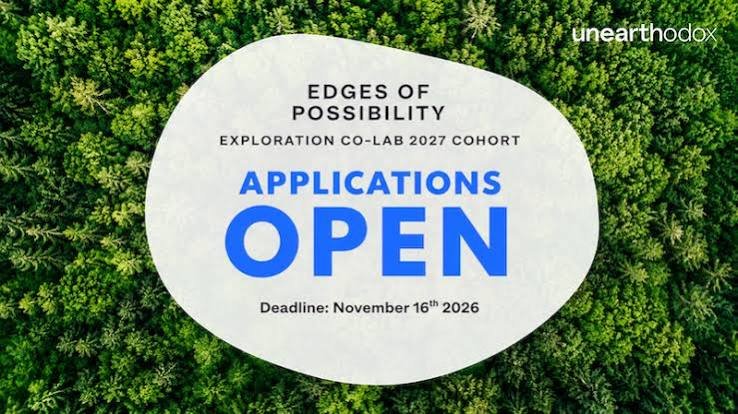
Unearthodox Exploration Co Lab 2027: Edges of Possibility for Innovators
The Unearthodox Exploration Co Lab 2027: Edges of Possibility is now accepting applications from innovators developing early stage initiatives that address environmental and societal challenges while reimagining the systems behind those challenges. The 10 month online incubation programme is designed for changemakers whose work explores new relationships between people, society and nature and whose ideas may not fit conventional innovation or funding models. Organised by Unearthodox, the Exploration Co Lab provides financial support alongside customised incubation, peer learning, coaching, systems thinking and opportunities for collaboration. Selected innovators will receive a CHF 10,000 grant and access to a shared pool of tailored non financial support designed to help them navigate complexity, refine their ideas and explore new pathways for systemic change. The 2027 edition focuses on “Edges of Possibility,” with particular interest in initiatives that move beyond surface level solutions and address root causes within humanity’s relationship with nature. This can include work connected to climate change, biodiversity, habitat loss, environmental justice, regeneration and other interconnected nature society challenges. About the Exploration Co Lab The Exploration Co Lab is Unearthodox’s alternative incubation programme for innovators working on systemic transformation. Rather than focusing only on rapid growth, conventional scaling or commercial outcomes, the programme creates space for experimentation, reflection, collaboration and deeper exploration of the conditions needed for transformative ideas to develop. The 2027 call seeks initiatives that question existing systems and norms and explore possibilities for a healthier relationship between human societies and the natural world. Unearthodox describes these innovators as “edge walkers,” referring to people pursuing unconventional approaches that may sit outside established categories. The programme builds on Unearthodox’s previous cohorts and its research into alternative approaches to incubation. The organisation aims to support both the people behind innovative ideas and the wider ecosystems that influence whether those ideas can flourish. Opportunity Benefits • CHF 10,000 grant funding to support the development of the selected initiative • 10 month online incubation journey beginning in 2027 • Individualised coaching and expert guidance • Peer learning and shared exploration with other innovators • Systems mapping and futures thinking support • Strategic positioning support for the innovator and initiative • Support for developing regenerative approaches to defining and measuring success • Access to a global community of systems innovators, mentors and network builders • Opportunities for collaboration, mutual support and deep allyship • Visibility and amplification through Unearthodox communication channels • Support for exploring new pathways toward systemic change Programme Areas The Exploration Co Lab welcomes work addressing the relationship between environmental and societal systems. Relevant areas can include: • Climate change • Biodiversity • Habitat loss • Environmental justice • Regeneration • Nature conservation • Human relationships with the more than human world • Community and ecological wellbeing • Systems change • Alternative governance, economic or institutional approaches • Social and environmental challenges connected to human relationships with nature The programme is intentionally open to initiatives that do not fit neatly into conventional categories. Applicants are encouraged to demonstrate how their work connects ecological wellbeing with human wellbeing, justice and systemic transformation. Eligibility Criteria Applicants should meet the following requirements: • Be over 18 years of age • Be an innovator with an early stage initiative already in motion • Work at the intersection of environmental and societal challenges • Be beyond the idea stage • Have some initial research, testing, a pilot, proof of concept or active community engagement underway • Be interested in addressing root causes and contributing to systemic change • Be willing to participate in a collaborative cohort based learning experience • Be able to participate in a programme conducted in English • Submit the application through the official online application portal • Not currently be employed or contracted by Unearthodox • Be able to legally accept the grant if selected • Not be located in a country where international sanctions prevent Unearthodox from sending funds What Stage of Work Can Apply? The Exploration Co Lab is designed for initiatives at different points within the early stages of development. Applicants may be: • Testing an approach with limited resources and learning directly from the people, environments or living systems they aim to serve • Proving a concept that demonstrates the core idea can work and requires further testing or development • Deepening an initiative that has already produced early insights and is ready to explore new pathways • Pivoting an existing initiative that requires a meaningful change in direction, approach or model • Working somewhere between these stages while actively shaping the direction of the initiative A concept that exists only on paper without any groundwork or activity is not sufficient for this call. Selection Criteria Applications are assessed according to five main criteria. • Systems Orientation: 25 percent, focusing on whether the initiative addresses root causes and systemic patterns rather than symptoms • Nature Society Vision: 25 percent, examining how ecological outcomes connect with human wellbeing, social justice and rights based approaches • Boundary Pushing: 25 percent, considering whether the idea proposes meaningful shifts rather than incremental changes • Transformational Intent: 15 percent, assessing readiness for deep allyship, learning and collaboration across conventional boundaries • Edge Walking: 10 percent, considering the applicant’s willingness to embrace risk and pursue unconventional approaches to change making Applications are reviewed by a panel involving experts from environmental and social fields, members of previous Exploration Co Lab cohorts and Unearthodox partners. Required Application Information Applicants should be prepared to explain their initiative and its potential contribution to systemic transformation. The application should address areas including: • The future the initiative is helping to create and the future it seeks to move away from • The larger systems level change the initiative aims to contribute to • The communities, places and living systems connected to the work • How the initiative challenges existing systems, norms or assumptions • How ecological wellbeing and human wellbeing are connected within the approach • Existing work, research, testing, pilots or community engagement • What already exists

IMF Fund Internship Program 2027
Applications are open for the IMF Fund Internship Program 2027, an opportunity for graduate students in economics to gain practical research experience at the International Monetary Fund. The program allows selected interns to apply their academic training to real world economic and policy questions affecting the IMF’s 191 member countries. The Fund Internship Program gives participants the opportunity to work alongside experienced IMF economists and contribute to an individual research or project assignment. Interns gain exposure to the work of a major international financial institution while strengthening their analytical, quantitative and research skills. The 2027 internship will take place over approximately 10 to 12 weeks at IMF Headquarters in Washington, DC. During the internship, participants will work under the supervision of IMF staff and contribute to research or operational work connected to the institution’s priorities. About the Internship The Fund Internship Program is designed to help graduate students connect advanced academic research with practical policy work. Interns work closely with IMF staff on focused research projects and gain insight into how economic analysis is applied within an international financial institution. For the 2027 Economics internship, candidates should be doctoral students who are within one to two years of completing their PhD in macroeconomics or a related field. Participants must remain enrolled as students during the internship and return to their academic studies afterward. The internship is based at IMF Headquarters in Washington, DC. The program provides an international working environment where students can interact with experienced economists and professionals working on economic and financial issues. Internship Benefits • Practical research experience at the International Monetary Fund • Individual research or project assignment supervised by IMF staff • Opportunity to apply academic economic research to real world policy questions • Hands on experience in an international policy institution • Development of analytical and quantitative research skills • Exposure to IMF work supporting its 191 member countries • Professional networking with experienced IMF economists and staff • Opportunities to present research findings to IMF staff • Potential for research findings to contribute to internal IMF publications • Experience that can support future careers in academia, economic policy and international organizations Internship Areas The Fund Internship Program can involve research and project work connected to areas such as: • Macroeconomics • International economics • Monetary policy • Public finance • Financial markets • Inflation dynamics • Financial stability • Inequality • Digital transformation • Economic policy research Eligibility Criteria To be considered for the 2027 Fund Internship Program for Economists, applicants must: • Be within one to two years of completing a PhD in macroeconomics or a related field • Be enrolled as a student at the time of the internship • Be able to return to their academic studies after completing the internship • Be under the age of 32 when the internship begins in June 2027 • Have excellent written and spoken English • Demonstrate strong analytical skills • Demonstrate strong quantitative skills • Possess strong computer skills • Be available to work at IMF Headquarters in Washington, DC for the internship period Required Application Materials Applicants for the Economics internship should prepare: • Curriculum Vitae or Resume • Statement of Interest or Cover Letter explaining their motivation for applying to the IMF • Recent academic transcript or documentation confirming current student status and recent grades • Completed technical questionnaire within the online application Applications must be complete to be considered. The IMF states that applications are submitted through its online recruitment system. Selection Criteria Applications are considered based on the applicant’s academic background, research preparation and ability to contribute to the work of the IMF. Important factors include: • Academic preparation in economics or a related field • Progress toward completion of a relevant PhD • Strength of analytical and quantitative skills • Research interests relevant to economic and policy questions • Written and spoken English ability • Computer and research skills • Ability to apply academic knowledge to practical policy issues Only candidates selected for further consideration will be contacted by the Fund Internship Program recruitment team. How to Apply Review the eligibility requirements for the IMF Fund Internship Program 2027. Prepare an updated Curriculum Vitae or Resume highlighting your academic background, research experience and relevant skills. Prepare a Statement of Interest or Cover Letter explaining your motivation for joining the IMF and your interest in economic research and international policy. Obtain a recent transcript or university documentation confirming your current student status and academic performance. Complete the technical questionnaire included in the online application. Submit the complete application through the IMF recruitment system before the December 5, 2026 deadline. Ensure that all required documents are included, as incomplete applications will not be considered.
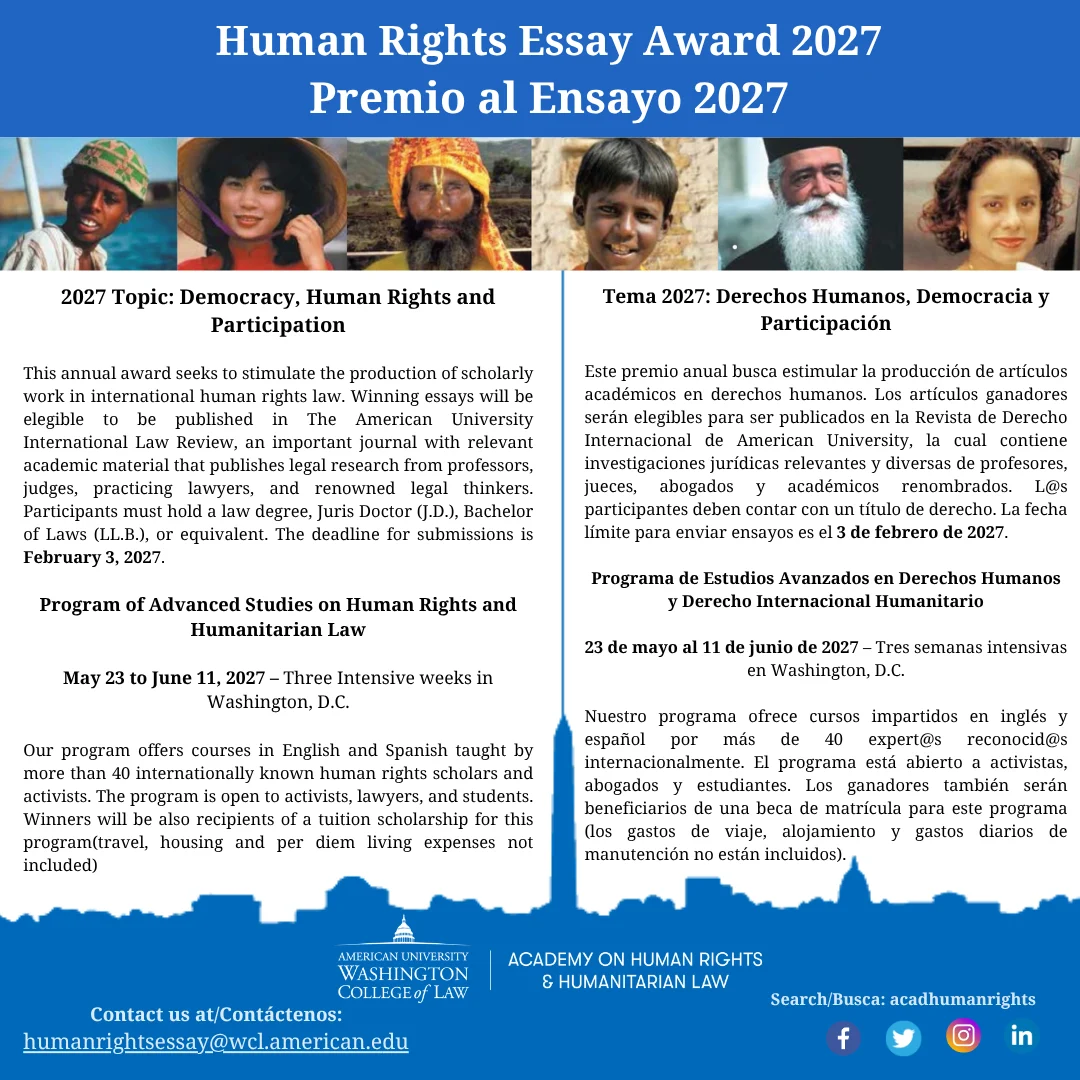
American University Human Rights Essay Award 2027
Applications are open for the American University Human Rights Essay Award 2027, an annual academic writing competition organized by the Academy on Human Rights and Humanitarian Law at American University Washington College of Law. The award encourages the production of high quality academic legal articles addressing important questions in international human rights law. The theme for the 2027 competition is “Democracy, Human Rights and Participation.” Applicants have the flexibility to select a specific legal issue connected to this theme, provided that the essay maintains a clear and substantive connection among democracy, human rights and participation. The Academy notes that international human rights law for purposes of the competition includes international humanitarian law and international criminal law. The competition is open to individuals who hold a law degree and have demonstrated experience or interest in international human rights law. Essays may be submitted in English or Spanish and must be unpublished legal essays written solely by the applicant. The submission must take the form of an academic legal article with appropriate citations and source references. The two best essays, one in English and one in Spanish, will receive full tuition scholarships to the Program of Advanced Studies on Human Rights and Humanitarian Law. The scholarship covers the academic programme and applicable fees, while travel, accommodation and daily living expenses are not included. The winning essays and honorable mentions may also be considered for publication in the American University International Law Review. About the Human Rights Essay Award The Human Rights Essay Award is an annual initiative of the Academy on Human Rights and Humanitarian Law at American University Washington College of Law. It is designed to encourage academic research and legal scholarship on contemporary questions in international human rights law. For 2027, the Academy invites applicants to examine the relationship between democracy, human rights and participation from regional, international, comparative, institutional or thematic perspectives. Applicants are encouraged to approach the theme creatively and critically while maintaining a clear legal connection to the central topic. The competition also connects with the Academy’s broader human rights education activities. The 2027 theme will also be addressed during the 32nd Inter American Human Rights Moot Court Competition scheduled for May 16 to May 21, 2027. Opportunity Benefits • Full tuition scholarship for the best English language essay • Full tuition scholarship for the best Spanish language essay • Coverage of application and administrative fees associated with the scholarship programme • Coverage of academic courses for up to four courses • Opportunity for the winning essays to be considered for publication in the American University International Law Review • Opportunity for honorable mention essays to be considered for publication • Official certificate recognizing the award • Academic exposure within the Academy on Human Rights and Humanitarian Law • Opportunity to develop and showcase advanced legal research and writing skills Programme Areas The 2027 essay should address issues connected to: • Democracy • International human rights law • Participation • International humanitarian law • International criminal law • Legal protection of democratic participation • Human rights and democratic institutions • Regional or comparative approaches to democracy and human rights • Institutional and thematic questions related to the 2027 theme Applicants may select their own specific subject within the broader theme. However, the Academy states that essays outside the scope of the selected topic may be disqualified. Eligibility Criteria • Hold a law degree, Juris Doctor, Bachelor of Laws or equivalent qualification • Demonstrate experience or interest in international human rights law • Select a subject directly related to the 2027 theme, Democracy, Human Rights and Participation • Submit an academic legal article with appropriate citations and source references • Submit an unpublished essay • Ensure the essay is written solely by the applicant • Submit the essay in either English or Spanish • Applicants who have previously won the Human Rights Essay Award are not eligible to participate in future editions Required Application Materials • Unpublished legal essay written by the applicant • Academic legal article focused on the 2027 theme • Proper citations and source references • Relevant supporting source materials retained by the applicant The official rules should be reviewed carefully before submission because the Academy sets specific requirements governing the essay, originality, citations, topic relevance and submission process. Selection Criteria Submitted essays are reviewed through a preselection process before being considered by an Honor Jury made up of professionals with recognized expertise in international human rights law. The selection process considers whether an essay meets the formal requirements of the competition and whether its substantive content falls within the designated annual theme. The Academy selects finalists in each language before the Honor Jury makes the final determination. The Academy reserves the right not to grant an award if submitted essays do not meet the required standards. The decision of the Honor Jury is final. How to Apply Review the official 2027 Human Rights Essay Award theme and regulations. Select a specific legal subject connected to Democracy, Human Rights and Participation. Develop an original academic legal article that directly addresses the selected subject. Ensure that the essay contains appropriate legal citations and source references. Confirm that the essay is unpublished and written solely by you. Review the official submission requirements for the applicable language. Submit the completed essay through the American University Human Rights Essay Award submission system. Complete your submission no later than February 3, 2027 at 11:59 PM Washington, DC time.
UONGOZI Institute Emerging Leaders Programme 2026 2027
Applications are open for the UONGOZI Institute Emerging Leaders Programme 2026 2027, a professional leadership development opportunity designed for mid level executives working across Africa. The programme is implemented by UONGOZI Institute in collaboration with the HAUS Finnish Institute of Public Management and is designed to help rising leaders strengthen their leadership capabilities, advance their careers and create positive change within their organisations and communities. The Emerging Leaders Programme is a dynamic, self paced six month programme that allows participants to pursue professional development while continuing with their careers. The programme challenges participants to develop greater self awareness, build resilience and a growth mindset, strengthen strategic thinking, communicate effectively and mobilise others to drive meaningful change. The programme is intended for professionals working in any sector across Africa who already have experience in supervision, management or leadership. Participants will learn from experts in leadership development from around the world while engaging with practical concepts that can be applied to their professional responsibilities. About the Programme The UONGOZI Institute Emerging Leaders Programme is designed to support professionals who want to advance their leadership capabilities without putting their careers on hold. Since its launch, the programme has supported hundreds of graduates and delivered numerous leadership development modules. The programme focuses on personal leadership and helps participants understand how their mindset, communication style, organisational environment and approach to leadership can influence their effectiveness. Participants are guided by an international faculty with expertise in leadership development. The programme encourages leaders to examine their strengths and challenges while developing practical approaches for managing uncertainty, inspiring others and achieving organisational results. Programme Benefits • Six months of structured leadership development • Self paced learning that allows participants to continue their professional responsibilities • Learning from leadership development experts from across the world • Development of a growth mindset and resilience • Stronger strategic thinking skills • Improved communication and ability to inspire change • Greater understanding of organisational culture • Increased leadership confidence • Opportunity to build professional leadership capabilities • Eligibility to be considered for a limited number of merit based scholarships Programme Areas The Emerging Leaders Programme focuses on several important areas of personal and organisational leadership, including: • Personal leadership and self awareness • Growth mindset and resilience • Strategic thinking • Communication and inspiring change • Organisational culture and effectiveness • Confidence and professional development • Mobilising others to achieve change • Leadership in uncertain and changing environments Eligibility Criteria Applicants for the UONGOZI Institute Emerging Leaders Programme should meet the following requirements: • Work in any sector across Africa • Have at least five years of work experience • Have at least one year of supervisory, managerial or leadership experience • Hold a bachelor’s degree or equivalent qualification • Have a good command of written and spoken English • Have excellent computer skills • Demonstrate an interest in strengthening leadership capacity and advancing professionally Programme Fee and Scholarships The programme fee is TZS 2.6 million per participant. Participants may pay the fee in two instalments: • 50 percent before registration in November • 50 percent before Module 4 in February Required Application Materials Applicants are required to submit: • Curriculum vitae not exceeding three pages • Recommendation, commitment and permission letter from the employer • Motivational statement of between 450 and 500 words Selection Criteria Applications are assessed based on the applicant’s professional experience, leadership exposure, educational background and suitability for the programme. Particular attention is given to applicants who demonstrate: • Relevant supervisory, managerial or leadership experience • Meaningful professional experience • Clear motivation for leadership development • Capacity to apply leadership learning in their professional environment • Strong communication skills • Readiness to participate in a professional development programme Scholarship opportunities are limited and are merit based. How to Apply Review the UONGOZI Institute Emerging Leaders Programme requirements and confirm that you meet the eligibility criteria. Prepare a curriculum vitae of no more than three pages. Obtain a recommendation, commitment and permission letter from your employer. Prepare a motivational statement of 450 to 500 words describing your leadership achievements, challenges and reasons for applying. Complete the online application through the UONGOZI Institute application platform. Submit the complete application before October 23, 2026 at 23:00 hours EAT. Wait for communication from UONGOZI Institute regarding the outcome of your application.

NVIDIA Graduate Fellowship 2027 to 2028
Applications are now open for the NVIDIA Graduate Fellowship 2027 to 2028, an international research fellowship supporting PhD students whose work advances accelerated computing and related technologies. The programme provides research funding of up to $60,000 per award and connects selected Fellows with NVIDIA researchers and technology. The NVIDIA Graduate Fellowship is designed for doctoral researchers working in areas such as artificial intelligence, machine learning, computer architecture, computer vision, robotics, autonomous vehicles, healthcare, networking, security, quantum computing and other related fields. The programme provides financial support through the Fellow’s university while also offering opportunities for research collaboration and technical engagement. Selected Fellows are required to complete an in person summer internship at an eligible NVIDIA research office before the Fellowship award year begins. International PhD students are welcome to apply, with internship opportunities available in locations including the United States, Canada, Germany, Sweden, Finland, Switzerland, Israel, Taiwan and Singapore. About the Fellowship The NVIDIA Graduate Fellowship supports doctoral research that has the potential to contribute to the development, performance or use of future computing technologies. The programme is particularly interested in research that connects with NVIDIA’s primary technical areas and advances the capabilities of accelerated computing. The fellowship has operated since 2002 and has supported hundreds of doctoral researchers. NVIDIA states that the programme has awarded more than 220 grants worth approximately $8 million since its establishment. Fellows are expected to remain actively engaged in their PhD research and complete the fellowship requirements during the nine month award year. In addition to financial support, the programme provides opportunities to work with NVIDIA researchers, gain practical exposure to NVIDIA technology and participate in the wider research community. Fellowship Benefits • Research funding of up to $60,000 per award • Funding administered through the recipient’s university • Support for stipend, tuition and mandatory fees • Research collaboration with NVIDIA researchers • Access to NVIDIA technology and technical expertise • Required in person summer internship at an eligible NVIDIA research office • Opportunity to present research at GTC San Jose • International research and professional exposure Research Areas Applicants may work in a broad range of research areas connected to NVIDIA technology and accelerated computing, including: • Generative artificial intelligence • Language models and speech • Neural architectures, theory and algorithms • AI software platforms • Autonomous vehicles • Computational imaging and computer vision • Computer architecture, circuits and VLSI • Computer graphics • Healthcare, medical and life sciences • Networking and interconnects • Parallel programming systems and algorithms • Robotics • Security and privacy • Quantum computing Related research areas may also be considered. Applicants should clearly explain how their work connects with NVIDIA’s research priorities. Eligibility Criteria Applicants must meet the following requirements: • Have completed their first year of PhD level studies before applying • Be pursuing a PhD in computer science, computer engineering, system architecture, electrical engineering or a related field • Be actively engaged in research as part of their PhD thesis • Remain a full time and active PhD student throughout the nine month award year • Not plan to graduate before the end of the fellowship academic year • Be available to complete the required in person summer internship before the fellowship year begins • Have a university capable of administering the fellowship award • Be able to complete the required internship at an eligible NVIDIA research office • Not be a full time NVIDIA employee • Not be an immediate family member of a full time NVIDIA employee International PhD students are eligible to apply. NVIDIA notes that award amounts can vary by country, region or location. Selection Criteria Applications are evaluated based on three broad areas: • Student quality, including recommendation letters, academic performance and achievements • Research quality, including research results, the proposed fellowship research and publication record • Relevance to NVIDIA, including the connection between the research and NVIDIA’s primary research domains Applicants should also demonstrate the potential for their research to influence the design, performance or use of future GPUs. Required Application Materials Applicants should prepare the following: • Research proposal of up to two pages, plus a bibliography • Resume or CV including contact information • Two to three recommendation letters • At least one recommendation letter from the applicant’s thesis advisor or professor • Confirmation of availability for the required in person summer internship How to Apply Review the NVIDIA Graduate Fellowship eligibility requirements and research areas. Prepare a focused research proposal that clearly explains the problem, research approach, progress and relevance to NVIDIA’s research priorities. Prepare an updated resume or CV highlighting academic achievements, research experience, publications and relevant technical work. Identify two to three suitable recommenders and request their support before adding them to the application portal. Create a profile in the NVIDIA Graduate Fellowship application system. Complete the application fields and upload the required research proposal and resume or CV. Confirm that you are available for the required in person summer internship. Invite your recommenders through the application portal and monitor the status of their letters. Ensure that all recommendation letters are completed and received by October 30, 2026. Review the complete application carefully and submit it before the deadline.

Dalai Lama Fellows Program 2027 for Emerging Changemakers
Applications are open for the Dalai Lama Fellows Program 2027, a year long leadership fellowship for emerging changemakers working to address social and community challenges. The programme is designed for young people who want to strengthen their leadership practice through self awareness, compassion, contemplation, community engagement and social innovation. Organised by Dalai Lama Fellows, the programme brings together changemakers from around the world who are working on locally relevant social change projects. Fellows receive leadership education, coaching, mentoring and opportunities for group learning while continuing their work within their communities. The 2027 fellowship will select approximately 15 to 20 changemakers from around the world. The formal fellowship year begins in April 2027 and concludes in March 2028. Most programme activities take place remotely, allowing Fellows to continue their professional or academic responsibilities while participating in the fellowship. About the Fellowship Dalai Lama Fellows is an international, non sectarian and inclusive leadership programme founded in 2010. It supports young changemakers working in areas including health and well being, education and youth development, social justice, environmental sustainability, cultural understanding and contemplation. The fellowship combines an online Head, Heart, Hands leadership curriculum with individual coaching, group learning and practical social innovation work. The Head dimension focuses on attention, self awareness and systems understanding. The Heart dimension develops compassion, connection and the ability to work across differences. The Hands dimension focuses on applying these principles through community based action. The fellowship is structured so that participants can remain engaged with their existing studies or professional responsibilities. Fellows are expected to dedicate approximately 12 hours each month to programme activities, in addition to the time required for their social change projects. Fellowship Benefits • Year long leadership development programme • Head, Heart, Hands online curriculum • Individual coaching and mentoring • Small group and full cohort learning opportunities • Training in mindfulness, emotional intelligence and compassionate leadership • Opportunities to strengthen systems thinking and communication skills • Support for developing and implementing a social change project • Connection with an international network of changemakers • Participation in a Contemplative Leadership Assembly • Travel, visa and lodging costs covered for the in person Contemplative Leadership Assembly when applicable • Lifelong membership in the Dalai Lama Fellows global community after graduation • Continued opportunities for networking, coaching, webinars and community engagement through the LifeLong Fellows network Programme Areas Fellows may work on social innovation projects addressing areas such as: • Health and well being • Education and youth development • Social justice • Environmental sustainability • Cultural understanding • Contemplative practices and human flourishing Projects should respond to a genuine need within a community that the applicant understands deeply. Eligibility Criteria • Applicants must be between 20 and 36 years old as of April 1, 2027. • Applicants must demonstrate fluency in written and spoken English. • Applicants must currently be engaged in a social change project or have a well articulated plan for a project. • Applicants must be able to remain meaningfully engaged with their project throughout the fellowship year. • Applicants must have in depth knowledge of the community and issue their project addresses. • Applicants should preferably have at least one year of previous experience working with the relevant community. • Applicants must have an interest in learning and engaging with contemplative practices. • Applicants must be able to participate consistently in the online curriculum, coaching and group learning activities. • Applicants must attend the virtual Contemplative Leadership Assembly scheduled for May 2027. • Applicants do not need to be university students and may participate while studying or working. • Applicants do not need to identify as Buddhist. The programme is non sectarian and welcomes people from different backgrounds and traditions. Required Application Materials • Applicant background and overview • Short essay responses • Video submission • Resume or CV • Letter of recommendation How to Apply Review the eligibility requirements and determine whether your social change work aligns with the fellowship. Prepare information about your background, community engagement and social innovation project. Complete the online application form through the Dalai Lama Fellows application platform. Answer the short essay questions using your own experiences, motivations and perspectives. Prepare and submit the required video submission. Upload your current resume or CV. Obtain and submit a letter of recommendation. Review the complete application and supporting materials carefully. Submit the application and all required materials by November 11, 2026 at 22:00 UTC.
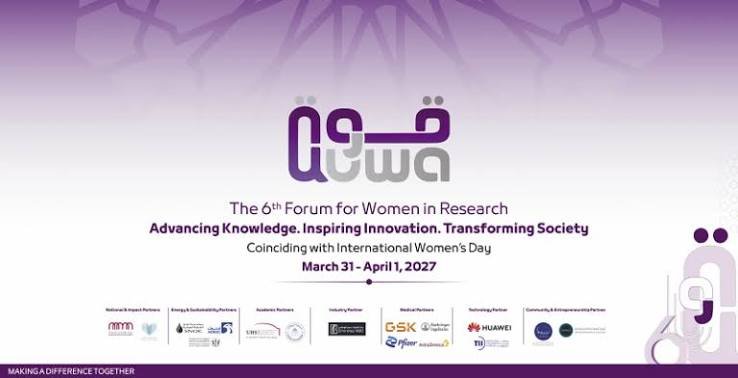
QUWA Research Grants 2027 for Women Researchers
Applications are open for the QUWA Research Grants 2027, a research funding opportunity supporting women researchers developing innovative projects that address important scientific and societal challenges. The grants are offered through the QUWA initiative of the University of Sharjah and its Forum for Women in Research, which brings together researchers, innovators, policymakers, industry partners and other stakeholders to promote research excellence and practical impact. The QUWA Research Grants are designed to help women researchers advance promising research projects, strengthen collaboration and translate innovative ideas into meaningful outcomes. The programme supports research across science, technology, health, engineering, humanities and social sciences, as well as several specialised sponsor supported research tracks. For 2027, the research categories include health and biomedical disciplines, technology and digital innovation, computing, engineering and sciences, humanities and social sciences, women’s studies and research focused on Palestine. Individual project grants range from AED 10,000 to AED 25,000, depending on the category and sponsor supported track. About the Opportunity The QUWA Research Grants are part of the University of Sharjah’s Forum for Women in Research, an international initiative focused on empowering women researchers and promoting collaboration across academia, industry, government and society. The sixth Forum for Women in Research is scheduled for March 31 to April 1, 2027, at the University of Sharjah and University of Khorfakkan. The Forum provides a platform for researchers to exchange knowledge, showcase research and develop collaborations addressing global and regional challenges. The research grants support projects that demonstrate strong scientific quality while also showing potential for community impact, originality and collaboration with industry or relevant partners. Opportunity Benefits • Research funding ranging from AED 10,000 to AED 25,000 per project • Financial support for innovative research projects • Opportunity to advance research addressing scientific and societal challenges • Opportunity to strengthen research collaboration • Platform to showcase innovative research through the QUWA Forum • Potential for research outcomes to contribute to community and societal development • Opportunities for knowledge exchange with researchers and other stakeholders Programme Areas Category 1: Health and Biomedical Research • Bioinformatics • Biomedical Engineering • Dentistry • Health Sciences and Digital Health • Medicine • Pharmacy Category 2: Emirates NBD Special Track in Technology • Artificial Intelligence and Agentic Banking Innovation • Blockchain and Digital Assets • Sustainability and Inclusive Finance • Operational Resilience and Cybersecurity Category 3: Computing, Engineering and Sciences • Computing and Informatics • Engineering • Sciences Category 4: NAMA Special Tracks in Humanities and Social Sciences • Gender Mainstreaming in Public Policies and Services • Legal and Institutional Responses to Life Transitions Affecting Women’s Economic Security • Measuring the Impact of Women’s Leadership Policies and Initiatives • Women’s Social Status in the UAE • Health Challenges and Quality of Life Among Aging Women Category 5: H.H. Shaikha Jawaher Center for Palestinian Studies • Women’s Studies in Palestine These categories provide opportunities for researchers working across a broad range of disciplines, from health and artificial intelligence to public policy, women’s economic security, social development and Palestinian women’s studies. Eligibility Criteria • The Principal Investigator must be a female researcher. • The Principal Investigator must be affiliated with a university. • Eligible university researchers include faculty members, postdoctoral fellows, MSc or PhD students and research assistants. • Research teams may include male collaborators or researchers. • Each applicant may submit only one research study as the Principal Investigator. • The proposed research must not have been published before the Forum. • The proposed project should fit one of the available QUWA research categories or special tracks. Required Application Information Applicants should prepare information that clearly presents their proposed research and demonstrates its relevance to the selected QUWA category. • Research study or project proposal • Research objectives and expected contribution • Research approach and methodology • Information about the Principal Investigator • University affiliation • Details of research team members and collaborators where applicable • Information demonstrating the novelty and potential impact of the research • Relevant industry or institutional partnership information where applicable Applicants should follow the official application portal for the exact information and documents requested in the 2027 application form. How to Apply Review the QUWA Research Grants 2027 categories and identify the research track that best matches your proposed project. Confirm that you meet the eligibility requirements as a female university researcher and Principal Investigator. Develop a research proposal addressing a relevant scientific or societal challenge. Ensure that the proposed research demonstrates scientific rigor, novelty and potential community impact. Include relevant information about your university affiliation, research team and potential industry partnerships where applicable. Complete the online QUWA Research Grants application through the official application portal. Review the application carefully and ensure that only one research study is submitted under your name as Principal Investigator. Submit the completed application before the October 15, 2026 deadline.