

Applications are open for the Oklahoma City Zoo & Botanical Garden Conservation Action Now Grants 2026, a small grant opportunity supporting early career professionals working to conserve imperiled species and habitats. The programme is designed to support practical conservation through research, education and species preservation. In 2026, the Conservation Action Now programme is specifically supporting projects involving the research and conservation of invertebrates. The grants are intended for early career professionals whose work can contribute to the protection of imperiled invertebrate species or their habitats. The Oklahoma City Zoo & Botanical Garden operates the Conservation Action Now programme as part of its broader commitment to supporting conservation efforts around the world. The Zoo states that its CAN grants support researchers working on imperiled species, habitats and surrounding communities through species preservation, research and education. Successful applicants can receive a competitive small grant of up to $2,500. Projects will be assessed on the merit of the proposal and their contribution to conservation education, scientific research or species preservation. About the Conservation Action Now Grants The Conservation Action Now Grants are designed to provide targeted financial support for conservation initiatives addressing threats to imperiled wildlife and habitats. The programme has previously supported projects involving species and ecosystems in different parts of the world, demonstrating its international conservation focus. For the 2026 funding cycle, the programme is focused exclusively on invertebrates. Proposed activities should contribute directly to the conservation of invertebrate species or their habitats. Projects may fall under one or more of three main purposes: • Conservation education that builds awareness of a conservation programme capable of creating positive change for invertebrates or their habitats • Scientific research conducted in situ or ex situ that has a direct impact on the conservation of an imperiled invertebrate species or its habitat in its native location • Species preservation involving direct care or work with an imperiled invertebrate species that improves the ability to preserve the species in its native habitat Grant Benefits • Competitive grant of up to $2,500 • Financial support for eligible invertebrate conservation projects • Support for conservation education activities • Support for scientific research • Support for species preservation initiatives • Opportunity to contribute to international wildlife conservation • Recognition through association with the Oklahoma City Zoo conservation programme Programme Areas The 2026 Conservation Action Now Grants support projects in the following areas: Conservation Education Projects that increase awareness and understanding of conservation programmes capable of benefiting invertebrate species or their habitats. Scientific Research Research conducted in natural settings or controlled environments that directly contributes to the conservation of imperiled invertebrate species or their native habitats. Species Preservation Practical work involving an imperiled invertebrate species that improves conservation and preservation efforts in its native environment. Eligibility Criteria Applicants must meet the programme’s early career requirement. • Currently enrolled in a graduate programme such as an MSc, PhD or DVM • Or awarded a graduate degree no earlier than 2021 • Project must involve the research and or conservation of invertebrates • Proposed activities must contribute to conservation of an imperiled invertebrate species or habitat • Individuals and institutions or organisations may apply • Previous applicants may reapply annually after submitting a required project update • Previous funding does not guarantee additional funding The programme is open to early career professionals working on relevant conservation activities. The published call does not restrict eligibility to a particular nationality or country. Required Application Materials Applicants should prepare: • Completed Conservation Action Now application form • Letter of commitment • Application documents submitted in PDF format • Project information demonstrating the conservation value of the proposed work Applicants should ensure that all required documents are complete before submission. The Zoo advises applicants to submit before the deadline because late applications will not be considered. Applicants should receive a confirmation email within 48 hours after the application has been received. Funding Restrictions Applicants should take the programme’s funding conditions into account when developing their budgets. • Salaries are generally not eligible, except for locally hired support staff • No more than 20 percent of awarded funds may be used for travel expenses • Funds cannot be used for indirect costs • Funds cannot be used for direct mail solicitations • Funds cannot be used for reimbursement of funds or annual campaigns • Grant checks are not made payable directly to individuals • The Oklahoma City Zoo must be recognised in project publications • A copy of relevant publications must be submitted to the Zoo The Zoo also requires a project update within one year after funds are distributed and a final report when the project is completed. Selection Criteria Applications are evaluated based on the merit of the proposed project and its alignment with the Conservation Action Now programme objectives. Projects should demonstrate: • Clear relevance to invertebrate conservation • A meaningful conservation objective • Strong scientific or practical justification • Potential contribution to conservation education, scientific research or species preservation • A clear connection between the proposed activities and conservation outcomes The strongest proposals should clearly explain the conservation problem being addressed, the proposed approach and how the work can contribute to the protection of an imperiled species or habitat. How to Apply Review the 2026 Conservation Action Now Grant requirements and confirm that your project focuses on invertebrate research or conservation. Confirm that you meet the early career eligibility requirement by being enrolled in a graduate programme or having received a graduate degree in 2021 or later. Develop a clear project proposal addressing conservation education, scientific research or species preservation. Complete the official Conservation Action Now application form. Prepare the required letter of commitment. Save the completed application materials in PDF format. Upload the completed application and letter of commitment through the Oklahoma City Zoo application system. Submit the application no later than 11:59 PM CST on November 13, 2026. Keep the submission confirmation email for your records.

AHRC Doctoral Landscape Award at the University of Sheffield 2027/2028
Applications are open for the AHRC Doctoral Landscape Award at the University of Sheffield for the 2027/2028 academic year. The award is funded through the Arts and Humanities Research Council and supports postgraduate researchers undertaking doctoral study within the Faculty of Arts and Humanities at the University of Sheffield. The University of Sheffield’s Doctoral Landscape Award is associated with the AHRC North and Northwest Hub, which brings together the University of Sheffield and nine other regional universities. The wider Doctoral Landscape Award programme is part of UK Research and Innovation’s investment in postgraduate research training and aims to strengthen the breadth of research skills and doctoral activity across the United Kingdom. For the 2027/2028 intake, the University of Sheffield will support four full PhD studentships. Up to one studentship may be allocated to an outstanding international candidate, meaning overseas applicants are eligible to apply but should be aware that competition for the international place is expected to be particularly strong. About the Opportunity The AHRC Doctoral Landscape Award provides funded doctoral study for researchers whose proposed PhD projects fall within the scope of the Faculty of Arts and Humanities. Students selected through the award will join the AHRC North and Northwest Hub cohort and are expected to participate fully in cohort training and related activities. The programme provides an opportunity to undertake advanced doctoral research while developing wider research, professional and transferable skills through the doctoral training environment. The University of Sheffield is home to more than 200 PhD researchers within its Faculty of Arts and Humanities, alongside numerous research centres bringing together academic staff, postgraduate researchers, early career researchers and external stakeholders. Opportunity Benefits • Three and a half years of PhD funding • Maintenance stipend at the UKRI rate • Current stipend of £21,805 for the 2026/2027 academic year • Tuition fees covered at the applicable Home or International rate • Part time study supported on a proportional basis • Membership of the AHRC North and Northwest Hub doctoral cohort • Access to cohort training and development activities • Opportunity to conduct doctoral research within the University of Sheffield Faculty of Arts and Humanities • Access to Sheffield’s wider doctoral research environment and research centres Programme Areas Applicants may propose research within the Faculty of Arts and Humanities, including areas represented by: • English • History • Philosophy • Digital Humanities • Languages • Arts • Societies • Law • Interdisciplinary research within the Faculty of Arts and Humanities Applicants should ensure that their proposed research is appropriate for the relevant academic school and that suitable supervisory expertise is available at the University of Sheffield. Eligibility Criteria • Applicants must be seeking admission to a PhD at the University of Sheffield within the Faculty of Arts and Humanities. • Applicants must not already be enrolled on a PhD. • Applicants should have a research proposal suitable for doctoral study within the Faculty. • International applicants are eligible to apply. • Up to one of the four annual studentships may be allocated to an outstanding international candidate. • International applicants should be aware that competition for the available international place may be particularly strong. • Applicants must complete the required PhD study application before submitting the funding application. The University of Sheffield specifically states that the award is not open to candidates who are already enrolled on a PhD. Required Application Materials The application process consists of two stages. • PhD study application submitted through the University of Sheffield online application portal • PhD research proposal and other materials required for admission to the relevant programme • University of Sheffield study application number • Funding application submitted through the dedicated funding form • Information requested within the funding application Applicants should prepare their funding responses before starting the funding form because the University states that the funding application must be completed in one sitting. How to Apply Identify a suitable PhD programme within the University of Sheffield Faculty of Arts and Humanities. Develop a strong doctoral research proposal that fits the academic area and available supervisory expertise. Contact the relevant academic department or prospective supervisor where appropriate to discuss your proposed research. The University recommends prospective students engage with the relevant academic staff before beginning their application. Submit your PhD study application through the University of Sheffield online application portal by December 14, 2026. Obtain your University of Sheffield application number after submitting the study application. Prepare your answers for the AHRC Doctoral Landscape Award funding application. Submit the funding application using the dedicated University funding form by 5 PM GMT on February 19, 2027. Ensure that all information is accurate and that the funding application is completed in one sitting. Monitor your email for further communication regarding academic assessment, nomination and the final selection process.

Mastercard Foundation Scholars Program at the University of Rwanda 2026/2027
The Mastercard Foundation Scholars Program at the University of Rwanda is now accepting applications for its 2026/2027 undergraduate scholarship intake. The program is implemented in partnership with the University of Rwanda and supports academically talented young people who face significant social or economic barriers to accessing higher education. For the 2026/2027 academic year, the program is recruiting its fifth undergraduate cohort and will offer 170 scholarships across selected programs at the University of Rwanda. The scholarship is designed to provide comprehensive financial support while also helping scholars develop academically, professionally and personally. The program particularly seeks to support young Africans with limited access to educational opportunities, with a strong focus on women pursuing Science, Technology, Engineering and Mathematics fields, young people with disabilities, refugees and displaced youth. Scholars are also expected to demonstrate leadership potential and a commitment to community engagement. About the Opportunity The Mastercard Foundation Scholars Program at the University of Rwanda is part of the Mastercard Foundation’s broader effort to expand access to quality higher education and support the development of Africa’s next generation of transformative leaders. The 2026/2027 undergraduate intake provides 170 scholarships across selected programs offered through seven University of Rwanda colleges and several campuses. The participating colleges include the College of Science and Technology, College of Medicine and Health Sciences, College of Agriculture, Forestry and Food Sciences, College of Business and Economics, College of Education, College of Arts and Social Sciences, and College of Veterinary Medicine and Animal Sciences. The scholarship supports students throughout their university experience and places emphasis on academic success, leadership, community service and preparation for dignified work. The program also encourages scholars to use their education and skills to contribute to their communities through its “Go Back, Give Back” approach. Opportunity Benefits • Full tuition fees • Fully paid on campus accommodation • Laptop • Learning materials • Full year monthly stipend • Annual return ticket allowance • Psychosocial support services • Academic mentorship • Virtual learning and tutoring support • Career guidance and professional development • Industrial mentorship • Internship opportunities with industry partners • Leadership development opportunities • Participation in leadership congresses • Community service opportunities • Mentoring through the “Go Back, Give Back” initiative • Membership of the Mastercard Foundation Scholars alumni network • Connection to the Global Scholars Community Programme Areas The 170 scholarships are distributed across selected undergraduate programs in the following areas: • Civil Engineering • Electrical Power Engineering • Electronics and Telecommunication Engineering • Transportation Engineering • Architecture • Environmental Planning and Management • Urban and Regional Planning • Biochemistry • Applied Mathematics • Applied Physics • Statistics • Computer Engineering • Information Technology • Information Systems • Mining Engineering • Economics • Transport and Logistics Management • Business Information Technology • Accounting and Finance • Medicine • Pharmacy • Clinical Psychology • Dental Therapy • Anesthesia • Midwifery • Nursing • Creative and Performing Arts • English and African Languages • Law • Social Work • Crop Production • Food Science and Technology • Horticulture • Aquaculture and Fisheries Management • Animal Production • Veterinary Medicine • Computer Science • Science Education • Special Needs Education • Early Childhood Education The 2026/2027 call allocates scholarships across six campuses and seven colleges, with the largest allocation going to selected programs within the College of Medicine and Health Sciences. Eligibility Criteria • Be a citizen of Rwanda or another African country, or be a refugee or displaced young person in Africa. • Be academically qualified for an eligible undergraduate program at the University of Rwanda. • Demonstrate significant social or economic need and or disability. • Be no older than 28 years at the time of application. • Applicants with certified evidence of a protracted life condition may be up to 30 years old. • Meet the University of Rwanda admission requirements for the selected program. • Have a University of Rwanda reference number and complete the required admission process. • Demonstrate leadership potential. • Provide evidence of community engagement, service or transformation initiatives. • Demonstrate commitment to giving back to the community. • Refugees and applicants with disabilities must provide appropriate legal documentation confirming their status. • Continuing students are not eligible for this intake. Applicants are assessed using three main considerations: Academic Talent, Economic Disadvantage and Leadership Potential. The current recruitment system assigns respective weights of 30 percent, 45 percent and 25 percent to these areas. Required Application Materials • University of Rwanda student or reference number • Digital passport photograph with a white background • Scanned National ID showing date of birth • Passport for international applicants where applicable • Refugee ID or supporting refugee documentation where applicable • Disability certificate where applicable • Leadership certificates where available • Information relating to educational background • Family and socioeconomic information • Leadership and community engagement information Applicants are advised to prepare clear copies of their supporting documents before beginning the online application. The current undergraduate recruitment portal accepts PDF, JPG or PNG files of up to 5 MB for the listed documents. Selection Criteria Selection for the Mastercard Foundation Scholars Program considers: • Academic talent and readiness for university study • Economic disadvantage and limited access to educational opportunities • Leadership potential • Community engagement and service • Commitment to contributing to community transformation • Eligibility for an approved University of Rwanda program How to Apply Review the eligible undergraduate programs offered under the Mastercard Foundation Scholars Program and identify a program for which you meet the University of Rwanda admission requirements. Apply for admission to the University of Rwanda and obtain your University reference number. Prepare the required identification, educational, leadership and supporting documents. Visit the official Mastercard Foundation Scholars Program undergraduate recruitment portal. Create or verify your account using your University of Rwanda student number. Complete the online scholarship form, including the identification, education, family, socioeconomic and leadership sections. Upload the required supporting documents in the specified formats. Carefully review all information and attachments before submitting the application. Submit

Liftoff Founders Week 2026
Applications are open for the Liftoff Founders Week 2026, an intensive five day programme in London designed for founders, research leads and operators interested in building new organisations and projects in the field of artificial intelligence safety. The programme brings together at least 30 founders, researchers, operators and funders for an intensive period of idea development, team formation and project planning. Liftoff Founders Week is connected to Project Tailwind, an initiative supported by Coefficient Giving that seeks ambitious new projects addressing important artificial intelligence safety problems that may currently lack dedicated organisations or teams. Project Tailwind offers pre seed grants ranging from $200,000 to $2 million, creating a potential funding pathway for promising ideas developed through the programme. The five day experience gives participants the opportunity to explore an idea, connect with potential co founders, receive feedback from experienced people in the field and discuss their projects directly with funders. Applicants do not need to have a finished idea or an existing co founder before applying. Participants may develop an idea individually or form a team of between two and four people during the programme. About the Opportunity Liftoff Founders Week is designed to help experienced individuals move from an existing track record in artificial intelligence safety or a related area toward launching a new project or organisation. During the week, participants work alongside other founders, research leads and operators while exploring problems that could benefit from new organisations or initiatives. The programme provides structured opportunities to test ideas, receive feedback and identify complementary skills among other participants. The programme is particularly relevant to people who have experience in research, policy, fieldbuilding, operations, communications or entrepreneurship and who are interested in starting something new rather than simply joining an existing organisation. Participants will also have opportunities to interact with grantmakers and receive feedback on their project proposals. Funding applications submitted through the programme are expected to receive a response within two weeks after Liftoff. Opportunity Benefits • £1,000 stipend for participants • Travel costs to London covered • Hotel accommodation covered for the programme week • Five days of intensive project development in London • Opportunities to meet potential co founders • Possibility to form founding teams of two to four people • Access to experienced founders, researchers and grantmakers • Office hours and feedback on project ideas • Opportunities to pitch ideas directly to funders • Funding consideration through Project Tailwind • Up to four weeks of additional support for promising teams • Support from LISA with preparing a full funding proposal • Professional network of founders, researchers and funders working in artificial intelligence safety • A clearer plan for what to build after the programme Programme Areas Liftoff Founders Week focuses on opportunities connected to artificial intelligence safety and related areas where new organisations or projects could address important gaps. Relevant areas include: • Artificial intelligence safety research • Artificial intelligence policy • AI safety fieldbuilding • Research organisations and initiatives • Operations for new organisations • Communications and community building • New products and programmes addressing AI safety challenges • Other emerging areas aligned with Project Tailwind The programme is particularly interested in applicants who can identify an important problem and explain why a new organisation, programme or research effort is needed. Eligibility Criteria • Founders who have previously built or run an organisation, programme or product • Research leads with a track record in artificial intelligence safety or a related field • Operators with strong skills in areas such as operations, communications or fieldbuilding • Applicants with experience in AI safety, research, policy or related fields • Applicants who have started or led an organisation, programme, product or research agenda • Applicants who can demonstrate meaningful work or achievements in a relevant area • Applicants who can clearly explain why they want to build something new • Applicants who do not yet have a finished idea may apply • Applicants do not need to have a co founder before applying • International applicants are welcome Required Application Information • Information about previous work and experience • Details about the applicant’s background and track record • Identification of the applicant category, such as founder, research lead or operator • Information about organisations, programmes, products or research initiatives previously built or led • Relevant experience in artificial intelligence safety or related fields • An explanation of the applicant’s motivation for starting something new • Indication of the Project Tailwind directions that interest the applicant most • Any other information requested through the official application form How to Apply Review the Liftoff Founders Week programme and Project Tailwind focus areas carefully. Assess your experience in artificial intelligence safety, research, policy, fieldbuilding, entrepreneurship, operations or related areas. Identify the applicant profile that best describes your experience as a founder, research lead or operator. Prepare information about organisations, programmes, products or research projects that you have built, led or contributed significantly to. Consider which Project Tailwind directions are most relevant to your interests and experience. Explain clearly why you want to start something new rather than join an existing organisation. Complete the Liftoff Founders Week application form. Submit the application before the deadline of 12 October 2026. If shortlisted, participate in the interview process scheduled between 12 and 15 October 2026. If selected, make arrangements to attend the five day programme in London from 9 to 13 November 2026.
University of California President’s Postdoctoral Fellowship Program 2026/2027
Applications are open for the University of California President’s Postdoctoral Fellowship Program 2026/2027. The programme offers postdoctoral research fellowships, professional development, faculty mentoring and academic networking opportunities to outstanding scholars across all fields whose research, teaching and service can contribute to the research excellence and public service mission of the University of California. The fellowship is designed to give scholars focused time to establish an independent research programme while preparing for academic careers and future faculty positions. Approximately 30 postdoctoral fellowships are awarded each year across the University of California system, with research conducted under the sponsorship of faculty at one of the ten UC campuses. The programme is open to scholars holding terminal degrees in their disciplines. Applicants are particularly encouraged where their research introduces new areas of inquiry, applies innovative approaches to existing fields, brings perspectives not currently represented within the relevant UC department, or is informed by life experiences and educational backgrounds that could broaden perspectives within the university. About the Fellowship The University of California President’s Postdoctoral Fellowship Program is intended for scholars pursuing postdoctoral research under the guidance of UC faculty. The programme supports researchers across disciplines and provides an environment where fellows can develop their research agenda, strengthen their academic profile and prepare for careers in higher education. Each fellowship award is for a 12 month period beginning July 1. A renewal for an additional term may be granted based on academic productivity and participation in programme activities. Fellows are expected to reside at their appointment campus, focus full time on research, meet regularly with their faculty mentor and participate in professional development activities such as the Fall Meeting and Spring Academic Retreat. Applicants must secure sponsorship from a tenured faculty member who will serve as their primary mentor. The mentor is expected to support the fellow’s research development, academic integration, professional networking and preparation for future faculty opportunities. Fellowship Benefits • Annual salary of $69,073 • $5,000 for research expenses and professional development • Health insurance benefits • Vision insurance benefits • Dental insurance benefits • Paid sick leave • Family and medical leave • Four weeks of paid time off during the fellowship term • Full time focused research opportunity • Faculty mentorship from a tenured UC professor • Professional development activities • Academic networking opportunities • Opportunity to establish an independent research programme • Participation in the academic life of a University of California campus Research Areas The fellowship is open across disciplines. Proposed research may include new areas of inquiry or innovative approaches to established fields. Applicants may propose research in areas including: • Humanities • Social sciences • Natural sciences • Engineering • Health and medical sciences • Education • Arts and creative disciplines • Interdisciplinary research • Other academic fields with recognised terminal degrees Eligibility Criteria • Applicants must hold or receive a PhD or another recognised terminal degree in their discipline before the fellowship begins. • Eligible terminal degrees may include PhD, JD, MD, MFA, DVM, EdD and other equivalent professional or academic degrees. • The degree must be awarded by an accredited university. • Applicants must be interested in conducting postdoctoral research at a University of California campus. • Applicants should be pursuing an academic career and demonstrate potential for a future faculty career. • Applicants must secure sponsorship from a tenured UC faculty member other than their PhD dissertation advisor. • Successful applicants must provide documentation demonstrating legal authorization to work in the United States. • Visa sponsorship and work authorization may be possible for successful international applicants through the appropriate UC process. • Applicants should demonstrate strong academic accomplishments and research potential. • Applicants should be prepared to explain how their research and experiences can contribute to the research excellence and public service mission of the University of California. • Applicants with significant United States public service experience may address this experience in their application. Required Application Materials • One page PhD thesis abstract • 700 to 1,000 word research proposal • 300 to 700 word Education and Background Statement • Curriculum vitae • One publication or unpublished research paper of no more than 35 pages • Contact information for the PhD thesis advisor reference • Contact information for the confirmed UC faculty mentor or sponsor • Letter of support from the confirmed faculty mentor or sponsor • Optional second reference • Optional secondary co mentor information • Academic information including PhD completion date, degree institution, discipline and proposed research area All application documents must be prepared in PDF format for submission through the online application portal. Selection Criteria Applications are reviewed by faculty members in the applicant’s field and related disciplines. Reviewers consider academic accomplishments, the strength and significance of the proposed research and the applicant’s potential for an impactful faculty career. The selection process may consider: • Academic accomplishments • Strength and significance of the research proposal • Outstanding research achievements • Development of new areas of inquiry • Innovative approaches to existing research fields • Potential contribution to UC research excellence and public service • Relevant leadership and public service experience • Individual experiences that inform the applicant’s potential contribution • Strength of the proposed faculty mentorship • Mentor commitment to supporting the applicant’s academic development How to Apply Review the University of California President’s Postdoctoral Fellowship requirements and confirm that you hold or will receive an eligible terminal degree before the fellowship begins. Identify a suitable UC tenured faculty member whose research aligns with your proposed project. Contact the potential faculty mentor and secure sponsorship for the fellowship application. The primary mentor must be a tenured faculty member other than your PhD dissertation advisor. Develop a clear research proposal of 700 to 1,000 words explaining the proposed research, its significance and its contribution to the relevant discipline. Prepare the one page PhD thesis abstract and the Education and Background Statement. Update your curriculum vitae and select a suitable publication or research paper for the writing sample. Provide the required
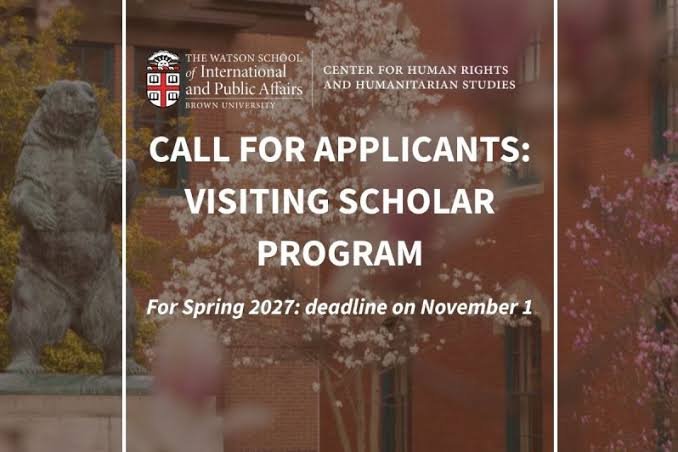
Center for Human Rights and Humanitarian Studies Visiting Scholar Program Spring 2027
The Center for Human Rights and Humanitarian Studies at the Watson School of International and Public Affairs at Brown University is inviting applications for its Visiting Scholar Program for Spring 2027. The program provides a short term academic affiliation for scholars and human rights practitioners who want to pursue their own research and writing while engaging with the intellectual community at Brown University. The program is designed for academics on sabbatical as well as human rights practitioners whose research or professional work would benefit from time at the Center. For Spring and Fall 2027, the Center is particularly interested in researchers and practitioners working on asylum and immigration rights, environmental justice, and environmental rights. Applicants working in other areas of human rights and humanitarian studies are also welcome to apply. Visiting Scholars are expected to dedicate their time primarily to their own research projects. They may also participate in the intellectual life of the Center through activities such as public presentations or workshops related to their work. The program therefore provides an opportunity to develop research while connecting with scholars, practitioners, and the wider Brown University community. About the Opportunity The Center for Human Rights and Humanitarian Studies Visiting Scholar Program is hosted by Brown University and provides selected scholars with a short term affiliation with CHRHS. The program is intended for individuals who already have a defined research project and can explain why conducting the work in person at Brown University is necessary. The Center promotes research and understanding of global human rights and humanitarian challenges. Visiting Scholars become part of its intellectual community while maintaining a primary focus on their proposed research or writing project. Appointments are available during the academic year from September 1 through May 30. For the Spring 2027 cycle, applicants should propose a suitable period for their visit within the available academic year. International applicants should note that they may need an exchange visitor J 1 visa to enter the United States. Applicants are responsible for making appropriate arrangements for their visit. Opportunity Benefits • Short term affiliation with the Center for Human Rights and Humanitarian Studies at Brown University • Opportunity to conduct research in person at Brown University • Engagement with the CHRHS intellectual community • Opportunity to give a public presentation or workshop on research or professional work • Academic and professional networking with researchers and practitioners • Opportunity to develop research and writing projects in a university environment • Potential access to limited shared office space, subject to availability • Opportunity to strengthen research connections in human rights and humanitarian studies Programme Areas The Center is particularly interested in applicants working on: • Asylum and immigration rights • Environmental justice • Environmental rights • Human rights • Humanitarian studies Applicants working on other relevant areas within human rights and humanitarian studies are also encouraged to apply. Eligibility Criteria • Open to academics on sabbatical • Open to human rights practitioners • Open to applicants based in the United States • Open to international scholars and human rights practitioners • Applicants should have a clearly defined research or writing project • Applicants should be able to explain the need to pursue their project in person at Brown University • Applicants should demonstrate qualifications relevant to their proposed research • Applicants should identify a regular Brown University faculty member who can sponsor and supervise the visit if selected • International applicants should be prepared to obtain an exchange visitor J 1 visa if required • Appointments must be for at least one month and no longer than one semester Required Application Materials • Cover letter indicating the preferred timing of the appointment • Short description and title of the proposed research project • Explanation of why the project needs to be pursued in person at Brown University • Research proposal of no more than three pages • Explanation of how the research fits with the Center’s thematic priorities • Evidence of qualifications relevant to the proposed research • Curriculum vitae • Names and contact information for two references • Letter of endorsement from a regular Brown University faculty member who would sponsor and supervise the visit Letters of reference from the two listed references are not required at the application stage. Selection Criteria Applications are expected to demonstrate the quality and relevance of the proposed research project, the applicant’s qualifications, and the connection between the project and the work of the Center. Applicants should clearly explain why the research requires an in person period at Brown University. The strength of the proposed project, its connection to human rights and humanitarian studies, and the applicant’s ability to make productive use of the visiting scholar affiliation will be important considerations. A Brown University faculty endorsement and sponsorship is also required. How to Apply Review the Visiting Scholar Program requirements and confirm that your research or professional work fits within human rights and humanitarian studies. Develop a clearly defined research project that can benefit from an in person affiliation with Brown University. Prepare a cover letter stating your preferred appointment period, proposed project title, project description, and reason the research needs to be conducted in person at Brown. Prepare a research proposal of no more than three pages, including the project’s connection to the Center’s thematic priorities and your relevant qualifications. Prepare your curriculum vitae and the contact details of two references. Secure a letter of endorsement from a regular Brown University faculty member who is willing to sponsor and supervise the proposed visit. Submit all required materials through the official application form before November 1, 2026. The Center for Human Rights and Humanitarian Studies Visiting Scholar Program offers academics and human rights practitioners an opportunity to spend a dedicated period at Brown University developing their own research while participating in a wider intellectual community. Applicants should carefully plan for their own financial support because the visiting scholar affiliation does not include salary, benefits, or other compensation.
European Winter School for Women 2027
The European Winter School for Women in the Study of Work and Employment Relations 2027 is inviting applications from women and non binary early career researchers based in Europe whose research focuses on work, labour and employment relations. The three day academic programme will take place from March 8 to 10, 2027, at the University of Bremen in Germany. The Winter School is designed to provide an engaging academic environment where emerging researchers can develop their research, receive detailed feedback from senior scholars, build professional networks and discuss academic career development. Between 12 and 15 participants will be selected through a competitive application process. The programme welcomes researchers from a range of academic backgrounds, including sociology, political science, European studies, labour studies, industrial relations, economics, psychology, gender studies and related disciplines. Doctoral researchers and early career scholars are encouraged to apply, including postdoctoral researchers who completed their PhD within the previous five years. There is no registration fee for selected participants. Those whose home institutions are unable to provide financial support may also receive full support for travel and accommodation. Applicants requesting financial assistance must explain their funding situation and provide estimated travel and accommodation costs as part of their application. About the European Winter School The European Winter School aims to strengthen and highlight the perspectives of women and non binary researchers studying work and employment relations. The field brings together different academic traditions to examine how work is organised, governed, experienced and contested across different social, economic and historical settings. The Winter School provides an opportunity for researchers to exchange experiences, develop their research and establish connections with scholars working across Europe. A central component of the programme will be paper development sessions. Participants will work with senior faculty and other researchers to develop papers they wish to advance during the Winter School. The programme will also address wider questions surrounding research careers, grant applications and professional development. The 2027 Winter School will be hosted by the Institute Labor and Economy at the University of Bremen, with participation from senior researchers and academics from institutions across Europe. Opportunity Benefits • No registration fee • Full travel support for selected participants without institutional funding • Full accommodation support for selected participants without institutional funding • Paper development sessions with senior scholars • Detailed academic feedback on research papers • Keynote discussions on current debates in work and employment relations • Grant writing roundtables • Academic career development discussions • Networking with researchers and senior academics across Europe • Engagement with social partners • Opportunities to develop longer term academic connections Programme Areas The Winter School covers research and academic development related to: • Work and employment relations • Labour studies • Industrial relations • Sociology • Political science • European studies • Economics • Psychology • Gender studies • Related research fields examining work and employment Eligibility Criteria • Applicants must be women or non binary scholars • Applicants must be based in Europe • Applicants must conduct research related to work, labour or employment relations • Doctoral researchers are eligible • Early career researchers are eligible • Postdoctoral researchers who completed their PhD within the previous five years may apply • Applicants should demonstrate a clear connection between their research and the study of work and employment relations • Applications must be submitted in English Required Application Materials • Extended abstract of the paper to be developed during the Winter School, maximum three pages • Academic CV, maximum two pages • Motivation letter, one page • Estimated travel costs if financial support is requested • Estimated accommodation costs if financial support is requested • Information about financial support available from the applicant’s home institution • Overview of estimated funding needs in tabular form where financial assistance is requested Selected participants will also be expected to submit a full paper draft by January 15, 2027 for development during the Winter School. Selection Criteria Applications will be assessed through a competitive selection process. The organisers will consider the relevance of the applicant’s research to the study of work and employment relations, the quality and potential of the proposed paper and the applicant’s motivation for participating in the Winter School. Only 12 to 15 places are expected to be available, making the preparation of a focused research abstract and clear motivation important parts of the application. How to Apply Review the eligibility requirements and confirm that your research is connected to work, labour or employment relations. Prepare an extended abstract of the paper you would like to develop during the Winter School. The abstract must not exceed three pages. Prepare an academic CV of no more than two pages. Write a one page motivation letter explaining your interest in the Winter School and how participation would support your academic development. If you require financial assistance, provide details of your available institutional funding and estimated travel and accommodation costs. Include an overview of your estimated funding needs in the required format. Submit the complete application in English by email before the October 15, 2026 deadline. If selected, prepare and submit your full paper draft by January 15, 2027 ahead of the March Winter School Applications should be submitted by email to wwswork@uni-bremen.de
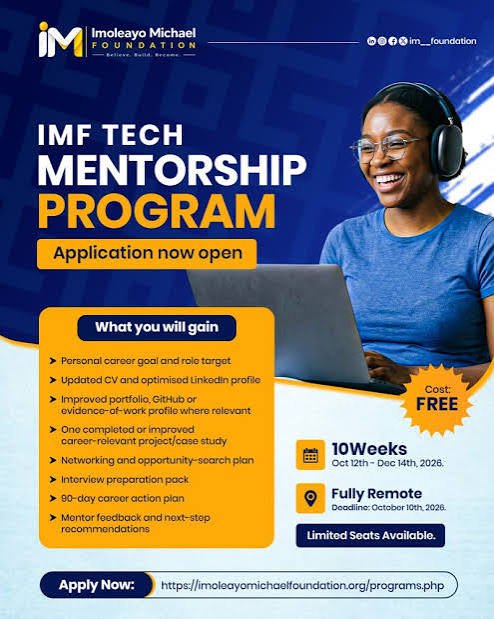
IMF Tech Mentorship Programme 2026
The Imoleayo Michael Foundation is inviting applications for the IMF Tech Mentorship Programme 2026, a free, fully remote mentorship opportunity designed for aspiring technology professionals in Nigeria. The programme is intended to help participants gain clearer career direction, strengthen their professional profiles, develop practical evidence of their skills and prepare for opportunities in the technology industry. The mentorship programme will run for 10 weeks from October 12 to December 14, 2026. It is designed for people who have already started their technology journey, including those currently learning a digital skill, recently completing relevant training, transitioning into technology or working within their first two years of a technology career. Rather than focusing only on technical learning, the programme addresses several areas that can help participants move from learning technology skills to building a career around those skills. Participants will receive mentorship, structured guidance, practical assignments and feedback while developing career materials and an action plan for their next steps. About the Mentorship Programme The IMF Tech Mentorship Programme is an initiative of the Imoleayo Michael Foundation, an organisation focused on providing young Africans with mentorship, skills, guidance and access to opportunities. The programme is designed for aspiring technology professionals who may have completed courses or begun developing technical skills but need additional support to determine how to apply those skills professionally. Through the 10 week programme, participants will work on career planning, professional branding, portfolio development, practical projects, networking and interview preparation. Mentors will provide feedback and recommendations throughout the process. The programme is fully remote, meaning participants can take part online without relocating. Applicants will need reliable internet access and a suitable device and must be able to commit to the complete programme. Programme Benefits • Free participation with no programme fee • Fully remote learning and mentorship • Direct mentor feedback and professional guidance • Clear career goal and target role development • CV improvement and professional profile support • LinkedIn profile optimisation • Portfolio, GitHub or evidence of work development • Career relevant project or case study development • Networking strategy and professional connection guidance • Interview preparation support • Structured 90 day career action plan • Accountability throughout the mentorship period Programme Areas The mentorship programme focuses on practical career development for people pursuing technology and digital careers. Key areas include: • Technology career planning • Career goal setting • Professional branding • CV development • LinkedIn optimisation • Portfolio development • GitHub and evidence of work • Practical project development • Case study development • Networking • Interview preparation • Career action planning Eligibility Criteria Applicants should meet the following requirements: • Be a Nigerian citizen or resident • Be currently learning a technology or digital skill • Have recently completed relevant technology or digital training • Be transitioning into a technology career • Be within the first two years of a technology career • Demonstrate effort, curiosity and willingness to learn • Be coachable and receptive to feedback • Have a clear reason for seeking mentorship • Have access to basic internet connectivity • Have a suitable device for participating remotely • Be able to commit to the full 10 week programme • Be willing to complete assigned activities What Participants Will Work Towards During the programme, participants will work toward developing practical career resources and strategies that can support their transition into technology employment or further professional development. Participants will identify a specific career goal and target role, review and improve their CV, and strengthen their LinkedIn profile. Depending on their technology field, they can also improve a portfolio, GitHub profile or other evidence demonstrating their capabilities. The programme also includes practical project or case study development. This gives participants an opportunity to demonstrate what they can do rather than relying only on certificates from completed courses. Participants will also develop networking strategies and prepare materials for future interviews. By the end of the mentorship, they are expected to work toward a structured 90 day career action plan outlining practical steps they can take after the programme. How to Apply Review the IMF Tech Mentorship Programme details and confirm that you meet the eligibility requirements. Consider your current technology or digital skill level and identify the career direction you want to pursue. Prepare the information required for the application, including your motivation for seeking mentorship. Complete the online application form provided by the Imoleayo Michael Foundation. Submit your application before the October 10, 2026 deadline. If selected, commit to the full programme from October 12 to December 14, 2026 and complete the assigned activities.

UNDP Technical Advisor Opportunity in South Africa 2026
The United Nations Development Programme (UNDP) is inviting applications for a Technical Advisor position based in Pretoria, South Africa. The opportunity is located within UNDP’s Regional Bureau for Africa and is open to both internal and external applicants. The position is offered at the IPSA 11 level under an International Personnel Service Agreement. It is a full time opportunity with a one year contract and is designed for an experienced development professional with expertise in strategic planning, economic transformation, development financing, sustainable energy, regional trade and related policy areas. The Technical Advisor will work under the Regional Bureau for Africa’s Strategy, Analysis and Research Team. The role involves providing evidence based technical and policy advice to countries across Africa, conducting research and analysis, supporting development planning, strengthening institutional capacity and building partnerships with governments, regional institutions, research organisations and other stakeholders. The vacancy is listed by UNDP as Job Identification 36845. About the Opportunity UNDP’s Regional Bureau for Africa supports countries across the continent in advancing national development priorities and achieving sustainable development goals. The Technical Advisor position forms part of an initiative intended to strengthen demand driven technical assistance, anticipatory analysis, policy advice and regional expertise. The successful candidate will provide technical advisory services in areas including strategic planning, structural economic transformation, public finance management, development financing, access to sustainable and affordable energy, and regional trade. The role also contributes to research, knowledge management, strategic positioning and partnership development. The Technical Advisor may represent the Regional Bureau for Africa at regional and global forums and provide briefings and evidence based recommendations to UNDP leadership and government officials. The position requires professionals who can work across interconnected development issues and contribute to multidisciplinary teams. UNDP highlights the importance of linking policy, financing, governance, climate, energy and other development priorities when supporting countries across Africa. Opportunity Benefits • Full time professional position within UNDP • One year International Personnel Service Agreement • Opportunity to contribute to development policy and programming across Africa • Exposure to regional development planning and economic transformation initiatives • Opportunity to work with governments, African regional institutions and development partners • Experience within UNDP’s Regional Bureau for Africa • Opportunities to contribute to research, policy analysis and knowledge products • Participation in relevant forums, workshops and conferences • Opportunity to strengthen regional professional networks • Contribution to capacity building and technical skills development within UNDP Country Offices Programme Areas The Technical Advisor may provide expertise across several areas: • Strategic planning and development planning • Structural economic transformation • Public finance management • Development financing • Sustainable and affordable energy • Regional trade and value chains • Policy research and analysis • Development programming • Capacity building • Strategic communications • Partnership development Key Responsibilities The Technical Advisor will provide high level policy advice by preparing practical and evidence driven analysis of complex development challenges. The role includes providing government officials with policy options and reviewing trends affecting national and regional development outcomes. The position also involves analysing economic, financial and environmental data and developing diagnostic tools to support development planning. The successful candidate may prepare technical reports on development challenges and opportunities in African countries and contribute to institutional research and Human Development Reports. Knowledge management is another important component of the role. The Technical Advisor will lead networks of regional expertise, support UNDP Country Offices and oversee the quality of knowledge products within their area of expertise. The role also involves strategic positioning and partnerships. The Technical Advisor will maintain relationships with government officials and other stakeholders, develop partnerships with research and policy institutions and participate in relevant regional and international forums. The successful candidate will also contribute to strengthening technical competencies and capacity within UNDP Country Offices. Eligibility Criteria • An advanced university degree, such as a Master’s degree or equivalent, in Business Administration, Public Administration, Economics, Political Sciences, Social Sciences or a related field • A Bachelor’s degree in a relevant field may be considered together with an additional two years of qualifying experience • A doctorate in a relevant field is preferred • At least seven years of progressively responsible professional experience with a Master’s degree • At least nine years of progressively responsible professional experience with a Bachelor’s degree • Experience in project management, coordination, capacity building or a related field • Experience working with African regional institutions such as the African Union and Regional Economic Communities • Experience working with civil society organisations and think tanks • Understanding of crosscutting development challenges affecting Africa • Experience in strategic communications and partnerships • Fluency in English • Knowledge of French or Portuguese is desirable UNDP also indicates that experience working with governments, UN agencies, NGOs, civil society organisations and international public organisations is desirable. Required Skills Applicants should demonstrate strong professional capabilities in areas relevant to the position, including: • Strategic planning • Systems thinking • Economic and policy analysis • Data analysis • Development programming • Project management • Capacity building • Partnership management • Stakeholder engagement • Strategic communications • Knowledge management • Results based management • Ability to work across multidisciplinary teams • Ability to develop evidence based policy recommendations Selection Criteria UNDP highlights several core competencies for the position, including achieving results, innovative thinking, continuous learning, adaptability, determination, partnership building and promoting diversity and inclusion. Technical competencies include systems thinking, strategic thinking, collective intelligence design, data analysis, relationship management, storytelling and results based management. Candidates should be able to demonstrate how their professional experience has enabled them to analyse complex development challenges, develop practical recommendations, work with diverse stakeholders and contribute to development programmes across Africa. How to Apply Review the official UNDP Technical Advisor vacancy and Job Identification 36845. Confirm that your academic qualifications and professional experience meet the requirements. Prepare an updated professional CV highlighting relevant experience in development policy, project management, research, economic transformation, capacity building and partnerships. Highlight your experience working with African regional institutions, governments, development organisations, civil society or research
Lee Kong Chian NUS Stanford Fellowship on Southeast Asia 2027 to 2028
The Lee Kong Chian NUS Stanford Fellowship on Southeast Asia 2027 to 2028 is now accepting applications from scholars and qualified professionals interested in conducting research and writing on contemporary Southeast Asia at Stanford University. The fellowship is hosted by the Walter H. Shorenstein Asia Pacific Research Center at Stanford University. The fellowship provides an opportunity for researchers and professionals in the social sciences and humanities to develop a substantial research project, strengthen their scholarship and engage with Stanford’s academic community. Fellows will be based on the Stanford University campus and will participate in seminars, workshops, presentations and other intellectual activities. Applicants from all nationalities and career stages are encouraged to apply. Candidates should have an ongoing professional position or background in the social sciences or humanities and a clearly defined research project focused on or significantly connected to contemporary Southeast Asia. About the Fellowship The Lee Kong Chian Fellowship is the flagship component of the Lee Kong Chian NUS Stanford Initiative on Southeast Asia, an initiative established by the National University of Singapore and Stanford University in 2007. The programme aims to advance the visibility, scope and quality of scholarship on contemporary Southeast Asia. Fellows are expected to use their time at Stanford to pursue research and writing while contributing to the university’s intellectual community. The fellowship is suitable for scholars, researchers and other qualified professionals whose work contributes to understanding contemporary Southeast Asia. Proposed projects should demonstrate a clear intellectual contribution to scholarship on the region and identify specific research and writing outcomes. Fellowship Benefits • US$8,000 monthly stipend for the duration of the fellowship • One round trip economy class airfare between the fellow’s home country and Stanford University • Two to three academic quarters of research and writing at Stanford • Access to Stanford’s academic and research community • Opportunities to present research and participate in seminars and workshops • Opportunities for intellectual exchange with scholars and researchers across Stanford University • Opportunity to advance research and develop scholarly outputs related to contemporary Southeast Asia Research Focus The fellowship supports research projects focused on or related to contemporary Southeast Asia. Proposed research should demonstrate a meaningful contribution to scholarship concerning the region. Projects may address contemporary issues through the social sciences or humanities, provided they align with the fellowship’s Southeast Asia focus and present clear research questions, arguments and expected outcomes. Eligibility Criteria • Applicants must have a professional background and ongoing position in the social sciences or humanities • Applicants from all nationalities are encouraged to apply • Candidates at all career stages may apply • Applicants should have a clearly defined research project focused on or related to contemporary Southeast Asia • The proposed project should demonstrate an intellectual contribution to scholarship on Southeast Asia • Applicants should be prepared to undertake research and writing during their residence at Stanford • Applicants should be able to provide an English language published writing sample related directly or indirectly to the proposed research project Required Application Materials • Full curriculum vitae including publications • Project statement of no more than three pages • Detailed fellowship schedule including anticipated dates of residence at Stanford • Published English language writing sample directly or indirectly related to the proposed research project • Full contact information, including email addresses, for three academic referees Fellowship Duration The fellowship period must begin and conclude between September 1, 2027 and June 30, 2028. How to Apply 1. Review the official Lee Kong Chian NUS Stanford Fellowship information and confirm that your professional background and proposed research align with the programme. 2. Develop a clearly defined research project focused on or related to contemporary Southeast Asia. 3. Prepare a project statement of no more than three pages explaining the research questions, arguments, intellectual contribution, planned research and expected outcomes. 4. Prepare a detailed schedule for the proposed fellowship period, including your anticipated residence dates at Stanford. 5. Prepare a full CV containing your academic and professional experience and publications. 6. Select a published English language writing sample that is directly or indirectly related to the proposed research project. 7. Provide the full contact information of three academic referees who can evaluate your proposal and qualifications. 8. Complete the official online application form and upload all required materials. 9. Submit the complete application before January 25, 2027, Pacific Time.