
Applications are open for the Hong Kong PhD Fellowship Scheme 2027/2028, an international doctoral fellowship established by the Research Grants Council of Hong Kong in 2009. The scheme is designed to attract outstanding students from around the world to pursue full time PhD studies at participating universities in Hong Kong. For the 2027/28 academic year, 400 PhD fellowships will be awarded. The fellowship is open to applicants from all countries who are seeking admission as new full time PhD students at eligible University Grants Committee funded universities in Hong Kong. Applicants are assessed on academic excellence, research ability and potential, communication and interpersonal skills, and leadership abilities. The fellowship provides an annual stipend of HK$344,400, approximately US$44,150, together with a conference and research related travel allowance of HK$14,400, approximately US$1,840, per year for up to three years. Where a PhD programme requires more than three years, additional support may be available from the selected university. About the Fellowship The Hong Kong PhD Fellowship Scheme provides an opportunity for talented researchers to undertake doctoral study within Hong Kong’s research and higher education system. The scheme supports research based PhD programmes across a wide range of academic disciplines offered by eight participating universities. The participating universities are City University of Hong Kong, Hong Kong Baptist University, Lingnan University, The Chinese University of Hong Kong, The Education University of Hong Kong, The Hong Kong Polytechnic University, The Hong Kong University of Science and Technology, and The University of Hong Kong. Applicants should carefully review the PhD programmes available at their chosen universities because admission requirements, programme structures, supporting documents and university application procedures can differ between institutions. Fellowship Benefits • Annual stipend of HK$344,400, approximately US$44,150 • Conference and research related travel allowance of HK$14,400 per year, approximately US$1,840 • Fellowship support for up to three years • 400 fellowship places for the 2027/28 academic year • Opportunity to pursue a full time PhD at one of eight participating Hong Kong universities • Potential additional support from the selected university for PhD study extending beyond three years • Access to Hong Kong’s research and academic environment Participating Universities • City University of Hong Kong • Hong Kong Baptist University • Lingnan University • The Chinese University of Hong Kong • The Education University of Hong Kong • The Hong Kong Polytechnic University • The Hong Kong University of Science and Technology • The University of Hong Kong Eligibility Criteria • Applicants from any country may apply. • Applicants must be seeking admission as new full time PhD students at a participating University Grants Committee funded university in Hong Kong. • Applicants should demonstrate outstanding academic performance. • Applicants should demonstrate strong research ability or potential. • Applicants should demonstrate good communication and interpersonal skills. • Applicants should demonstrate leadership abilities. • Applicants must satisfy the specific admission requirements of their selected PhD programme and university. • Applicants may select up to two programmes or departments at one or two participating universities. Selection Criteria The Research Grants Council states that academic excellence is the primary consideration in selection. Shortlisted applications are reviewed according to the relevant academic area by one of two selection panels. The selection panels consider: • Academic excellence • Research ability and potential • Communication and interpersonal skills • Leadership abilities Universities may also conduct interviews as part of their assessment process. Required Application Information The initial HKPFS application requires applicants to provide personal information and their choices of university and PhD programme. Applicants can submit only one initial application through the HKPFS Electronic System. Applicants should prepare to provide: • Personal particulars • Choice of university and PhD programme • Priority order for up to two programme choices • Information required by the HKPFS Electronic System • HKPFS Reference Number in subsequent university applications • Supporting documents required by the selected university or universities for PhD admission • Any additional materials required by the specific PhD programme The full application requirements are determined by the individual universities and programmes. Applicants should therefore check their selected university carefully before submitting the full admission application. How to Apply Review the PhD programmes and admission requirements offered by the eight participating universities. Identify up to two suitable PhD programmes or departments at one or two universities. Prepare the information and supporting documents required for the HKPFS initial application and the selected university applications. Submit one initial application through the Hong Kong PhD Fellowship Scheme Electronic System. Complete the initial application before December 1, 2026 at 12:00 noon Hong Kong time. Save the HKPFS Reference Number generated after submitting the initial application. Submit the full PhD admission application to the selected university or universities using the HKPFS Reference Number before their respective deadlines. Follow all university specific admission and interview requirements. Monitor communications from the Research Grants Council and selected universities regarding the application and selection process.
Conservative AI Policy Fellowship 2027
Applications are open for the Foundation for American Innovation’s Conservative AI Policy Fellowship 2027. The fellowship is an eight week, part time programme designed for conservative policy professionals in Washington, DC who want to develop a practical understanding of artificial intelligence and the policy debates surrounding emerging technologies. The programme is intended for professionals working across areas such as technology, national security, economic policy, energy, government and public policy research. It also welcomes technology professionals considering a transition into AI policy and exceptional early career applicants with a strong interest in the field. The fellowship does not require applicants to have a technical background in artificial intelligence. Instead, the programme emphasizes policy judgment, intellectual curiosity, initiative and the ability to engage seriously with different perspectives on the economic, national security and societal implications of advanced AI. About the Fellowship The Conservative AI Policy Fellowship is organized by the Foundation for American Innovation and is based at its office on Capitol Hill in Washington, DC. The eight week programme provides fellows with an introduction to AI from a policy perspective and explores how emerging technologies intersect with American economic, technological, national security and social policy. Weekly sessions are generally scheduled for Friday afternoons or Tuesday evenings. Fellows should expect approximately two to three hours of participation during a typical week, including the main session, reading or preparation and periodic work on a short policy memo or project. A mandatory weekend retreat will also take place during the fellowship. The retreat includes intensive workshops, collaborative projects and networking opportunities. Fellowship Benefits • Fully funded participation • $1,500 stipend for eligible fellows • Meals covered in accordance with applicable government ethics rules • Retreat expenses covered • Weekly sessions with technologists and policy experts • Practical introduction to artificial intelligence policy • Mentorship and guidance on a policy memo or project • Collaborative workshops and project work • Networking with professionals working on AI and emerging technology • Exposure to major economic, national security and societal questions surrounding AI Programme Areas The fellowship covers several major areas of artificial intelligence and emerging technology policy. • AI fundamentals from a policy perspective • National security and defense • Energy and American AI infrastructure • Reindustrialization • Semiconductor chips • Export controls • Technological competition with China • Labor and market policy • Economic and labor market effects of AI • AI safety • Children and family • Broader policy questions surrounding advanced AI Eligibility Criteria Applicants should be interested in artificial intelligence, emerging technology and the policy questions associated with these areas. The fellowship is particularly suited to: • Congressional staff and executive branch officials working on technology, national security, economic policy, energy or related issues • Policy researchers and think tank professionals working on significant questions involving AI and emerging technology • Professionals in the technology sector interested in moving into AI policy • Exceptional early career applicants with a serious interest in AI policy • Applicants with strong professional or academic performance • Applicants who demonstrate initiative, ambition or leadership • Applicants who can consider policy tradeoffs and engage seriously with competing perspectives • Applicants who are intellectually curious about issues beyond their existing area of expertise Required Application Information Applicants should use the application to demonstrate their interest in AI policy and explain how the fellowship connects with their current work or longer term professional goals. A strong application should clearly communicate: • Why artificial intelligence policy matters to the applicant’s work • The applicant’s interest in consequential AI policy questions • Relevant professional or academic experience • Evidence of initiative, ambition or leadership • The applicant’s ability to exercise thoughtful policy judgment • An ability to recognize tradeoffs and engage with competing perspectives • The connection between the fellowship and the applicant’s professional goals • Intellectual curiosity about questions outside the applicant’s current area of expertise • Any relevant experience with artificial intelligence or emerging technology Applicants do not need previous AI policy experience if they can demonstrate strong policy aptitude and a clear reason for developing expertise in the field. How to Apply Review the Foundation for American Innovation’s Conservative AI Policy Fellowship information and confirm that the programme fits your professional or academic interests. Consider how your current work, experience or career goals connect with artificial intelligence and emerging technology policy. Prepare your application responses, clearly explaining your interest in AI policy and the questions you hope to explore. Demonstrate relevant professional or academic performance, initiative, leadership, intellectual curiosity and policy judgment. Review your schedule carefully to ensure that you can attend the required weekly sessions and the full weekend retreat. If you are a government employee, consult your relevant ethics office regarding participation and acceptance of fellowship benefits. Submit the completed application through the Foundation for American Innovation before October 30, 2026 at 11:59 PM ET.
AEGIX Emerging Scholars Program 2026
The AEGIX Emerging Scholars Program 2026 is an international research and mentorship opportunity for emerging researchers and practitioners working at the intersection of artificial intelligence, public policy and societal flourishing. The programme is designed to support the next generation of AI governance leaders through practical research, mentorship, professional development and engagement with experts working across different sectors. Organised by the AEGIX Institute, the programme is intended for advanced students and early career professionals who are interested in understanding and addressing the policy, ethical and societal implications of artificial intelligence. Applicants from the Global South are strongly encouraged to apply, making the programme particularly relevant to emerging scholars seeking to contribute perspectives from regions that are often underrepresented in global technology governance discussions. Each selected scholar will focus on a self chosen research topic aligned with AEGIX’s areas of work. Participants will undertake hands on research with mentorship and may have the opportunity to develop their work into publications and other research outputs produced by the institute. About the Opportunity The AEGIX Emerging Scholars Program supports researchers and practitioners who want to contribute to responsible AI governance and develop deeper expertise in AI ethics, policy and societal impact. The programme combines research with mentorship rather than focusing solely on academic study. Scholars receive guidance as they develop their research agenda and professional trajectory. They also become part of a wider community that connects researchers, policymakers, technologists and other professionals interested in responsible artificial intelligence. The programme is particularly suitable for applicants who already have an academic, professional or research interest in fields connected to AI governance. Relevant backgrounds include policy, computer science, philosophy, international relations, law and related disciplines. Opportunity Benefits • Dedicated mentorship for research and professional development • Guidance in developing an individual research agenda • Opportunity to complete a supervised research project • Potential publication in AEGIX Policy Memos • Potential publication in AEGIX Intelligence Briefings • Access to AEGIX Dialogues • Access to selected closed workshops and institute events • Engagement with experts and peers across different sectors • Admission into the Emerging Scholars Network after graduation • Opportunities for continued collaboration and participation in future AEGIX initiatives Programme Areas The programme focuses broadly on the responsible governance and societal implications of artificial intelligence. Scholars develop research aligned with the core areas of AEGIX. Relevant areas include: • Artificial intelligence ethics • AI governance • Technology policy • International relations and emerging technology • Law and artificial intelligence • Societal implications of AI • Responsible technology development and deployment • Policy responses to emerging AI challenges AEGIX also works on practical governance tools, sector specific AI analysis and responsible AI development, providing a wider context for scholars interested in policy and governance research. Eligibility Criteria • Open to advanced students and early career professionals • Applicants may come from policy, computer science, philosophy, international relations, law or related fields • Applicants should have an interest in AI, policy and societal flourishing • Applicants should be able to develop a focused research topic or proposal • Global South applicants are strongly encouraged to apply • Applicants should be able to participate in the part time programme and its hybrid online activities Required Application Materials Applicants are required to submit: • Statement of Interest • Curriculum Vitae • Brief research proposal The research proposal should present a clear topic that can be developed through the programme and should demonstrate the applicant’s interest in AI governance, policy or related societal questions. How to Apply Review the AEGIX Emerging Scholars Program requirements and determine whether your academic or professional background aligns with the programme. Develop a clear research idea connected to artificial intelligence, policy, ethics, governance or societal impact. Prepare your Statement of Interest explaining your background, motivation and interest in the programme. Prepare an updated CV highlighting your academic, professional, research and relevant project experience. Prepare a brief research proposal outlining the topic you would like to investigate during the programme. Submit the required materials through the AEGIX application process before the October 25, 2026 deadline.

Ashoka Carnegie Challenge for Civic Leadership 2027
Applications are now open for the Ashoka Carnegie Challenge for Civic Leadership 2027, an opportunity designed for young people who are creating positive change in their schools and communities. The Challenge supports young changemakers who have an idea for addressing a community challenge or are already leading a project that brings people together to create meaningful change. The Challenge is powered by Ashoka Changemakers and the Andrew Carnegie Foundation and is open to young people between the ages of 5 and 20 who are living in Kenya, Nigeria, South Africa, the United States, or United States territories. Applicants may submit a new idea that they want to develop or an existing youth led project that is already creating impact. Participants can access different funding opportunities throughout the Challenge, including early Civic Seed Grants, finalist awards and Grand Prize awards. The programme also provides peer feedback, training, live support sessions and opportunities to connect with other young changemakers. About the Challenge The Carnegie Challenge for Civic Leadership focuses on civic leadership through action. Applicants are encouraged to identify a challenge or opportunity in their community, develop a vision for positive change and involve others in creating solutions. Projects can address different issues affecting schools and communities. The Challenge does not require applicants to have an established organisation or fully developed project. New ideas are welcome alongside existing initiatives that are already demonstrating progress. The Challenge evaluates applications according to four main areas: Dream, Team, Creativity and Changed World. These areas consider the importance of the issue, the applicant’s vision, their ability to mobilize others, the originality of their approach and the potential or demonstrated impact of their initiative. Opportunity Benefits • Multiple opportunities to receive funding during the Challenge • Civic Seed Grants for eligible early applicants with new ideas • Civic Promise Awards for selected winners • Civic Impact Awards for selected finalists • Civic Leadership Awards for Grand Prize winners • Peer feedback through the online Challenge platform • Opportunities to connect with other young changemakers • On demand training and educational resources • Live support sessions and office hours • Opportunity to become a certified Ashoka Youth Venturer • Access to tools and resources for youth social entrepreneurship • Opportunity to participate in an in person convening for selected funded participants • Travel and participation costs covered for eligible participants invited to the in person convenings Eligibility Criteria • Applicants must be between 5 and 20 years old by January 31, 2027 • Applicants must live in Kenya, Nigeria, South Africa, the United States or a United States territory • The submitted initiative must be youth led • Applications must be submitted in English • Applicants may submit a new idea or an existing project • Applicants in Kenya, Nigeria and South Africa who are 18 or younger must have adult support when completing the application • Applicants in the United States who are 13 or younger must have adult support when completing the application • Employees of the Andrew Carnegie Foundation or Ashoka, as well as their children and grandchildren, are not eligible Selection Criteria Applications are considered according to four areas: • Dream: The initiative addresses a meaningful challenge or opportunity and presents a clear vision for positive change. • Team: The initiative brings people together around a shared purpose and enables others to contribute, collaborate or lead. • Creativity: The initiative introduces a new idea, fresh perspective or distinctive approach to an existing challenge. • Changed World: New ideas should demonstrate potential to create positive change, while existing projects should demonstrate progress and potential for continued impact. Required Application Information Applicants should be prepared to provide information that explains their idea or project and demonstrates its civic impact. • Description of the challenge or opportunity being addressed • Vision for the positive change the applicant wants to create • Information about the project or new idea • Explanation of how the initiative involves or mobilizes others • Details demonstrating creativity and originality • Evidence of progress and impact for existing projects • Information showing how the initiative can create continued or expanded impact • Application submitted in English How to Apply Review the eligibility requirements and Challenge rules carefully. Identify a meaningful issue or opportunity in your school or community. Decide whether you are applying with a new idea or an existing youth led project. Develop a clear explanation of the challenge, your proposed solution and the change you want to create. Explain how you involve other people and how your initiative encourages collaboration and participation. Highlight the creative aspects of your idea or project and provide evidence of progress where applicable. Complete the online application through Ashoka Changemakers. Applicants in Kenya, Nigeria and South Africa seeking consideration for the early Civic Seed Grant should submit eligible new ideas by October 10, 2026. Applicants in the United States seeking consideration for the early Civic Seed Grant should apply by November 17, 2026. Submit the final application by January 31, 2027.

Joyful Impact Accelerator for Social Entrepreneurs 2026
Applications are open for the Joyful Impact Accelerator for Social Entrepreneurs 2026, a year long leadership and personal development programme designed for leaders of high potential social impact organizations. The accelerator supports social entrepreneurs who are working to create meaningful change while seeking greater sustainability, personal renewal, and joy in their leadership journey. The programme brings together a diverse cohort of mission driven leaders for a sustained experience of peer learning, curated content, individualized coaching, reflection, and professional growth. It is designed for founders and senior leaders who are navigating complex challenges and want to deepen both their personal leadership and organizational impact. For the 2026 cohort, the programme is open specifically to full time Founders, Executive Directors, and CEOs of US based social impact organizations. Eligible organizations may operate as nonprofit or for profit entities. Applicants should also be at an important inflection point in their personal or professional lives and be prepared to engage deeply with questions surrounding leadership, well being, impact, and sustainable change. About the Joyful Impact Accelerator The Joyful Impact Accelerator is a year long experience created to help leaders of social impact organizations discover their next level of impact, personal renewal, and joy. Social entrepreneurs frequently operate as both visionaries and operational leaders. They are responsible for developing their organizations while responding to complex social challenges, supporting teams, building partnerships, and sustaining their own motivation. The accelerator recognizes the importance of integrating personal and professional growth in order to support long term leadership. Throughout the programme, participants connect with peers from diverse backgrounds, engage with carefully selected learning content, and receive individualized coaching that helps them apply lessons to their own leadership and organizational context. The experience includes regular learning and reflection, two in person retreats, and one virtual retreat spanning two afternoons. The combination of individual reflection and collective learning is intended to create a supportive environment where participants can examine their challenges, learn from others, and identify practical changes they want to make. Accelerator Benefits • Free participation in the year long accelerator programme • Individualized coaching • Curated learning content focused on impactful, sustainable, and joyful social change • Connection with a diverse community of social impact leaders • Opportunities for peer learning and shared experiences • Support for personal and professional renewal • Opportunities to reflect on leadership and organizational challenges • Two in person convenings • One virtual retreat • A structured environment for deeper leadership development Programme Areas The accelerator focuses on several interconnected areas of leadership and social entrepreneurship, including: • Social impact leadership • Personal and professional well being • Sustainable social change • Leadership reflection and renewal • Peer learning • Organizational impact • Individualized leadership coaching • Community building • Personal growth and transformation Eligibility Criteria Applicants for the 2026 cohort should: • Feel a strong calling toward social impact • Be a full time Founder, Executive Director, or CEO of a US based social impact organization • Lead either a nonprofit or for profit social impact organization • Be at an inflection point in their life or leadership • Be willing to reflect deeply on their professional and personal well being • Be open to making meaningful changes in their personal and professional lives • Want to build relationships with a distinctive community of social impact peers • Be eager to learn from the lived experiences of other leaders • Be willing to share their own experiences in support of collective learning • Be prepared to participate fully throughout the programme • Be able to commit approximately one to two hours per week • Be available for two in person retreats • Be available for one virtual retreat spanning two afternoons Required Application Information The Opportunity Desk listing does not specify a separate list of mandatory supporting documents. Applicants should therefore carefully complete the online application and provide the information requested by the programme organizers. Applicants should be prepared to communicate: • Their current leadership role • Their organization and its social impact mission • Their motivation for joining the accelerator • Their current leadership or organizational inflection point • Their willingness to engage in personal and professional reflection • Their interest in learning from and contributing to a diverse peer community • Their ability to commit the required time throughout the year How to Apply Review the eligibility requirements for the Joyful Impact Accelerator for Social Entrepreneurs 2026. Confirm that you are a full time Founder, Executive Director, or CEO of a US based social impact organization. Consider your current leadership situation and identify the areas where you are seeking reflection, growth, renewal, or greater impact. Prepare the information required for the online application. Complete the official application form with accurate information about yourself and your organization. Confirm that you can commit approximately one to two hours each week as well as the required retreats and convenings. Submit the completed application before the October 18, 2026 deadline.
Melton Foundation Global Solvers Accelerator 2027
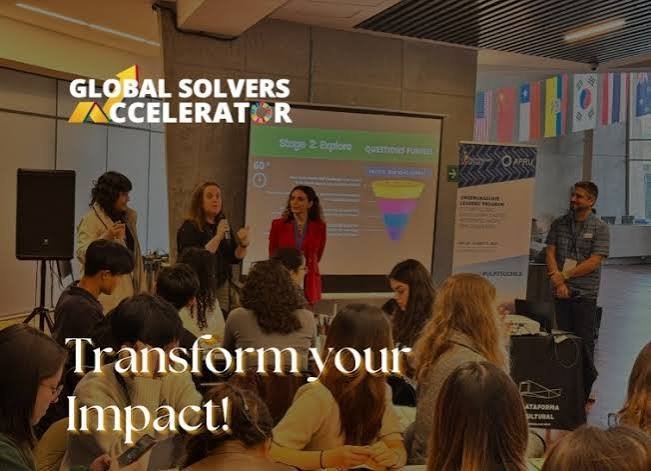
Applications are open for the Melton Foundation Global Solvers Accelerator 2027, a ten month leadership and peer learning programme for emerging changemakers who are actively driving social impact in their communities. The programme brings together a cohort of approximately 15 to 20 practitioners from around the world to strengthen their leadership, develop their projects and learn through meaningful cross cultural collaboration. The Global Solvers Accelerator is designed for people who are already working on social, economic or environmental challenges and want to deepen both their practice and their personal leadership. Rather than focusing mainly on rapid growth or scaling, the programme provides a space for participants to examine difficult questions, explore practical challenges, receive feedback and learn alongside peers working in different contexts. The 2027 programme combines online learning, collaborative inquiry, practical assignments and peer exchange with a fully sponsored in person Global Solvers Co Lab in Germany. Participants will engage with trainers, mentors and fellow changemakers while applying what they learn directly to their ongoing initiatives. About the Global Solvers Accelerator The Global Solvers Accelerator is a flagship programme of the Melton Foundation that connects emerging social impact practitioners through a sustained learning journey. Participants are encouraged to bring real challenges from their work into the programme and explore them through reflection, experimentation, peer feedback and collaborative learning. The programme is guided by the Melton Foundation’s Global Citizenship Development Framework. It places emphasis on understanding social challenges across cultures and systems, strengthening leadership and shared leadership, and building relationships based on openness, honesty and trust. Participants can come from diverse fields including education, climate action, public health, civic engagement, livelihoods, disability inclusion, social entrepreneurship, research and other areas of sustainable development. The 2027 online programme will run from April 1 to November 30, 2027, following onboarding in March. The in person Global Solvers Co Lab is tentatively scheduled for July 3 to July 10, 2027, in Germany. The Co Lab is fully sponsored. Participants who successfully complete the programme will be formally inducted into the lifelong Melton Fellowship network, providing continued opportunities for learning, collaboration and professional development. Programme Benefits • Ten months of leadership and peer learning • Global network of social impact practitioners • Practical tools, methods and learning resources • Peer feedback and collaborative inquiry • Guidance from trainers and mentors • Opportunities to strengthen an existing social impact project • Cross cultural and cross sector collaboration • Fully sponsored week long Global Solvers Co Lab in Germany • Access to the lifelong Melton Fellowship network after successful completion • Opportunities for continued mentoring, learning and collaboration through the Melton community • Need based scholarships covering 20%, 50% or 80% of the programme fee Programme Areas The Global Solvers Accelerator welcomes practitioners working across different areas of social change, including: • Education • Climate action • Public health • Civic engagement • Sustainable livelihoods • Disability inclusion • Social entrepreneurship • Community development • Research and innovation • Social, economic and environmental challenges connected to the Sustainable Development Goals Eligibility Criteria Applicants should: • Be between 20 and 35 years old • Be actively involved in an ongoing social impact project, enterprise, research effort, movement or community initiative • Have the ability to influence decisions within the project or initiative • Demonstrate a track record of real social impact • Be interested in advancing sustainable development and creating positive social change • Be curious, open minded and willing to work with people from different cultures, backgrounds and identities • Be ready to learn, unlearn and relearn through peer exchange • Have sufficient English language skills to participate fully in the programme • Be able to commit approximately four hours per week to programme activities between March and November 2027 • Be able to participate fully in the in person Global Solvers Co Lab in Germany • Be able to contribute toward the programme fee if selected, with scholarships available for applicants with demonstrated financial need Required Application Information Applicants should be prepared to provide information through the online application form, including: • Personal and professional background information • Details about their current social impact project or initiative • Information about their experience and impact • Responses to the programme application questions • Information demonstrating their motivation to participate • Information about their leadership and involvement in their project • Scholarship request information if financial assistance is required • References who can provide a recommendation if the application advances to the vetting stage How to Apply Review the Global Solvers Accelerator 2027 eligibility requirements and programme structure. Read the Melton Foundation Application Guide carefully before beginning the application. Prepare your information about your social impact project, leadership experience, motivation and expected contribution to the peer learning community. Complete the official online application form. Request a scholarship within the application if you require financial assistance. Submit the completed application by November 15, 2026 at 23:59 US Eastern Standard Time. If shortlisted, prepare to participate in the virtual assessment centre and ensure that your references are available to provide recommendations if contacted.

Scholarships in Denmark for International Students: Danish Government Scholarships, Erasmus Mundus, Fulbright and More
Denmark offers several scholarship and financial support opportunities for international students who want to pursue higher education in the country. These opportunities are provided through Danish universities, European mobility programmes, international exchange schemes and government supported funding. The official Study in Denmark portal, managed by Denmark’s Ministry of Science, Higher Education and Digital Affairs, highlights several major funding routes available to international students. These include Danish Government Scholarships for highly qualified students from outside the European Union, Erasmus Mundus Joint Master’s Scholarships, Erasmus mobility opportunities, Nordplus, Fulbright Denmark grants and, for eligible international students, Danish State Educational Support. The funding opportunities are not part of one single scholarship programme. Instead, each scheme has its own eligibility requirements, application procedure, funding structure and deadline. Students should therefore identify the opportunity that matches their nationality, academic level, chosen programme, university and residence status. Denmark is also an attractive destination for international students because its higher education system offers hundreds of English taught programmes across a wide range of disciplines. The official Study in Denmark portal currently lists more than 600 English taught study programmes. About Scholarships in Denmark Scholarships in Denmark can support students through different forms of financial assistance. Depending on the programme, funding may cover tuition fees, contribute toward living expenses, support international mobility or provide grants for study and research. For students from outside the European Union, European Economic Area and Switzerland, tuition fees generally apply unless the student qualifies for an exemption. Official Danish guidance indicates that annual tuition fees for full degree programmes can generally range from approximately €6,000 to €16,000. The Danish Government Scholarship is one of the main funding routes for highly qualified international students. Danish universities receive a limited number of scholarships each year and are responsible for selecting recipients. Other international students may benefit from Erasmus Mundus Joint Master’s programmes, Erasmus exchange opportunities or other mobility schemes. American postgraduate students and scholars may also apply for Fulbright Denmark grants. Opportunity Benefits • Full or partial tuition fee waivers under eligible Danish Government Scholarships • Grants that may contribute toward living expenses • Opportunities to study in Denmark through Erasmus Mundus Joint Master’s programmes • International academic mobility through Erasmus • Nordic and Baltic mobility opportunities through Nordplus • Study and research opportunities in Denmark through Fulbright Denmark • Access to hundreds of English taught study programmes • Opportunities to explore additional European scholarship and research mobility programmes Programme Areas Scholarship opportunities are available across different academic disciplines depending on the university and programme. Potential study areas include: • Business and economics • Engineering and technology • Computer science and information technology • Natural sciences • Social sciences • Humanities • Health and life sciences • Environmental and sustainability studies • Research and doctoral studies Applicants should check the individual university or scholarship programme for available fields and specific academic requirements. 1. Danish Government Scholarships Danish universities receive a limited number of government scholarships each year for highly qualified full degree students from outside the European Union, European Economic Area and Switzerland. The scholarships are administered directly by Danish higher education institutions. Each university selects the students who receive funding and determines the exact financial package available. The scholarship may consist of: • A full tuition fee waiver • A partial tuition fee waiver • A grant toward living costs • A combination of tuition support and living cost assistance The exact award therefore varies between universities. Applicants should not automatically assume that every Danish Government Scholarship is fully funded. Eligibility Criteria Applicants for Danish Government Scholarships generally need to: • Be citizens of a country outside the European Union, European Economic Area or Switzerland • Be enrolled in a full degree higher education programme in Denmark • Have a time limited Danish residence permit for educational purposes • Meet the academic and admission requirements of the selected institution There are also circumstances in which applicants are not eligible, including certain residence situations and cases where an applicant has a legal entitlement to the same rights as Danish citizens. Applicants seeking admission to an Artistic Higher Education Institution are also excluded from the Danish Government Scholarship framework. 2. Erasmus Mundus Joint Master’s Scholarships Erasmus Mundus provides another important funding route for students interested in studying in Denmark. Erasmus Mundus Joint Master’s programmes are delivered through partnerships involving universities and higher education institutions in different European countries. Some programmes include Danish institutions as part of the consortium. The programme is open to both European and non European students, depending on the specific joint master’s programme. Applicants should identify a relevant Erasmus Mundus Joint Master’s programme and check its scholarship availability, academic requirements and application deadline. Eligibility Criteria Requirements vary according to the individual Erasmus Mundus programme. Applicants generally need to: • Hold the academic qualification required by the selected master’s programme • Meet the programme’s language requirements • Satisfy any subject specific admission requirements • Submit the required application documents • Apply within the deadline specified by the individual programme There is no single deadline covering every Erasmus Mundus programme associated with Denmark. 3. Erasmus Study Abroad Opportunities Erasmus also provides opportunities for eligible students to undertake part of their higher education in Denmark. The programme primarily supports students from European Union, European Economic Area countries and Switzerland who want to study abroad as part of their existing higher education. Study periods can generally range from two to twelve months. Students interested in this option should contact their home university or relevant national education agency to determine whether an exchange agreement is available. This route is particularly relevant to students who want to spend part of their degree in Denmark rather than complete an entire degree programme there. 4. Nordplus Opportunities Nordplus supports academic mobility within the Nordic and Baltic region. Students enrolled at Nordic or Baltic higher education institutions may have opportunities to study temporarily in another participating Nordic or Baltic country as part of their existing degree. Nordplus is therefore not a

AIBM Graduate Research Fellowship 2026
The American Institute for Boys and Men (AIBM) is inviting applications for its Graduate Research Fellowship, an opportunity designed to support graduate students conducting rigorous and objective research on issues affecting boys and men. The fellowship provides $10,000 per year for up to two years to help emerging scholars advance research that can contribute to a stronger evidence base and improve the wellbeing of boys and men. The fellowship supports researchers working across disciplines and welcomes both qualitative and quantitative research. Applicants may be conducting research in areas such as economics, political science, sociology, psychology, public policy, education and related fields. For the 2026 fellowship cycle, AIBM has identified several areas of particular interest, including men’s employment and labour force participation, online gambling, gaming and pornography, modern fatherhood, and social connection, belonging and civic engagement among young men. AIBM may also consider strong proposals addressing other issues related to boys and men. About the AIBM Graduate Research Fellowship The AIBM Graduate Research Fellowship is part of the Institute’s broader effort to strengthen research on boys and men and support a community of emerging scholars working in this area. AIBM describes its research mission as rigorous and objective, with an emphasis on producing evidence that can improve understanding of the challenges and opportunities facing boys and men. The fellowship therefore supports graduate researchers whose work can contribute meaningful evidence to the wider field. Research may address education, employment, family and fatherhood, health, digital behaviour, social and emotional development, economic policy, gambling, online pornography, civic engagement and other subjects relevant to boys and men. Fellowship Benefits • $10,000 per year • Funding available for up to two years • Support for research interviews and fieldwork • Funding for experiments and research participants • Support for purchasing research data • Stipend support • Conference and travel support • Eligible research fees • Support for contributions from project collaborators • Opportunity to join a growing community of scholars researching boys and men The fellowship does not cover indirect institutional overhead costs. Research Areas AIBM welcomes proposals on topics related to boys and men, with particular interest in the following areas for the current cycle. Men’s Employment and Labour Force Participation Research may examine declining employment and labour force participation among men, particularly men without a four year college degree. Proposals may explore employment patterns, economic opportunities, workforce participation and factors affecting men’s connection to the labour market. Online Gambling, Gaming and Pornography AIBM is interested in research examining how online gambling, gaming and pornography affect boys and men. This area connects with the Institute’s broader work examining digital environments and their social, emotional and financial effects. Modern Fatherhood Research can contribute to a modern, inclusive and strengths based understanding of fatherhood. Projects may examine fathers, father figures, male role models and their relationships with boys and young men. Social Connection, Belonging and Civic Engagement AIBM is also interested in research examining ways to strengthen social connection, belonging and civic engagement among young men. Research may explore how communities and institutions can create stronger connections and encourage constructive participation in civic life. Other Research Topics Applicants whose research does not fit precisely within the highlighted areas may still apply. AIBM also considers research relating to boys’ education, mental and physical health, family relationships, social and emotional development, economic policy and other issues affecting boys and men. Eligibility Criteria • Currently enrolled in a PhD programme at an accredited university in the United States • Conducting research aligned with AIBM’s mission • Research may be at the dissertation stage, although dissertation stage is not required • Applicants may come from disciplines including economics, political science, sociology, psychology, public policy and education • Both qualitative and quantitative research are eligible • Proposed research should be rigorous and empirical • Research should address issues affecting boys and men • Applicants should demonstrate how their research can contribute to the wider field AIBM encourages applications from researchers whose work can contribute to policy discussions and practical interventions. Research Expectations A strong proposal should clearly establish the research question and explain why the issue matters. Applicants should demonstrate a sound empirical approach and provide a clear explanation of how evidence will be collected or analysed. Research should have a meaningful connection to boys and men. Applicants should also explain how their work could contribute to understanding challenges, identifying opportunities or developing evidence that can inform policy and practice. The fellowship can support research at different stages, so applicants should explain how the funding would help move their project forward. Required Application Information Applicants should prepare an application that clearly explains: • The research question • The problem or issue being investigated • The relevance of the research to boys and men • The proposed empirical approach • The expected contribution to the research field • The potential relevance to policy or practical interventions • How fellowship funding would support the research • The research activities that would be undertaken with fellowship support Applicants should ensure that their proposal clearly demonstrates alignment with AIBM’s mission and the fellowship’s research priorities. Selection Criteria AIBM is particularly interested in researchers whose work can contribute to policy discussions and interventions designed to improve outcomes for boys and men. Applications are expected to demonstrate: • Rigorous research design • Strong empirical foundations • Clear and important research questions • Relevance to boys and men • Potential contribution to the broader research field • Potential usefulness for policy or practical interventions • Alignment with AIBM’s current areas of interest Proposals addressing the highlighted research areas may be particularly relevant to the current fellowship cycle, while AIBM also welcomes strong ideas addressing other issues within its broader mission. How to Apply Review the AIBM Graduate Research Fellowship information and eligibility requirements. Confirm that you are currently enrolled in a PhD programme at an accredited university in the United States. Develop a clear research proposal addressing an issue affecting boys and men. Explain your research question, methodology,
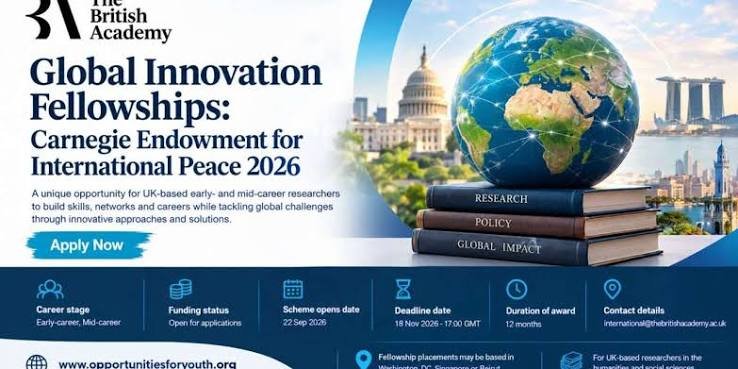
Carnegie Endowment for International Peace Global Innovation Fellowships 2026
Carnegie Endowment for International Peace 2026 offer an opportunity for UK based early career and mid career researchers in the humanities and social sciences to develop their professional networks, strengthen policy engagement skills, and explore innovative approaches to major international challenges. The fellowship is offered by the British Academy in partnership with the Carnegie Endowment for International Peace. It is designed to create stronger connections between academic research, policy and professional practice, enabling researchers to take their expertise beyond conventional academic settings while gaining experience within an international foreign policy organisation. Successful fellows will be embedded within Carnegie for a period of 12 months. Depending on the proposed area of work, placements may be based in Washington DC, Singapore or Beirut. The programme is offering up to two fellowships, with awards of up to £150,000 for 12 months on a Full Economic Costing basis at 80 percent. About the Global Innovation Fellowship The Global Innovation Fellowships are intended to support researchers who want to build new relationships beyond academia and apply their knowledge in creative, cultural, public, private and policy environments. The programme recognises that many international challenges require perspectives from different disciplines and professional settings. Through the partnership with Carnegie, fellows can engage with experts working on international affairs, climate change, technology, global governance, regional politics and other complex policy issues. The fellowship is designed as a mutually beneficial partnership. Fellows bring their research expertise, perspectives and ideas to Carnegie while gaining exposure to policy research, international networks and practical approaches to addressing global challenges. The British Academy describes Carnegie as an international foreign policy institution whose experts work across borders and disciplines on major issues including democracy, technology and climate change, with regional expertise spanning Asia, Africa, Europe, India, the Middle East and Russia and Eurasia. Fellowship Areas Applicants can apply in one of four thematic areas: • Sustainability, Climate and Geopolitics: Research on interconnected climate, sustainability and nature based challenges, with the fellowship based in Washington DC. • Global Order and Institutions: Research examining global order and disorder, international institutions and the challenges affecting the international system, based in Washington DC. • South and East Asia: Research focused on South Asia, East Asia or Southeast Asia, including issues connected to India or China and their regional or global roles. The fellowship may be based in Washington DC or Singapore. • Middle East and North Africa: Research addressing political, social and economic change and long term geopolitical trends in the Middle East and North Africa, including the Gulf and Iran. The fellowship may be based in Washington DC or Beirut. There is no prescribed disciplinary background within the humanities and social sciences. However, applicants must demonstrate a strong understanding of the relevant issues, policy landscape and systemic challenges associated with their proposed area. Fellowship Benefits • Fellowship duration of 12 months • Award of up to £150,000 • Placement within the Carnegie Endowment for International Peace • Potential fellowship locations in Washington DC, Singapore or Beirut • Opportunities to build international professional networks • Direct engagement with policy experts and practitioners • Opportunity to translate academic research into practical policy applications • Development of new approaches to complex policy challenges • Exposure to international policy research and professional practice • Opportunities to strengthen communication with non academic audiences • Career development through engagement across academia, policy and practice • Opportunities to develop future collaborations and professional relationships Eligibility Criteria Applicants must meet the following requirements: • Be ordinarily resident in the United Kingdom. • Be an early career or mid career researcher. • Hold a current long term appointment at a UK based institution that will continue for at least the duration of the fellowship. • Be based at an eligible Higher Education Institution or Independent Research Organisation. • Work within an eligible humanities or social sciences discipline. • Have relevant expertise from an appropriate disciplinary, conceptual, methodological, analytical, policy or practical perspective. • Demonstrate an interest in working across academia, policy and professional practice. • Show willingness to explore new perspectives and innovative approaches. • Demonstrate the potential value of engagement with the Carnegie Endowment for International Peace. • Meet the requirements associated with working at and with Carnegie. • Not hold more than one British Academy award of a comparable nature at the same time. • Not currently be working towards a PhD. • Not be awaiting the outcome of a viva examination. • Not be awaiting acceptance of corrections required by examiners. Independent researchers without an eligible institutional appointment cannot apply under this call. Required Application Materials Applicants should prepare the required information through the British Academy Flexi Grant application system, including: • Personal and contact information • Nationality and current appointment details • Information about the employing UK institution • Details of academic and professional qualifications • Details of the proposed fellowship and thematic area • Research and professional expertise relevant to the chosen area • Fellowship proposal and plan of activity • Explanation of the anticipated policy relevance and impact • Career development rationale • Financial information and budget • Relevant supporting information required by the British Academy • Supporting statement from the Head of Department Selection Criteria Applications are assessed through eligibility checks, relevant peer review and consideration by a final selection panel. Shortlisted candidates are invited to an interview, which is a mandatory part of the assessment process. The selection process considers: • Research expertise in the chosen area • Experience and interest in engaging closely with policy counterparts • Expected benefit and impact on policymaking • Contribution to the applicant’s future policy engagement ambitions • Ability to communicate research clearly and provide concise policy relevant oral briefings • Value for money The interview is scheduled for 8 February 2027. How to Apply Review the official British Academy Global Innovation Fellowships information and scheme guidance. Confirm that you meet the UK residency, employment, career stage and disciplinary requirements. Select the fellowship area that most closely matches your research expertise and
Imperial AI Policy Fellowship 2027
The Imperial AI Policy Fellowship 2027 is a nine month professional learning and development programme at Imperial College London for senior civil and public servants seeking to strengthen their understanding of artificial intelligence and its implications for public sector policy, strategy, regulation and service delivery. Delivered through the Imperial Policy Forum at Imperial College London, the Fellowship combines expert led learning, in person sessions, online engagement, peer exchange and an individual research project supported by academic mentors. The programme is designed to help public sector professionals move beyond theoretical discussions of artificial intelligence and apply their knowledge to real policy challenges within their departments and areas of responsibility. The 2027 Fellowship will run from February to October 2027. Participants will spend approximately 6 to 8 hours per month on the programme and must attend four in person days at Imperial College London throughout the Fellowship. The programme is delivered through a combination of London based and online activities. About the Opportunity The Imperial AI Policy Fellowship is designed for senior civil and public servants whose responsibilities involve policy design, policy delivery, technology, digital transformation, AI strategy or related areas of public sector work. The programme provides Fellows with an opportunity to understand fundamental artificial intelligence concepts and examine their implications for policy, regulation, strategy and public service delivery. Expert led lectures, workshops and discussions provide a structured foundation, while the individual research component allows participants to explore a specific issue connected to their professional responsibilities. Fellows also engage with the Imperial Policy Forum and the wider Imperial community. The programme can provide opportunities to interact with academics, specialists, fellow policymakers and members of Imperial’s technology and innovation ecosystem. A central element of the Fellowship is the Fellow led research project. Participants identify an AI policy challenge or guiding question relevant to their work and develop it with support from one or more academic mentors. Opportunity Benefits • Tailored learning based on individual professional needs and interests • Practical application of AI knowledge to real public sector challenges • Academic mentorship throughout the research project • Access to Imperial College London expertise in AI, engineering, medicine and science • Networking with senior civil servants and public sector professionals • Engagement with the Imperial Policy Forum and wider Imperial community • Opportunities to examine AI policy, regulation, strategy and implementation • Development of a practical research output relevant to the participant’s professional responsibilities • Participation in expert led lectures, workshops and discussions • Exposure to AI innovation and technology activities at Imperial Programme Areas The Fellowship explores artificial intelligence and its relationship with public sector policy and institutional decision making. Areas of activity may include: • AI fundamentals and capabilities • AI policy and regulation • AI strategy • Public sector AI adoption • AI governance • Digital transformation • AI infrastructure and data management • Public sector innovation • AI applications and evaluation • Technology policy • Responsible implementation of artificial intelligence The research project can take several forms, including written recommendations for AI adoption within a government department, strategic planning, technical solutions, experimental AI applications, improvements to AI systems and data infrastructure, facilitated workshops or a published white paper. Eligibility Criteria • Be a senior civil servant or public servant • Have responsibilities related to policy design or delivery in an area affected by artificial intelligence • Alternatively, have responsibility for AI policy or strategy within a department or public sector organisation • Have a professional interest in understanding how AI affects public sector work • Be able to commit approximately 6 to 8 hours per month for the nine month programme • Be available to attend four in person days at Imperial College London • Be able to develop an individual research project or guiding question connected to an AI policy challenge • Be able to participate in both online and in person programme activities The programme is particularly relevant to professionals working on technology, digital transformation, AI governance, regulation, strategic planning and public sector innovation. Imperial’s programme information does not state a specific nationality or continent based restriction. Required Application Information Applicants should prepare information that demonstrates their professional responsibilities, interest in artificial intelligence policy and objectives for participating in the Fellowship. • Completed Imperial AI Policy Fellowship application form • Information about current professional responsibilities • Explanation of interest in artificial intelligence and public sector policy • Details of professional goals and expectations from the Fellowship • A proposed AI policy challenge or research question • Information that helps Imperial understand the applicant’s suitability for the programme Applicants should consult the official application form for the complete information requested before submitting their application. Research Project The research project is a major component of the Fellowship and is designed around each participant’s professional priorities. Fellows may investigate how their department could adopt artificial intelligence, examine regulatory requirements for emerging technologies, improve data systems, develop recommendations for decision makers or design practical interventions for colleagues. Previous project examples have included an AI model supporting food regulation, research concerning accountability in healthcare, a human centred AI workshop and work examining sovereign AI in defence. These examples demonstrate how the Fellowship can connect academic expertise with practical public sector challenges. Programme Structure The nine month Fellowship will run from February to October 2027. Participants will engage through online learning and activities alongside four in person days at Imperial College London. The expected time commitment is approximately 6 to 8 hours per month. The in person sessions provide opportunities for lectures, workshops, discussions and engagement with Imperial academics and specialists. Between these sessions, Fellows work on their individual research projects with academic mentoring and continue engaging with the Fellowship community. This structure allows participants to undertake the programme while continuing their professional responsibilities. Fellowship Cost The participation fee for the 2027 Imperial AI Policy Fellowship is: £1,500 The official programme information states that no VAT is added to the fee. Applicants should therefore plan for the participation cost as part of