
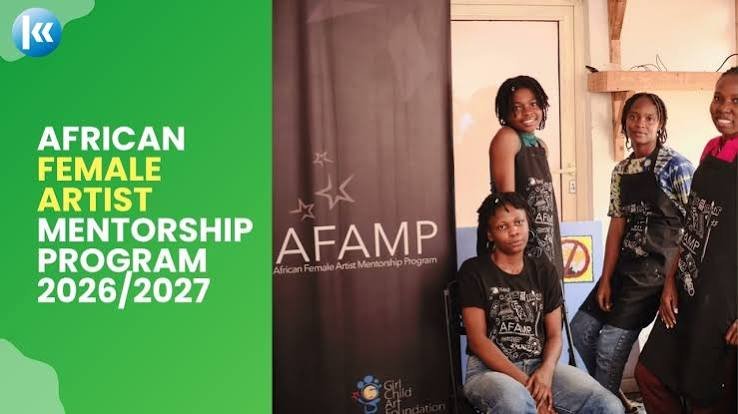
Applications are open for the African Female Artist Mentorship Program 2026 2027, an initiative of the Girl Child Art Foundation designed to support emerging female artists across Africa. The programme provides young women artists with access to professional mentors, practical artistic guidance, community engagement opportunities, and support tailored to their individual creative practices and professional ambitions. The African Female Artist Mentorship Program is intended for female artists who are in the early stages of their professional careers and have a clear interest in developing their artistic practice. Rather than following a general classroom based curriculum, the programme provides individualized mentorship that responds to the goals, challenges, methods, and aspirations of each selected artist. The 2026 2027 programme will focus on painting, textile and fibre, ceramics, drawing, printmaking, and sculpture. Mentors are professional artists with substantial experience in artistic practice, exhibitions, grant writing, juries, curatorial resources, and galleries. The programme combines one on one mentoring with group sessions and opportunities for participants to engage with communities through exhibitions and other activities. About the Mentorship Program The African Female Artist Mentorship Program was created by the Girl Child Art Foundation in response to the need for greater support for young African women pursuing careers in the creative industry. It builds on the Foundation’s wider work through art workshops, exhibitions, and art based educational programmes. The mentorship is particularly suited to emerging visual artists who maintain an active studio practice and have developed a body of work outside formal training environments. Participants are expected to remain committed to their practice throughout the programme and dedicate significant time to developing their work. The programme aims to create a safe, free, and accessible environment where young women can strengthen their artistic skills, explore areas of interest, develop professional direction, and connect their creative work with wider communities. Mentorship is delivered through individualized sessions with professional artists as well as group gatherings. The official programme information states that mentors are living and working in Nigeria and have at least ten years of professional artistic practice. Mentorship Benefits • Free participation for selected mentees • One on one mentorship with professional artists • Online and in person mentoring sessions • Mentoring meetings at least once every two weeks • Four group mentoring sessions • Individualized guidance based on artistic goals and professional ambitions • Opportunities to develop technical and artistic skills • Exposure to professional artistic practice • Opportunities to contribute to exhibitions and community events • Access to a network of artists and creative practitioners Programme Areas The 2026 2027 cycle focuses on: • Painting • Textile and fibre • Ceramics • Drawing • Printmaking • Sculpture Participants can use the mentorship to explore artistic methods and professional development needs connected to their creative practice. Eligibility Criteria Applicants must meet the following requirements: • Be a female artist • Be African • Be between 19 and 40 years old • Be in the early stages of a professional artistic career • Maintain an active visual art practice • Have developed a body of work outside formal training environments • Be able to commit significant time to developing their artistic practice during the programme • Be willing to participate consistently in mentorship meetings and programme activities • Applicants enrolled in post secondary study are not eligible Required Application Materials Applicants must prepare the following: • An application letter of no more than two pages • The application letter should describe the applicant’s artistic experience and studio activity during the past year • A clear explanation of goals for the mentorship programme • An explanation of how the programme would benefit the applicant’s current artistic work • A plan showing how adequate time will be devoted to artistic development while managing other commitments • A description of current challenges within the applicant’s artistic practice and the steps being taken to address them • Ten JPEG images or ten short videos of artistic work • Videos must be no longer than five minutes each • An annotated image list containing the title, date, medium, and dimensions of each submission • A letter of reference from an established artist or curator familiar with the applicant’s work • Names and contact information for additional references who have experience with the applicant’s work • A link to a personal website or a resume or CV of no more than two pages Applicants may submit any combination of images and videos as long as the total number of submissions is ten. How to Apply Review the eligibility requirements and confirm that you qualify for the 2026 2027 programme. Prepare an application letter of no more than two pages explaining your artistic practice, goals, challenges, and reasons for seeking mentorship. Prepare ten artistic submissions using JPEG images, short videos, or a combination of both. Create an annotated list containing the title, date, medium, and dimensions of each submitted work. Obtain a reference letter from an established artist or curator who is familiar with your work. Prepare additional reference contact information and provide either a personal website link or a resume or CV of no more than two pages. Review the complete application to ensure that all required materials are included. Email the application proposal to gcaf@girlchildart.org
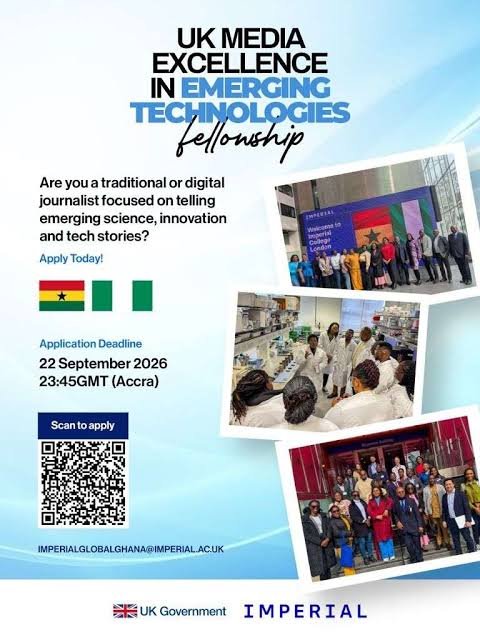
UK MEET Fellowship 2026 for Journalists and Digital Content Creators in Ghana and Nigeria
Applications are open for the UK West Africa Media Excellence in Emerging Technologies Fellowship 2026, also known as the UK MEET Fellowship. The professional development programme is designed for journalists and digital content creators in Ghana and Nigeria who are interested in science, innovation and technology reporting. The Fellowship is delivered by the British High Commission in partnership with Imperial College London through Imperial Global Ghana. It aims to strengthen participants’ ability to understand complex scientific and technological subjects and communicate them accurately, creatively and responsibly to wider audiences. Selected participants will take part in online preparation followed by an intensive six night residential training programme in their country of residence. The programme combines science and technology reporting, digital storytelling, ethical reporting and direct engagement with researchers, policymakers, innovators and industry professionals. About the UK MEET Fellowship The UK Media Excellence in Emerging Technologies Fellowship focuses on strengthening media professionals’ capacity to report on science, innovation and technology, referred to by the programme as SIT. The Fellowship responds to the growing importance of emerging technologies and scientific developments in public life. Participants will learn how to approach complicated subjects, identify credible sources, assess evidence, explain uncertainty and communicate technical information in ways that remain accessible to general audiences. The programme combines scientific understanding with practical media skills. Rather than concentrating on a single technology, it develops transferable skills that journalists and digital creators can apply across different reporting areas. The programme is delivered through collaboration between the British High Commission and Imperial College London through Imperial Global Ghana. Participants will have opportunities to interact directly with researchers and other professionals working across science, innovation and technology. Programme Areas The Fellowship covers several major science, innovation and technology themes, including: • Artificial intelligence • Climate and environmental risk • Biomedical innovation • Circular economy and electronic waste • Other emerging science, innovation and technology issues Participants will also develop five core competencies: • Understanding complex scientific and technological concepts • Effective science communication • Understanding emerging technologies and their public implications • Applying ethical considerations to science and technology reporting • Engaging effectively with researchers, policymakers, innovators and industry professionals Digital Storytelling and Media Skills The Fellowship includes practical training in digital communication and storytelling. Participants will develop skills in areas such as: • Platform strategy • Short form video • Data storytelling • Visual design • Public communication of technical information These skills are designed to help participants adapt science and technology stories for different audiences and digital platforms. The programme also emphasizes responsible reporting. Participants will consider issues including accuracy, source selection, privacy, conflicts of interest, uncertainty, representation and responsible use of digital tools. Residential Training A major component of the Fellowship is an intensive six night residential training programme. Participants attend the residential programme in their country of residence. Ghana based participants take part in the Ghana programme, while Nigeria based participants participate in the Nigeria programme. The programme begins with online preparation before the residential training. Online Preparation Two short online sessions and pre reading are scheduled for the week of 5 October 2026. Ghana Residential Programme The Ghana residential programme is scheduled for the week of 12 October 2026. Nigeria Residential Programme The Nigeria residential programme is scheduled for the week of 19 October 2026. UK Knowledge Exchange Selected pitch award winners will have the opportunity to participate in a fully funded week long knowledge exchange visit to London during the week of 30 November 2026. Fellowship Benefits Participants can benefit from: • Six night residential training in Ghana or Nigeria • Online preparation and pre training sessions • Practical science, innovation and technology reporting training • Digital storytelling training • Training in platform strategy, short form video, data storytelling and visual design • Engagement with researchers, policymakers, innovators and industry professionals • Opportunities to develop an original story concept • Opportunity to pitch an original story for production and publication support • Networking with journalists and digital content creators • Fully funded week long London knowledge exchange for selected pitch award winners • Engagement with Imperial College London during the UK knowledge exchange Eligibility Criteria Applicants must meet the programme’s eligibility requirements. • Be at least 18 years old • Currently be based in Ghana or Nigeria • Apply through the country track where they are currently based • Be a journalist working in print, broadcast or online media, or an eligible social media content creator • Digital creators must have an active and publicly viewable presence on platforms such as TikTok, Instagram, YouTube, X or Facebook • Digital creators must produce content relevant to science, innovation or technology • Have produced at least five original pieces of science, innovation or technology related content within the previous 12 months • Provide links to the relevant published work • Be available for the online preparation and the full residential programme • Be able to communicate and work professionally in English • Hold a valid international passport or be capable of obtaining one in time for the programme Partial attendance is not permitted, so applicants should ensure they can participate fully in the required programme activities. Required Application Information Applicants should be prepared to provide: • Personal and contact information • Country of application • Gender information • Relevant professional background • Evidence of eligibility • Links to at least five original science, innovation or technology related content pieces produced during the previous 12 months • Information demonstrating experience in relevant reporting or digital content creation • Information about potential impact from participating in the Fellowship • Information relevant to collaboration and science communication interests Applicants should carefully review the application form and provide accurate links to their previous work. Story Pitch Opportunity The Fellowship includes a practical opportunity for participants to develop an original story concept during the residential programme. On the final day, participants will pitch their ideas for an opportunity to receive funding to produce and publish an original story. The public programme
AGNES Intra Africa Mobility Grants 2026
The AGNES Intra Africa Mobility Grants for Junior Researchers 2026 are open to doctoral researchers from sub Saharan Africa who wish to undertake a short research stay at a university or research institute in another sub Saharan African country. The programme supports research mobility, scientific collaboration, knowledge exchange and professional networking among emerging researchers across Africa. The grants are offered by the African German Network of Excellence in Science, AGNES, with financial support from the German Ministry for Economic Cooperation and Development and support from the Alexander von Humboldt Foundation. The programme is designed to strengthen scientific capacity and encourage cooperation between young African researchers and experienced scientific hosts. Selected doctoral researchers can undertake a research stay lasting between one and two months at a host institution in another sub Saharan African country. The proposed activities must form part of the applicant’s doctoral research and should provide access to research facilities, expertise, resources or other opportunities that are not available in the applicant’s home country. About the Opportunity The AGNES Intra Africa Mobility Grant provides financial support for doctoral researchers who need to conduct part of their research at another African university or research institute. The proposed research stay may involve laboratory work, bench work, research studies, use of library resources, data collection, other research activities or writing part of a doctoral thesis. Applicants must clearly explain how the proposed stay contributes to their doctoral research. The programme also places emphasis on strengthening research connections within Africa. Applicants work with an identified scientific host at the destination institution, creating opportunities for knowledge transfer, mentorship and longer term professional collaboration. AGNES states that eligible candidates from sub Saharan African countries may apply, while applications from several under represented countries are particularly welcomed. These countries include Ghana, Burkina Faso, Guinea, Côte d’Ivoire, Liberia, Mali, Senegal, Sierra Leone, Angola, Central African Republic, Chad, Democratic Republic of the Congo, Rwanda, Zambia, Uganda, Tanzania, Malawi, Lesotho, Botswana, Mozambique, Mauritius, Mauritania, Namibia, Zimbabwe, Cape Verde and Sao Tome and Principe. Opportunity Benefits • Research mobility support for one to two months • Up to €2,300 for a one month research stay • Up to €2,650 for a one and a half month research stay • Up to €3,000 for a two month research stay • Support for return travel between the applicant’s country of residence and host country • Subsistence support during the research stay • Research cost allowance for the host institution where applicable • Opportunity to work with an experienced scientific host • Access to research facilities and expertise at another African institution • Professional networking with researchers across sub Saharan Africa • Opportunities for knowledge and skills transfer • Strengthened doctoral research capacity • Opportunities to develop African research collaborations Eligibility Criteria Applicants must meet the following requirements: • Be officially registered for a doctoral degree at a university or tertiary institution in sub Saharan Africa at the time of application • Be a national of a sub Saharan African country • Have at least one article from their thesis work already published • The published article must appear in a non predatory journal • The journal must be indexed by Scopus or Web of Science • Demonstrate that the doctoral research is relevant to development in sub Saharan Africa • Demonstrate that the proposed research activity cannot be conducted in the applicant’s home country • Identify a scientific host at a university or research institute in another sub Saharan African country • Have a mutually agreed research proposal and work schedule with the scientific host • Be able to conduct the proposed research within the eligible mobility period • Submit the complete application in English Female researchers may apply for both the General and Special AGNES grants but can receive only one grant. Male researchers may apply for the General AGNES grant. Required Application Materials Applicants must prepare a complete application with a maximum total file size of 12 MB. • Research or project proposal of no more than five pages • Proposed research activities and work schedule • Written agreement from the scientific host regarding the proposal and schedule • Standard CV using the AGNES CV template • Official proof of current doctoral registration • Official academic transcripts for undergraduate and postgraduate studies where applicable • Official explanation of the grading system in English if required • List of published articles • Scopus or Web of Science links for each eligible publication • Electronic copy of the first page of each publication showing the title, authors and abstract • Two travel quotations covering return travel to the host country • Estimated cost of living covering accommodation, meals, local transportation and health insurance • Letter of invitation from the scientific host • Confirmation that working space will be available during the proposed research period • Binding declaration from the host institution requesting the relevant research cost allowance The publication list and first pages of publications must be combined into a single PDF document. Grant Amount and Eligible Costs The maximum grant depends on the length of the proposed research stay. • One month: up to €2,300 • One and a half months: up to €2,650 • Two months: up to €3,000 The maximum amount covers all expenses, including the host institution allowance. How to Apply Review the official AGNES Intra Africa Mobility Grant 2026 call and confirm that you meet all eligibility requirements. Identify a university or research institute in another sub Saharan African country that provides the expertise, facilities or resources required for your doctoral research. Establish contact with an appropriate scientific host and agree on the research proposal, activities and work schedule. Prepare a research proposal of no more than five pages in English. Complete the AGNES CV template in English. Obtain official proof of doctoral registration and academic transcripts. Prepare evidence of at least one thesis related publication in a journal indexed by Scopus or Web of Science. Obtain two quotations for return travel to the host country.

French Republic Human Rights Prize 2026
Applications are now open for the French Republic Human Rights Prize 2026, an international award that recognises and supports individuals and organisations working to promote and protect human rights. Established in 1988, the prize is administered by the French National Consultative Commission on Human Rights, known by its French abbreviation CNCDH. The 2026 edition focuses specifically on protecting the right to asylum and the fundamental rights of refugees, asylum seekers and displaced persons. Applicants from any nationality can apply, and proposed projects may be implemented in France or in another country. Five winning projects will share a total financial award of €70,000 to support implementation of their proposed initiatives. The five laureates will also receive medals and be invited to France for the official award ceremony around Human Rights Day on 10 December 2026. About the French Republic Human Rights Prize The French Republic Human Rights Prize was created in 1988 under the initiative of the CNCDH. It recognises actions and projects that contribute to the effective promotion and protection of human rights around the world. The prize does not impose nationality restrictions. Individuals and organisations can submit projects carried out in France or internationally. Every year, the CNCDH announces one or two specific themes for the prize. For 2026, the single theme concerns the protection of asylum rights and the fundamental rights of people affected by forced displacement. The CNCDH states that the prize aims to recognise the important role of civil society in advancing human rights. A jury made up of CNCDH members selects five laureates and five additional candidates for special mentions. 2026 Prize Theme The theme for the 2026 edition is: Protecting the right to asylum and the fundamental rights of refugees, asylum seekers and displaced persons. Projects should address the protection of fundamental rights for people experiencing forced displacement. This may include refugees recognised under international refugee law, people seeking asylum and people displaced within their own countries. The 2026 call highlights the importance of effective legal protection, access to rights and the implementation of international human rights and refugee law. Eligible Project Areas Projects can address a range of activities connected to the 2026 theme, including: • Public awareness and advocacy concerning asylum and refugee rights • Legal and administrative assistance for refugees and asylum seekers • Access to justice and protection of civil, political, economic, social and cultural rights • Training for professionals and institutions involved in asylum and displacement • Support for the effective integration of refugees and displaced persons • Resettlement initiatives and restoration of rights • Advocacy aimed at improving laws, policies or practices affecting displaced people • Initiatives that actively involve people directly affected by displacement Particular attention may be given to projects providing comprehensive support, using transformative or restorative approaches and ensuring meaningful participation of the people concerned. Prize Benefits • Five winning projects share a total grant of €70,000 • Financial support is provided for implementation of the winning projects • Five laureates receive a medal and diploma • Winners are invited to France for the official award ceremony • Laureates can benefit from French diplomatic protection • Five additional candidates receive Special Mention medals • Special Mention recipients receive recognition but no financial award The CNCDH states that the five laureates share the €70,000 financial allocation, while special mentions are not financially endowed. Eligibility Criteria • Applications may be submitted by individuals • Non governmental organisations may apply • Applicants can be of any nationality • Projects may be implemented in France or another country • The proposed initiative must address the 2026 theme • Projects should promote or protect the fundamental rights of refugees, asylum seekers or displaced persons • The proposed activities should follow a human rights based approach • Applicants should demonstrate relevant actions already carried out and the project they intend to develop • The application must include an evaluation of the project budget Required Application Materials Applicants should prepare a complete application file containing: • A signed letter of application • The completed official 2026 application form • A presentation of the applicant or organisation and relevant activities • A description of the proposed project • A financial evaluation or budget for the project • Postal details of the applicant or organisation • Banking details, including relevant RIB or IBAN information For organisations, the application letter must be signed by the President or legal representative. Individual applicants must sign their own application.. How to Apply Review the official 2026 theme and prize rules. Confirm that your organisation, initiative or project addresses the protection of asylum rights and the fundamental rights of refugees, asylum seekers or displaced persons. Download the official 2026 application form from the CNCDH website. Prepare a signed application letter. Provide information about your previous human rights activities and proposed project. Prepare a clear financial evaluation showing how the project will be implemented. Include the required postal and banking information. Prepare the application in French where possible. Submit the complete application by 4 October 2026 at midnight GMT+1. Applications may be submitted by post or email to the CNCDH. The official contact for information about the 2026 prize is prixdesdroitsdelhomme@cncdh.fr.
Cardiff University PhD Studentships and Projects 2026 | 100 Doctoral Opportunities
Cardiff University is offering a broad range of PhD studentships and research projects for prospective doctoral researchers seeking to pursue advanced study in the United Kingdom. The current doctoral opportunities listing features 100 research projects across numerous academic disciplines, including computer science, artificial intelligence, engineering, medicine, psychology, biological sciences, physics, mathematics, environmental sciences, economics, sociology and the humanities. The opportunities are hosted across Cardiff University’s academic schools, research centres and specialist research groups. Some projects are directly funded, while others are competition funded. A number of projects are open to applicants from around the world, although funding eligibility differs between individual opportunities. Cardiff University is a member of the Russell Group and has an extensive research environment spanning science, technology, medicine, social sciences, arts and humanities. The university states that its postgraduate research students work with field leading researchers and have access to research facilities and doctoral development opportunities. About the PhD Opportunities The Cardiff University PhD studentships and projects listing allows prospective researchers to explore doctoral research opportunities according to academic discipline, department, supervisor, research group, funding status and keywords. Current areas represented in the listings include: • Computer Science and Artificial Intelligence • Cybersecurity and Data Analytics • Biological Sciences and Biosciences • Chemistry • Engineering and Materials Science • Physics and Astronomy • Mathematics • Medicine and Healthcare Sciences • Psychology and Neuroscience • Environmental Sciences • Geography • Economics • Politics and Government • Sociology • Veterinary Sciences • Nursing and Health • Communication and Media Studies • Architecture, Building and Planning • Languages, Literature and Culture Opportunity Benefits The benefits depend on the funding attached to the selected doctoral project. • PhD study at Cardiff University • Access to specialist research facilities • Academic supervision and research training • Opportunities to work with established researchers • Professional development through doctoral training • Research and training support for eligible funded students • Living cost support through applicable studentships • Tuition fee support through applicable funding awards • Access to doctoral research communities and networks • Opportunities for interdisciplinary research and collaboration For UK Research and Innovation supported studentships, Cardiff University states that a typical full time studentship lasts three to four years and can include home tuition fees, additional funding for training and research expenses, and a tax free stipend for living expenses. International applicants should check the funding conditions of each individual project because UKRI funding normally covers home fee levels, with Cardiff providing a fee discount for eligible international students. Programme Areas The available doctoral projects cover a wide range of research themes. Examples from the current listing include cybersecurity research, brain imaging, chronic pain and neurodiversity, photon counting interferometry, virtual reality approaches to health, medication adherence, cerebellar network dysfunction, glioblastoma therapy resistance and gene diet interactions in psychiatric risk. The university also provides opportunities connected to wider doctoral training programmes supported by research councils and other funding organisations. These include areas supported by the AHRC, BBSRC, ESRC, EPSRC, MRC, NERC and STFC. Eligibility Criteria Eligibility varies according to the selected PhD project and its funding source. Applicants should: • Meet the academic entry requirements specified by the selected doctoral project • Have an appropriate academic background for the proposed research • Meet any subject specific requirements stated by the project supervisor or academic school • Check whether the studentship is available to UK, European or international applicants • Meet the funding eligibility requirements where the project is funded • Satisfy any English language requirements applicable to the programme • Review any additional research experience, technical skills or professional requirements listed for the selected project Applicants should not assume that eligibility for one Cardiff University PhD project applies to another, as the individual projects can have different requirements. Required Application Information The application requirements depend on the selected PhD project. Applicants should prepare the materials requested on the specific project page and may need to provide: • Academic qualifications and transcripts • Curriculum vitae • Evidence of relevant academic or research experience • Research proposal where requested • Personal or supporting statement where requested • Evidence of English language proficiency where applicable • References • Any additional documents specified by the academic school or funding body How to Find a Suitable PhD Project Applicants can use the Cardiff University doctoral opportunities listing to search for projects based on their interests and circumstances. Visit the Cardiff University PhD studentships and projects listing. Search by academic department, discipline, research group, supervisor or keyword. Review the research topic and supervisor information for projects that match your background. Check the funding status carefully to determine whether the opportunity is directly funded, competition funded or intended for self funded applicants. Confirm whether the project accepts international applications if you are applying from outside the United Kingdom. Read the complete eligibility requirements and application instructions for the selected project. Check the exact application deadline and required documents. Prepare your application according to the instructions provided for that specific doctoral opportunity. Submit the application through the application system specified by Cardiff University or the relevant funding programme.
Perplexity Research Fellowship 2027
The Perplexity Research Fellowship 2027 is a paid research opportunity for exceptional early career researchers, engineers, and analysts interested in contributing to the development of advanced artificial intelligence systems. The programme is designed for people with strong technical or quantitative backgrounds who want to apply their expertise to frontier AI research. The fellowship is offered by Perplexity as a talent development programme within its AI Research and Systems team. Fellows work full time and are considered short term employees for the duration of the fellowship. The programme is intended to give early career STEM talent an opportunity to contribute to research while working alongside teams developing new AI systems. Research areas may include multi agent planning, continual learning, pre training, human AI interaction, interdisciplinary research and other areas connected to the advancement of AI systems. Perplexity is particularly interested in applicants who bring strong technical expertise from disciplines beyond traditional AI research. About the Fellowship The Perplexity Research Fellowship is focused on bringing talented researchers from diverse technical and quantitative disciplines into AI research. The programme recognizes that important contributions to AI can come from people whose academic and professional backgrounds are not traditionally centred on artificial intelligence. Fellows are expected to bring analytical ability, technical depth, curiosity and a willingness to learn rapidly. Perplexity is looking for people who can apply rigorous thinking to complex problems and communicate their ideas effectively within interdisciplinary research teams. The fellowship is particularly relevant to applicants with backgrounds such as physics, cognitive science, quantitative finance, theoretical mathematics and other rigorous analytical fields. Applicants do not necessarily need to have spent their entire careers working in AI, provided they demonstrate technical excellence and a strong interest in developing beneficial AI systems. Fellowship Benefits • Annualized base salary of $180,000 for Predoctoral Research Fellows • Annualized base salary of $220,000 for Postdoctoral Research Fellows • Full time employment for the fellowship period • Health insurance • Dental insurance • Vision insurance • Immigration and visa sponsorship support based on individual circumstances • Opportunity for strong performing fellows to transition into full time research focused positions • Opportunity to contribute to frontier AI research • Experience working with interdisciplinary AI research teams • Potential to develop research expertise across emerging areas of artificial intelligence Programme Areas The fellowship can involve research across a broad range of AI topics, including: • Multi agent planning • Continual learning • Pre training • Human AI interaction • Interdisciplinary AI research • Frontier intelligence • Emerging AI systems and research directions Applicants are encouraged to bring expertise from their own technical or quantitative discipline and explore how that expertise can contribute to new AI research directions. Eligibility Criteria • Be an early career researcher, engineer or analyst with strong technical or quantitative abilities • Demonstrate strong mathematical and analytical foundations • Have technical depth in a rigorous technical or quantitative discipline • Demonstrate the ability to tackle complex problems in your area of expertise • Be able to apply knowledge and skills to new research domains • Demonstrate curiosity and willingness to learn rapidly • Communicate complex ideas clearly • Work effectively with interdisciplinary teams • Demonstrate technical excellence and genuine interest in developing beneficial AI systems • Predoctoral applicants should demonstrate exceptional early career potential in a technical or quantitative discipline • Postdoctoral applicants should have recently completed a PhD in a technical or quantitative discipline Perplexity specifically welcomes applicants whose expertise comes from disciplines outside conventional AI research. Examples mentioned in the fellowship description include physics, cognitive science, quantitative finance and theoretical mathematics, although applicants from other rigorous analytical disciplines are also encouraged to apply. Selection Focus Perplexity is looking for applicants who demonstrate: • Strong analytical thinking • Mathematical foundations • Technical depth • Expertise in a technical or quantitative discipline • Ability to approach complex problems • Curiosity about new research domains • Capacity for rapid learning • Strong written and verbal communication • Ability to collaborate across disciplines • Commitment to developing beneficial AI systems The programme is intended for people who can bring perspectives and methods from their existing fields into AI research rather than limiting applicants to traditional AI career pathways. How to Apply Review the Perplexity Research Fellowship description and determine which fellowship track matches your background. Prepare your application materials according to the instructions provided by Perplexity. Highlight your technical or quantitative expertise, research experience and ability to tackle complex problems. Explain your research interests and demonstrate how your existing expertise can contribute to AI research. Complete the application through the official Perplexity careers application portal. Submit your application by September 30, 2026 to receive priority consideration. Monitor your application and remain available for the recruitment process. If selected, expect to begin the fellowship within approximately eight weeks of acceptance. The Perplexity Research Fellowship is currently accepting applications on a rolling basis, with September 30, 2026 identified as the priority consideration date.
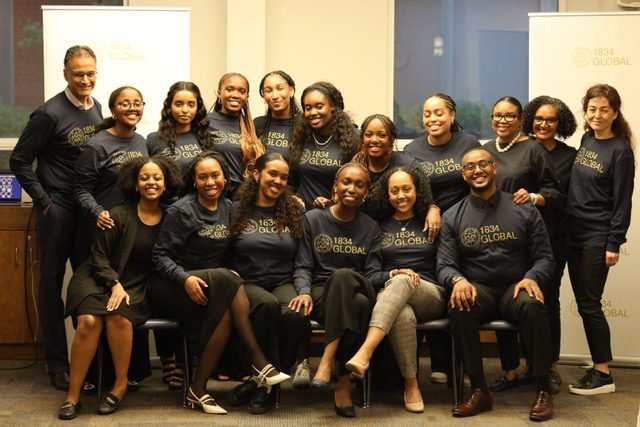
1834 Global Fellowship 2027 for Black Canadians
The 1834 Global Fellowship 2027 is a nine week leadership and professional development programme designed for high potential Black Canadians who are interested in global civic affairs, international development, diplomacy and Canadian foreign policy. The fellowship supports young leaders aged 20 to 30 with practical skills, mentorship, policy research experience and professional networks that can help prepare them for careers connected to global affairs. The programme is offered by the 1834 Foundation in collaboration with the Centre for Diaspora and Transnational Studies at the University of Toronto. It combines weekly virtual sessions, collaborative research projects and expert mentorship, giving Fellows opportunities to engage with global issues while developing their research, writing, leadership and critical thinking skills. During the fellowship, participants work in policy teams on research projects connected to real world global issues. Each team is paired with an experienced coach who provides guidance throughout the research process. The programme concludes with the 1834 Global Summit, an in person event bringing together policymakers, analysts, nonprofit leaders and civically engaged Black youth. About the Fellowship The 1834 Global Fellowship is structured around three major programme components. 1834 Global Mixers provide weekly facilitated sessions covering global issues and leadership challenges. Fellows engage in discussions and activities designed to strengthen their professional and personal competencies in areas including diplomacy, governance, advocacy and policy development. 1834 Global Research Projects place Fellows into policy teams working on research connected to real world global issues. Teams receive ongoing support from experienced coaches with expertise in global affairs. Fellows use the experience to develop research, communication and strategic thinking skills. 1834 Global Summit serves as the culminating experience of the fellowship. Fellows present their research and engage with policymakers, analysts, nonprofit leaders and other participants interested in civic and international affairs. The programme is designed to help participants build practical capabilities and professional connections while gaining greater exposure to global policy institutions and international affairs. Fellowship Benefits • Nine week professional and leadership development programme • Weekly facilitated sessions on global issues and leadership • Expert mentorship and coaching from professionals in global affairs • Practical experience conducting policy research • Collaborative work with other emerging Black leaders • Opportunities to strengthen research and writing skills • Development of critical thinking and strategic communication skills • Exposure to diplomacy, governance, advocacy and policy design • Opportunity to present research at the 1834 Global Summit • Networking with policymakers, analysts, nonprofit leaders and civically engaged youth • Professional development relevant to careers in international development, diplomacy and Canadian foreign policy • Connection to the broader 1834 Foundation community Programme Areas The fellowship explores a range of subjects connected to global civic and international affairs, including: • Diplomacy • International development • Canadian foreign policy • Global governance • Advocacy • Policy design • Global affairs • Leadership development • Research and policy analysis • Strategic communication Eligibility Criteria Applicants for the 1834 Global Fellowship 2027 must meet the following requirements: • Be between 20 and 30 years old • Identify as Black or of African descent • Be a Canadian citizen or permanent resident of Canada • Have an interest in international development, diplomacy or Canadian foreign policy • Be able to participate in the nine week virtual fellowship • Commit approximately 3.5 hours per week to the programme • Be willing and able to travel for the final in person Summit The programme is intended for aspiring Black leaders who are interested in developing their capacity to contribute to global civic and international affairs. Required Application Materials Applicants must submit their application through the secure 1834 Foundation online application system. • Personal statement of no more than 400 words explaining how the applicant hopes to contribute to and benefit from the fellowship • Two letters of reference • One reference from an academic source • One reference from an employer or community leader • Current resume • Contact information • Education history • Work experience • Extracurricular involvement • Volunteer activities Applicants are responsible for ensuring that their reference letters are submitted before the deadline. Referees may also send letters directly to the 1834 Foundation at Programs@1834foundation.ca. How to Apply Review the eligibility requirements for the 1834 Global Fellowship 2027. Prepare a personal statement of no more than 400 words explaining your motivation, expected contribution and what you hope to gain from the fellowship. Prepare an updated resume covering your education, professional experience, extracurricular activities and volunteer involvement. Arrange two reference letters, including one from an academic source and one from an employer or community leader. Submit the complete application through the secure online application system provided by the 1834 Foundation. Ensure that all reference letters are received before the application deadline. Submit your application by October 13, 2026.
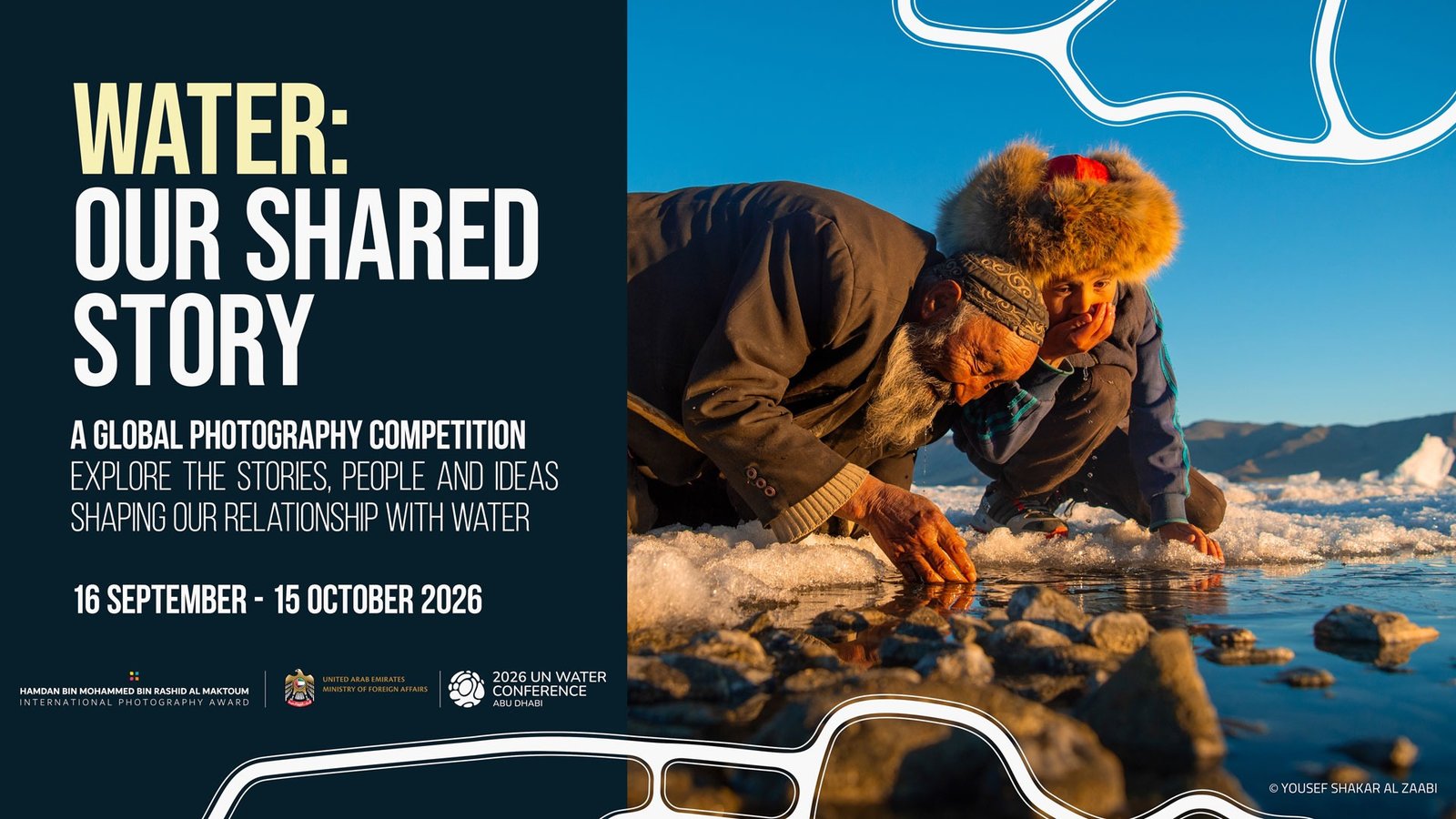
HIPA 2026 Water Our Shared Story Photography Competition
The Hamdan bin Mohammed bin Rashid Al Maktoum International Photography Award (HIPA) has opened applications for its 2026 international photography competition, themed Water: Our Shared Story. The competition invites photographers from around the world to use photography to explore the importance of water and its relationship with people, communities, the planet, innovation and the challenges faced by societies. Organised in collaboration with the UAE Ministry of Foreign Affairs and the 2026 United Nations Water Conference, the competition aims to contribute to a wider global conversation about water. Through visual storytelling, participants can document how water shapes everyday life, communities, economies and ecosystems while highlighting challenges and solutions connected to water. The 2026 United Nations Water Conference will be co hosted by the United Arab Emirates and Senegal in Abu Dhabi from December 8 to 10, 2026. The conference seeks to bring together governments and stakeholders to accelerate progress toward Sustainable Development Goal 6, which focuses on ensuring the availability and sustainable management of water and sanitation for all. About the Competition HIPA is using photography to create a visual record of the many ways water affects human life and the natural environment. The 2026 theme encourages photographers to look beyond conventional images of water and present meaningful stories about people, communities, environmental systems, innovation and water related challenges. Applicants are expected to create a portfolio that communicates a clear story through 5 to 10 photographs. Each portfolio must include a title and description explaining the story being presented. The competition is particularly connected to the global discussion surrounding sustainable water management. Photographers can therefore explore subjects ranging from access to water and community livelihoods to environmental protection, technological solutions and the consequences of water related challenges. Opportunity Benefits • First prize of US$10,000 • Second prize of US$8,000 • Third prize of US$5,000 • Opportunity to have photography considered by an international judging panel • Opportunity to contribute visual perspectives to the global conversation on water • International exposure through HIPA and its associated platforms • Opportunity for selected photography to be used in HIPA promotional and competition related materials, subject to the competition rules The prize money is subject to any applicable taxes, fees or surcharges that may apply to the winner. HIPA states that prizes are delivered within two months following the announcement of the competition results. Programme Areas Participants should develop a photographic story connected to one or more of the following areas: • Water and People • Water and Communities • Water and Planet • Water and Innovation • Water and Challenges These areas allow participants to explore water from social, environmental, technological and human perspectives. Eligibility Criteria • The competition is open to individual photographers from around the world. • Applicants must be at least 18 years old at the time of submission. • Participants must submit between 5 and 10 photographs. • The photographs must form a coherent story related to the competition theme. • Participants must provide a title and description for their portfolio. • Mobile phone photography is accepted. • Drone photography is accepted. • Submitted photographs must be original work created or taken by the participant. • Photographs must not infringe the copyright, privacy, publicity or intellectual property rights of another person or organisation. • Participants must comply with HIPA’s rules concerning identifiable people, private property and copyrighted materials appearing in submitted photographs. Required Application Materials • A portfolio containing 5 to 10 photographs • A title for the photographic portfolio • A description of the portfolio • Original JPEG files of the submitted photographs • Each submitted photograph should be at least 5 MB • The longest edge of each photograph should be at least 2,000 pixels • Image quality should be no less than 300 dpi • Original RAW files or unedited versions may be requested as part of the submission process How to Apply Review the official HIPA competition rules and the theme Water: Our Shared Story. Develop a coherent photographic story connected to water, people, communities, the planet, innovation or water related challenges. Select between 5 and 10 original photographs that work together as a visual story. Prepare a suitable title and description for the portfolio. Check that each photograph meets the required JPEG, file size, resolution and image quality requirements. Remove signatures, logos, borders, frames and other added marks from the submitted photographs. Ensure that any identifiable people, copyrighted materials or private property appearing in the photographs can be supported by the required permissions if HIPA requests them. Submit the photographs online through the HIPA members submission platform. Complete the submission before October 15, 2026 at 11:59 PM UAE Standard Time, GMT plus 4. Keep original and unedited versions of your photographs available in case HIPA requests them during the judging process.
Polyfoni Social Sciences for AI Fellowship 2026 to 2027
Applications are open for the Polyfoni Social Sciences for AI Fellowship 2026 to 2027, a four month part time research collaboration designed for social scientists with fieldwork experience in regions where artificial intelligence products are being deployed. The fellowship provides an opportunity to apply social science knowledge to the development, evaluation and governance of AI systems. The fellowship will run remotely from November 2026 to March 2027. Fellows will conduct a cultural audit of a real AI product in a region where they have genuine contextual knowledge. Rather than beginning a new research project from scratch, participants will apply their existing fieldwork experience through Polyfoni’s structured Cultural Audit Method. Polyfoni is particularly interested in researchers from the humanities and social sciences who can contribute perspectives that are often underrepresented in AI development. Applicants may come from fields including anthropology, sociology, science and technology studies, development studies, political science, humanities and area studies. About the Fellowship The Polyfoni Social Sciences for AI Fellowship connects social science researchers with academic and industry mentors to investigate how AI products operate across different cultural and regional contexts. Fellows will undertake a cultural audit that examines the assumptions embedded in a specific AI product and identifies where those assumptions may fail when the product is deployed in a particular context. The audit follows four main stages: assumption mapping, contextual failure identification, severity assessment and recommendations. Fellows will work closely with Polyfoni supervisors to select and shape an audit project. Possible areas include health AI, agricultural AI, ocean related AI and large language models used in markets where English is not the dominant language. The final output will be a report written for an AI product team. The research will also be published through Polyfoni’s platforms under the fellow’s name, providing an opportunity to share the findings with a wider audience. Fellowship Benefits • Dual mentorship from an academic collaborator and an AI industry professional • Training in Polyfoni’s Cultural Audit Method • Online masterclasses focused on AI governance and related professional development • Monthly group sessions with other fellows • Opportunities for peer feedback and interaction with AI industry practitioners • Research publication through Polyfoni’s platforms under the fellow’s name • Opportunity to contribute to the open access publication Making AI Listen • Exposure to potential career pathways connecting social science and technology • Professional connections through the Polyfoni network Programme Areas The fellowship welcomes applications from a broad range of social science and humanities disciplines, including: • Anthropology • Sociology • Science and Technology Studies • Development Studies • Political Science • Humanities • Area Studies Fellows may examine AI applications in sectors such as health, agriculture, fintech, content moderation and other areas where AI products are being deployed. Eligibility Criteria • Applicants should have an interest in using social science training to contribute to how AI products are built, evaluated and governed. • Applicants may come from the humanities, social sciences or related disciplines. • MSc and PhD students, early career researchers and researchers in adjacent fields are welcome to apply. • There are no strict degree requirements. • Applicants should ideally have fieldwork experience in a Global South context. • Applicants should demonstrate deep contextual knowledge of a place, community or sector where AI is being deployed. • Priority regions include East Africa, South Asia, Southeast Asia, Latin America and China. • Applicants should have a clear interest in working at the intersection of social science and AI. • Applicants should have a concrete idea of an AI product they could audit. • Fellows are expected to commit approximately five hours per week to the audit. • Applicants must be comfortable working in English. • Additional language skills are an advantage. • Prior AI experience is not required. • Applicants from diverse regions and disciplinary backgrounds are encouraged to apply. Polyfoni particularly encourages applications from early career researchers and scholars based in the Global South. Required Application Information • A short motivation statement of no more than 500 words • A clear explanation of your interest in the intersection of social science and AI • A concrete idea of an AI product that you would like to audit • Evidence of relevant regional, community or sector knowledge • Evidence of fieldwork experience where applicable Applicants who progress beyond the initial stage will be contacted for a CV review. How to Apply Review the Polyfoni Social Sciences for AI Fellowship requirements and determine whether your social science or humanities background and fieldwork experience align with the programme. Identify an AI product deployed in a region, community or sector that you understand well through your research or fieldwork experience. Prepare a motivation statement of no more than 500 words explaining your interest in social science and AI and outlining the AI product you would like to audit. Submit your initial application through the Polyfoni application process. If shortlisted, provide your CV for further review. Participate in an interview and research discussion with the Polyfoni team if invited. If selected, join the fellowship remotely from November 2026 and commit approximately five hours each week to the cultural audit through March 2027.
Penn State HDFS PhD Graduate Program 2027
The Department of Human Development and Family Studies at Pennsylvania State University has opened applications for its 2027 Doctor of Philosophy programme. The programme is designed for students seeking advanced academic and research training in human development, family studies and the behavioral sciences. The Penn State HDFS PhD programme provides students with opportunities to work closely with faculty researchers while developing expertise in research design, data collection, analysis and scientific communication. Students participate in an active research environment and can work with mentors whose research interests align with their academic and professional goals. The programme may be suitable for students interested in developmental science, family development, intervention and prevention, research methodology and related areas of behavioral science. Penn State also provides funding support to admitted doctoral students who remain in good standing, including graduate assistantships, tuition support, stipends and an insurance subsidy. About the Penn State HDFS PhD Programme The Human Development and Family Studies programme at Penn State is built around interdisciplinary research and a lifespan approach to understanding individuals, families and social contexts. Graduate students are expected to become involved in faculty research and work with mentors whose research fits their interests. Students can contribute to research projects involving participants, data collection, analysis, academic publications and conference presentations. The department does not offer a standalone master’s degree. Applicants should therefore apply for the PhD programme rather than applying for a separate master’s programme. Programme Areas Graduate students can develop research expertise across several areas of Human Development and Family Studies, including: • Family development • Childhood development • Adolescent development • Adult development and aging • Intervention and prevention • Research methodology Opportunity Benefits • Guaranteed funding for a minimum of four years for admitted doctoral students who remain in good standing • Full tuition support through standard departmental graduate assistantships • Ten month stipend through standard graduate assistantships • Insurance subsidy • Teaching assistantship opportunities • Research assistantship opportunities • Fellowship opportunities for incoming graduate students • Traineeship opportunities for eligible students from the second year onward • Potential summer funding through teaching, administrative or research opportunities • Financial support opportunities for conference registration and travel • Support for workshops and research related expenses • Opportunities to work directly with faculty researchers and research mentors • Opportunities to conduct research, analyse data, publish findings and present at academic conferences Eligibility Criteria Applicants should have an academic background and professional interests that align with human development, family studies, behavioral science or related research areas. • Applicants must apply to the Doctor of Philosophy degree in HDFS • Applicants entering with a bachelor’s degree will complete a master’s degree en route to the PhD • Applicants should demonstrate preparation and potential for advanced graduate study and research • Applicants should have research interests that can be supported by the department’s faculty and research environment • International applicants may apply and must meet the additional requirements established by the Penn State Graduate School • Applicants should be prepared to provide all required academic and supporting documentation Required Application Materials Applicants should prepare the following programme specific materials: • Scientific writing sample • Official academic transcripts • Curriculum vitae or résumé • Statement of professional and career plans • Three letters of recommendation How to Apply Review the Penn State HDFS PhD programme and identify faculty research areas that align with your interests. Review the Penn State Graduate School admission requirements for the doctoral programme. Prepare your scientific writing sample, academic transcripts, CV or résumé and statement of professional and career plans. Arrange three letters of recommendation from individuals who can speak to your academic, research or professional potential. Complete the Penn State Graduate School application and select the Doctor of Philosophy degree in Human Development and Family Studies. Upload all required documents through the admissions portal. Review your application carefully to ensure that all required materials have been submitted. Submit the complete application by December 1, 2026, taking Penn State’s Eastern Standard Time zone into account.