
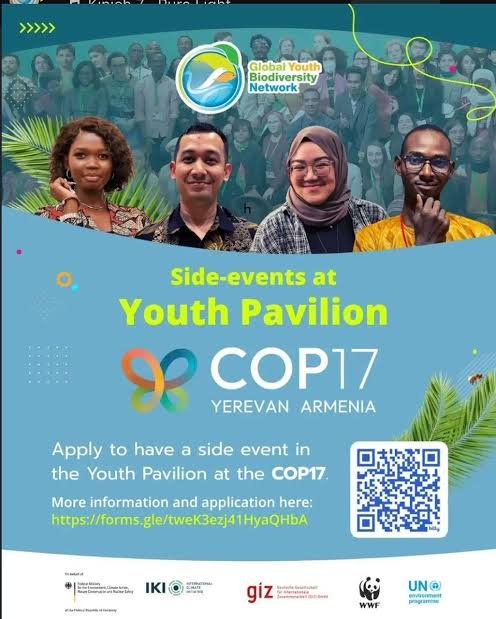
Applications are open for the COP17 Youth Pavilion Side Events 2026 in Yerevan, Armenia, offering young people, youth groups, networks, youth led organisations and partners an opportunity to propose and host interactive events during the seventeenth meeting of the Conference of the Parties to the Convention on Biological Diversity, known as CBD COP17. The Youth Pavilion is organised by the Global Youth Biodiversity Network (GYBN) and is designed as a dedicated space for youth participation, networking, knowledge sharing, cultural activities and discussions connected to biodiversity and environmental issues. Applicants are invited to bring ideas that can contribute to meaningful youth engagement during the international conference. The call welcomes creative and interactive event proposals rather than limiting applicants to a single format. Proposed activities may include intergenerational dialogues, workshops, panel discussions, cultural activities, artivism, networking sessions, knowledge sharing and other engaging formats relevant to the COP17 context. About the COP17 Youth Pavilion Side Events The Youth Pavilion provides a platform dedicated to young people, youth groups, youth led networks and organisations and their partners. It is intended to amplify youth voices and create opportunities for young people to contribute to conversations surrounding biodiversity and the wider COP17 agenda. The initiative encourages event proposals that create meaningful interaction rather than relying solely on conventional presentations. Activities can bring together young people, organisations, experts and other stakeholders to exchange knowledge, discuss challenges, showcase initiatives and explore solutions. GYBN particularly welcomes proposals for intergenerational dialogues, discussions and activities that maintain a clear focus on youth participation. The Youth Pavilion can therefore serve as a space to highlight youth led approaches, experiences and ideas while creating connections between participants from different countries and backgrounds. Opportunity Benefits • Opportunity to host an event at the COP17 Youth Pavilion • Platform to amplify youth voices in an international biodiversity setting • Opportunity to share youth led ideas, experiences and solutions • Networking with young people, organisations and other stakeholders • Opportunity for knowledge exchange and collaborative learning • Space for cultural activities and creative environmental expression • Opportunity to facilitate intergenerational dialogue • Platform to contribute to discussions connected to biodiversity and environmental issues • Opportunity to showcase youth initiatives and perspectives Who Can Apply? The call is open to individuals and organisations with relevant ideas that they would like to bring to the Youth Pavilion. • Young people • Youth groups • Youth networks • Youth led organisations • Youth led networks • Partners with relevant event ideas Applicants should develop a proposal that is suitable for a youth focused environment and relevant to the broader context of COP17. Suggested Areas of Focus The call does not prescribe a mandatory list of topics. Applicants can therefore develop activities around issues of their choice provided they are relevant to the Youth Pavilion and COP17. Potential areas include: • Youth participation in environmental decision making • Biodiversity conservation • Environmental challenges affecting young people • Youth led solutions • Climate and biodiversity connections • Intergenerational collaboration • Indigenous and local knowledge • Community action • Environmental education • Sustainable development • Cultural expression and artivism • Networking and knowledge exchange Applicants should ensure that their proposed activity has a clear connection to youth participation and the broader biodiversity context. Required Application Information Applicants should be prepared to provide information about their proposed Youth Pavilion activity through the official application form. The proposal should clearly communicate: • The idea or topic of the proposed event • The intended event format • How the activity will engage participants • The relevance of the activity to youth and the COP17 context • The value the event can contribute to the Youth Pavilion Applicants should make their proposals practical, engaging and suitable for an international youth focused programme. How to Apply Develop an interactive event idea that is relevant to youth participation, biodiversity or environmental issues. Choose an appropriate format such as an intergenerational dialogue, workshop, panel discussion, cultural activity, networking session or another creative activity. Prepare the information required to explain your proposed activity and its relevance to the Youth Pavilion. Complete the official online application form provided by the organisers. Submit your proposal before September 20, 2026 at 23:59 UTC. If selected, monitor your email for communication from the organisers between September 22 and September 28.
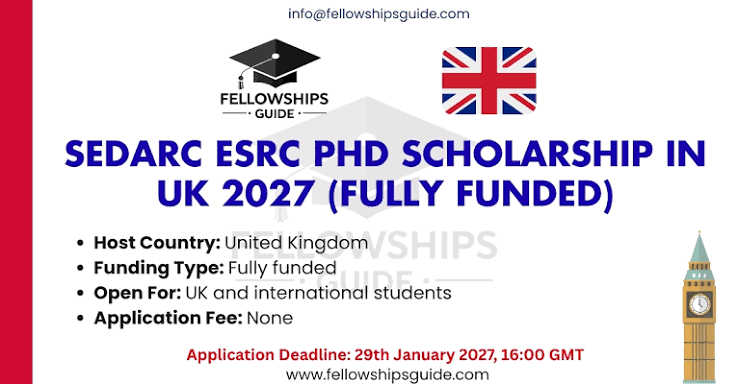
SEDarc ESRC PhD Studentships 2027 in the UK
The South East Doctoral Training Arc (SEDarc) is offering Economic and Social Research Council (ESRC) funded PhD studentships for researchers seeking to begin doctoral study in the United Kingdom in September 2027. The programme supports research across the social sciences and brings together six universities in London and South East England. The SEDarc studentships are open to both UK and international applicants who meet the academic and research requirements of their chosen university. Successful applicants receive funding for doctoral tuition at the UK home fee rate and a living allowance at UK Research and Innovation (UKRI) rates. For eligible international students, SEDarc institutions generally cover the difference between home and international tuition fees, although the University of Reading is an exception. The programme combines doctoral research with advanced research training, professional development and a funded placement. Students undertake an individual research project within one of five interdisciplinary pathways addressing major social, economic, environmental, institutional and technological challenges. The participating universities are the University of Kent, Kingston University, the University of Reading, Royal Holloway, University of London, the University of Surrey and the University of Sussex. Applicants must first apply through their chosen institution and secure nomination before submitting their final SEDarc application. About the PhD Studentships SEDarc is a Doctoral Training Partnership funded through the ESRC and UKRI. Its doctoral training model combines an individual research project with specialist skills development and a placement outside or within academia. The standard doctoral studentship has a minimum funded duration of 3.25 years, with up to three additional months available for a placement. Applicants without a relevant social science Master’s degree may be eligible for an integrated Master’s and PhD route, which can extend the funding period to a maximum of 4.25 years plus the placement period. SEDarc supports research across fourteen social science disciplines organised into five interdisciplinary thematic pathways. These pathways are designed to encourage research that addresses complex real world challenges through collaboration across disciplinary boundaries. Opportunity Benefits • PhD tuition fees at the UK home fee rate • Living allowance at UKRI rates • International tuition fee difference covered by participating institutions, except the University of Reading • Additional research and training funding • Support for eligible UK or overseas fieldwork • Funding for overseas institutional visits where applicable • Support for difficult language training where relevant • Funded placement in academia, government, policy, business or the third sector • Approximately 200 hours of general skills training during the first year • Approximately 200 hours of specialist skills training during the second and third years • Individual doctoral research and supervision • Professional development and employability preparation Participating Universities • University of Kent • Kingston University • University of Reading • Royal Holloway, University of London • University of Surrey • University of Sussex SEDarc also works with partner organisations outside higher education to expand research, training and placement opportunities for doctoral students. Research Pathways Applicants should develop research that fits within one of the five SEDarc interdisciplinary pathways. • Living Sustainably • Healthy Thriving Communities • Inclusive Economic Growth • Secure, Effective and Trusted Institutions • Transformative Technologies for Society These pathways provide a broad framework for research addressing social, economic, environmental, institutional and technological challenges. Potential research areas vary between universities and departments. They can include disciplines such as economics, sociology, politics, international relations, geography, psychology, criminology, business, environmental studies and other related social science fields. Eligibility Criteria • Open to UK and international students • Applicants must meet the academic entry requirements of their selected university and doctoral programme • Applicants must identify a suitable PhD programme within the SEDarc consortium • Applicants must identify an appropriate research supervisor • Proposed research should fit within a relevant SEDarc interdisciplinary pathway • Applicants should demonstrate strong potential for doctoral research • Applicants must complete the institutional application process before nomination • Applicants without a relevant social science Master’s degree may be eligible for the integrated Master’s and PhD route • Applicants must not already have started their PhD, as SEDarc funding is for new doctoral entrants • International applicants must satisfy the immigration and admission requirements of their chosen university Application Process SEDarc does not operate as a simple direct application scheme. Applicants must first go through the relevant university and department. The general process is: Choose one of the six participating SEDarc universities. Identify a suitable doctoral programme and research area. Review the department specific admission requirements and deadlines. Identify and contact a potential research supervisor. Apply for admission to the selected PhD programme through the university. Complete the university’s internal SEDarc application process. If shortlisted, complete or revise the SEDarc application as instructed. The university nominates its strongest candidates to the SEDarc consortium. Submit the final SEDarc application by the consortium deadline
2026 to 2027 Better Life Lab Multimedia Reporting Grants for Journalists and Storytellers
The Better Life Lab at New America is inviting journalists and storytellers to apply for its 2026 to 2027 Multimedia Reporting Grants, an opportunity supporting powerful, solutions oriented stories about caregiving, child care, family support, disability care, elder care, and end of life care. The programme is designed for storytellers who can use journalism and creative media to examine challenges within care systems while highlighting practical solutions, innovations, and possibilities for stronger care infrastructure. The grants are focused on stories that can help audiences understand why care matters to families, communities, children, workers, and the wider economy. Rather than focusing only on problems, the Better Life Lab is particularly interested in reporting that investigates approaches already being tested or implemented and examines what can be learned from them. Selected storytellers will have their stories commissioned on a rolling basis beginning in October 2026. They will also be invited to participate in the Better Life Lab reporting cohort and receive editorial guidance and placement assistance. Both new and experienced reporters are welcome to apply, with people whose perspectives have traditionally been underrepresented in the media particularly encouraged to submit proposals. About the Better Life Lab Multimedia Reporting Grants The Better Life Lab is a programme of New America focused on work family justice, gender equity, and the value of care. Its reporting grants support journalists and storytellers who want to explore the many ways care affects people’s lives and the systems that support families and communities. Care can include raising children, supporting relatives during illness, assisting people with disabilities, caring for older adults, and providing support during the end of life. Through its reporting grants, the Better Life Lab seeks stories that examine these experiences while identifying solutions that could contribute to stronger and more equitable care systems. The 2026 to 2027 grants focus particularly on two major areas: innovations in child care and investments in care infrastructure. Opportunity Benefits • Reporting commissions beginning on a rolling basis from October 2026 • Funding for selected reporting projects • Participation in the Better Life Lab reporting cohort • Editorial guidance from the Better Life Lab • Assistance with story placement and publication • Opportunity to develop solutions oriented journalism • Exposure to a network of storytellers working on care related issues • Opportunity to reach broad and diverse audiences through creative storytelling • Support for new and experienced reporters Reporting Areas Innovations in Child Care One major focus is reporting on real world innovations that could contribute to a more equitable and accessible child care system. Possible areas include: • Rethinking when learning begins • Examining who is served by child care systems • Exploring the quality of child care • Examining child care costs • Exploring how child care is financed • Highlighting innovations that improve access and equity • Exploring approaches that provide families with greater choices • Examining ways to support living wages for child care educators and providers Applicants are encouraged to investigate programmes, models, policies, practices, and community initiatives that are already underway and could offer useful lessons for the future. Investments in Care Infrastructure The second focus is investment in care infrastructure across different stages of life. Stories may explore issues affecting: • Infants and young children • Families requiring child care • People with disabilities • Older adults • Families caring for aging relatives • People approaching the end of life • Family members and other caregivers The reporting can examine how stronger care infrastructure could affect families, communities, gender equality, and economic life. Storytelling Formats The Better Life Lab welcomes a broad range of reporting and creative formats. Applicants are not limited to traditional written journalism. Possible formats include: • Print stories • Online articles • Photojournalism • Graphic stories • Podcasts • Audio stories • Multimedia projects • Videography The programme is also interested in new and creative approaches that can make care related issues understandable and engaging for broad and diverse audiences. Solutions Oriented Journalism A central feature of the programme is its emphasis on solutions journalism. The Better Life Lab is looking for reporting that goes beyond describing what is wrong and investigates approaches that may help address care related challenges. Applicants should consider how their proposed story can identify practical responses, innovations, programmes, policies, or community efforts. Strong story ideas can explore why care matters, what innovations are already being attempted, whether those innovations can be expanded or replicated, and what a stronger care system could look like. The programme is particularly interested in stories that help audiences understand the connection between care and everyday life while showing what is possible. Eligibility Criteria • Journalists and storytellers are eligible to apply • New reporters are welcome • Experienced reporters are welcome • Applicants from perspectives traditionally underrepresented in the media are particularly encouraged • Applicants should have a compelling story idea connected to caregiving or care infrastructure • Proposed stories should have a clear solutions oriented element • Stories should be suitable for one of the programme’s accepted reporting or storytelling formats • Applicants should be able to develop reporting that can engage broad and diverse audiences Required Application Information The current programme announcement directs applicants to the Better Life Lab application form. The publicly available announcement does not specify a fixed list of application documents. Applicants should therefore review the application form carefully and provide the information requested about their proposed reporting project, storytelling approach, and relevance to the programme’s focus. How to Apply Review the Better Life Lab’s 2026 to 2027 Multimedia Reporting Grants announcement. Identify a reporting idea connected to caregiving, child care, disability care, elder care, end of life care, or care infrastructure. Develop a solutions oriented story concept that investigates practical approaches, innovations, or possibilities. Select the storytelling format that best fits the proposed project, such as print, online reporting, photography, audio, podcasting, graphics, multimedia, or video. Complete the official application form with the requested information. Submit the application through the Better Life Lab
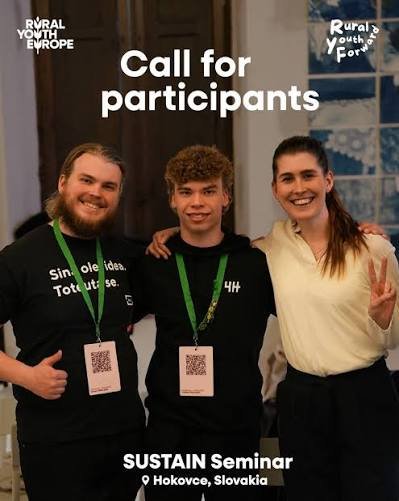
SUSTAIN Seminar 2026 in Slovakia
The SUSTAIN Seminar 2026 is an international youth opportunity in Slovakia for young Europeans interested in rural youth development, leadership, organisational sustainability and policy making. The seminar will bring together 25 motivated young people from across Europe to explore how rural youth organisations and networks can become stronger, more sustainable and more influential in decision making. Organised by Rural Youth Europe and the Rural Youth Parliament in Slovakia, the seminar will take place from 8 to 13 November 2026 in Hokovce, Slovakia. The main programme will focus on organisational development, leadership, volunteer engagement, sustainable financing, partnerships, youth participation and European policy engagement. The SUSTAIN Seminar forms part of the Rural Youth Forward project, which aims to strengthen resilient rural youth networks and create meaningful opportunities for young people in rural communities to participate in policy processes. The activity is supported through the Erasmus+ Programme of the European Union. About the SUSTAIN Seminar The SUSTAIN Seminar focuses on sustaining and growing local and national rural youth organisations and networks while strengthening their European dimension. Many rural youth organisations face challenges such as limited volunteer capacity, dependence on short term funding, difficulties with leadership succession, weak organisational structures and challenges in transferring knowledge between generations. The seminar will help participants explore practical ways to address these issues and build organisations that can remain active and effective over the long term. Participants will have opportunities to examine organisational structures, leadership practices, volunteer engagement, communication, partnerships, financing and policy participation. The official organiser is seeking 25 motivated young people from across Europe for the six day activity, including travel dates. Opportunity Benefits • Shared accommodation covered by the organisers • Meals covered from dinner on 8 November through breakfast on 13 November 2026 • Travel reimbursement according to the project travel guidelines • No participation fee • International networking with rural youth representatives from across Europe • Peer learning and exchange of good practices • Practical organisational development experience • Leadership and volunteer engagement learning • Exposure to European youth participation mechanisms • Participation in a Civic Dialogue with relevant stakeholders • European Parliament simulation experience • Opportunity to develop an organisational action plan • Opportunity to contribute to recommendations and policy work Programme Areas The SUSTAIN Seminar will cover several areas connected to rural youth leadership and organisational development. Organisational Sustainability Participants will explore organisational vision, governance, membership, programmes, feedback systems, risk management, knowledge transfer and organisational development. Leadership and Volunteer Engagement The programme will examine leadership development, volunteer engagement, generational renewal, knowledge sharing, team building and organisational growth. Sustainable Financing and Partnerships Participants will consider approaches to sustainable financing, partnership development, stakeholder engagement and organisational communication. European Youth Participation The seminar will introduce participants to European participation mechanisms such as Have Your Say, the European Citizens’ Initiative, citizens’ panels, public consultations and petitions to the European Parliament. Civic Dialogue Participants will take part in a Civic Dialogue involving European and national stakeholders, supported by Europe Direct and a Team Europe expert. European Parliament Simulation The programme includes a simulation of the European Parliament where participants will explore policy negotiation and collaborative decision making while working towards a shared Rural Youth Resolution. Organisational Action Planning Participants will develop practical organisational action plans and recommendations that can contribute to the wider Rural Youth Forward project. Eligibility Criteria The SUSTAIN Seminar is intended for young people from across Europe who have an interest or involvement in rural communities and youth development. Applicants should generally meet the following criteria: • Be between 18 and 30 years old at the time of the seminar • Have a connection to a rural community • Be available to participate in the full programme from 8 to 13 November 2026 • Have an interest or experience in rural youth work, community development, youth participation, organisational development or policy making • Be willing to actively participate in discussions, workshops and group activities • Be able to communicate and participate in English • Be willing to share experiences, ideas and practices with other participants • Demonstrate motivation to apply learning within their community or organisation SUSTAIN Seminar 2026 Dates The programme will take place according to the following schedule: • Arrival: 8 November 2026 • Main seminar programme: 9 to 12 November 2026 • Departure: 13 November 2026 • Overall activity dates: 8 to 13 November 2026 Required Application Information Applicants should complete the official online registration form and provide the information requested by the organisers. Applicants should be prepared to demonstrate: • Their connection to rural communities • Their experience or interest in rural youth development • Their motivation for participating • Their ability to participate for the full duration • Their willingness to contribute to peer learning • Their ability to participate in English • Their interest in applying the knowledge gained after the seminar Participation is limited to 25 selected young people, so submitting an application does not automatically guarantee participation. How to Apply Review the SUSTAIN Seminar information and eligibility requirements. Confirm that you can attend the full activity from 8 to 13 November 2026 in Hokovce, Slovakia. Prepare the information required for the online application. Complete the official SUSTAIN Seminar registration form. Submit your application before the deadline of 25 September 2026. Wait for official confirmation before making travel arrangements. The official Rural Youth Europe event page states that registration is open until 25 September 2026.
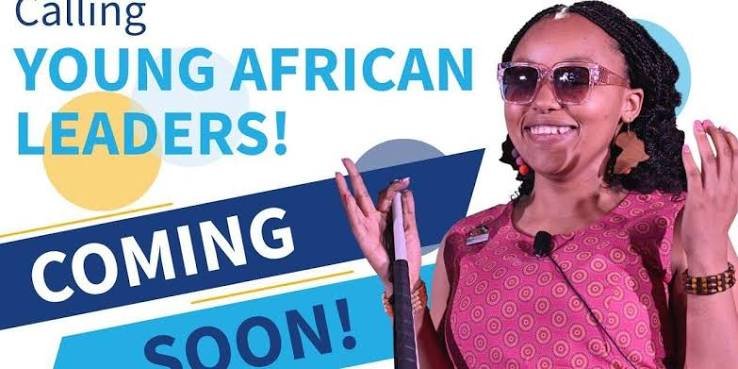
2027 Mandela Washington Fellowship for Young African Leaders
The 2027 Mandela Washington Fellowship for Young African Leaders is a U.S. Government funded leadership and professional exchange opportunity for accomplished young leaders from Sub Saharan Africa. The Fellowship is the flagship programme of the Young African Leaders Initiative, commonly known as YALI, and provides participants with leadership development, professional learning, networking and engagement opportunities in the United States. Applications for the 2027 Fellowship are scheduled to open on September 22, 2026. The programme is designed for young African professionals and community leaders who have demonstrated leadership, achievement and a commitment to making a positive contribution in their communities, countries or professional sectors. The Fellowship brings together leaders from across Sub Saharan Africa for an intensive six week Leadership Institute hosted by a U.S. college or university. Fellows participate in academic and practical learning while engaging with American professionals, organisations and communities. Since its establishment in 2014, the programme has connected nearly 7,800 young leaders from all 49 countries in Sub Saharan Africa. About the Fellowship The Mandela Washington Fellowship is administered by the U.S. Department of State’s Bureau of Educational and Cultural Affairs and funded by the U.S. Government. IREX administers the Fellowship programme. The programme is not an academic degree programme. Instead, it combines leadership development, practical learning, professional networking and cultural exchange. Fellows learn alongside other emerging African leaders and engage with U.S. institutions and professionals. During the six week Leadership Institute, Fellows participate in activities designed to strengthen their leadership and professional capabilities while providing opportunities to exchange ideas and experiences across different sectors and countries. 2027 Fellowship Tracks Business and Trade This track is intended for leaders working in entrepreneurship, business development, trade, investment, economic growth and related areas. Participants can explore practical approaches to business and economic development while exchanging ideas with African peers and U.S. professionals. Emerging Technologies This track focuses on leaders working with technology and emerging technological fields that are influencing economies and societies. Participants can develop professional knowledge, explore innovative approaches and connect with others working at the intersection of technology, leadership and development. Governance and Security This track is designed for leaders working in governance, public service, security, policy and related areas. Participants have opportunities to examine leadership approaches, exchange perspectives and engage with U.S. institutions and professionals. Fellowship Benefits • Six week Leadership Institute at a U.S. college or university • Leadership and professional development • Academic and practical learning • Networking with young African leaders from across Sub Saharan Africa • Engagement with U.S. businesses, organisations and professionals • Community and cultural activities • Professional exchange and knowledge sharing opportunities • Access to the broader Mandela Washington Fellowship alumni network • Opportunities to develop relationships with African and U.S. institutions The Fellowship is funded by the U.S. Government. Applicants should consult the official 2027 programme instructions when released for the complete list of covered programme costs and travel arrangements. Programme Areas Applicants for the 2027 Fellowship can select from three areas: • Business and Trade • Emerging Technologies • Governance and Security Applicants should select the track that most closely reflects their current professional experience and long term goals. Eligibility Criteria The official 2027 application instructions should be reviewed when applications open because requirements can change between Fellowship cycles. Based on the current programme information and previous official eligibility requirements, applicants should expect to meet criteria including: • Be between 25 and 35 years old at the time specified by the application cycle • Exceptional applicants between 21 and 24 may be considered • Be a citizen and resident of an eligible Sub Saharan African country • Be proficient in spoken and written English • Have an established record of leadership and accomplishment • Have professional, civic, entrepreneurial, public service or community experience relevant to the selected track • Demonstrate commitment to public or community service, volunteerism or mentorship • Not be a U.S. citizen or permanent resident • Be eligible to receive a U.S. J 1 visa • Not be an employee of the U.S. Government or an immediate family member of an employee of the U.S. Government • Not have previously participated in the Mandela Washington Fellowship • Demonstrate commitment to returning to Africa and contributing skills and experience to their community or country Previous participation in other YALI programmes does not automatically mean that an applicant has participated in the Mandela Washington Fellowship. Selection Criteria • Proven record of leadership and accomplishment in business, entrepreneurship, civic engagement or public service • Demonstrated commitment to public or community service, volunteerism or mentorship • Ability to work cooperatively with people from diverse backgrounds • Strong social and communication skills • Demonstrated knowledge, interest and professional experience related to the selected Fellowship track • Clear goals for applying knowledge and skills gained through the Fellowship • Commitment to returning to Sub Saharan Africa and contributing to community development Required Application Information This may include: • Current curriculum vitae or resume • Professional and leadership experience • Community service, volunteer and mentorship experience • Awards and recognitions • Information about relevant projects and initiatives • Evidence of professional accomplishments • Responses to Fellowship essay questions • Information about the preferred Fellowship track • Goals for using Fellowship knowledge and skills after the programme • Plans for contributing to the applicant’s community or country The official application is submitted online and is free of charge. How to Prepare 1. Select your Fellowship track Review Business and Trade, Emerging Technologies and Governance and Security and determine which area most closely connects with your current work and future goals. 2. Update your CV Highlight leadership positions, professional achievements, community involvement, awards, entrepreneurial activities, volunteer work, mentorship and projects where you achieved measurable results. 3. Identify your strongest leadership examples Think about specific situations where you solved a problem, created an initiative, supported other people, led a team or produced meaningful results. 4. Prepare your application essays The official Fellowship advises applicants to use real world examples when answering application questions.
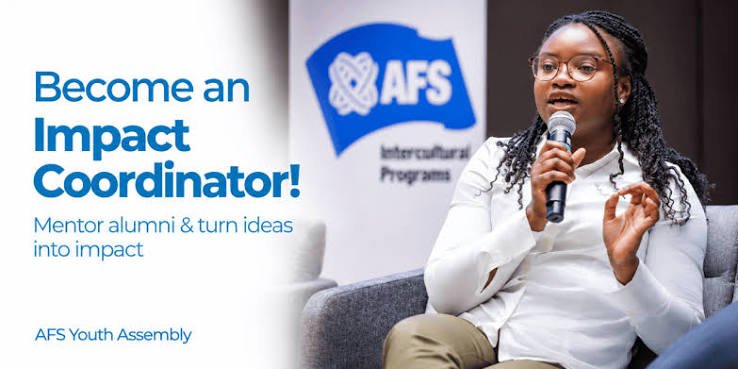
AFS Youth Assembly Impact Coordinator 2026
Applications are open for the AFS Youth Assembly Impact Coordinator opportunity for young leaders who have previously participated in the AFS Youth Assembly and are interested in strengthening youth action and social impact within their regions. The initiative is part of the next phase of the AFS Youth Assembly Alumni Impact Network, which connects young leaders across regions and supports them in turning ideas into meaningful projects and initiatives. The AFS Youth Assembly is building a stronger global network of alumni across six regions: Africa, Asia and Oceania, Europe, LATCAR, MENA, and North America. Impact Coordinators will play an important role in helping alumni move from ideas to implementation, connecting them with relevant resources, mentorship, funding opportunities, and other members of the network. The Impact Coordinator role is designed for young leaders with experience working with youth, developing social impact projects, or participating in initiatives and social ventures. Coordinators will help organize alumni, encourage collaboration, support action oriented activities, and showcase the work of young people to a wider global audience. About the Opportunity The AFS Youth Assembly Alumni Impact Network provides a platform for former Youth Assembly participants to continue collaborating and creating impact after the Assembly. Impact Coordinators serve as regional leaders who help alumni develop ideas, launch initiatives, access resources, and connect with other changemakers. AFS currently works through six regions, allowing coordinators to focus on the needs and opportunities within their respective communities while remaining connected to a global network. The role is voluntary and requires a meaningful commitment of time and effort over the two year term. Impact Coordinators are expected to help create an active alumni community by organizing virtual or in person meetings, encouraging collaboration, supporting projects, and sharing progress with AFS staff. They may also help highlight successful alumni projects through global communication channels. Opportunity Benefits • Serve as a global youth leader for a two year term • Receive a full scholarship to attend the 2027 AFS Youth Assembly in Geneva • Develop practical leadership, communication, coordination, and organizational skills • Receive an AFS Global Competence certificate • Access training support • Gain experience supporting social impact initiatives and youth projects • Be featured through AFS social networks and other global communication channels • Receive opportunities to showcase projects and impact work • Build connections with AFS alumni and youth leaders across different regions • Strengthen professional and academic skills through practical leadership experience Responsibilities • Lead as a regional global leader for a two year term • Organize, motivate, and lead fellow AFS Youth Assembly alumni • Coordinate regular virtual or in person alumni meetups • Encourage collaboration among alumni in the region • Support alumni in developing action oriented activities • Help alumni turn social impact ideas into practical projects • Connect alumni with relevant resources, partners, impact hubs, and youth opportunities • Promote and showcase successful alumni projects to a global audience • Track project progress and provide updates to AFS staff • Encourage continued youth engagement following the AFS Youth Assembly Eligibility Criteria • Previous participation in the AFS Youth Assembly is required • Live in the region you intend to represent • Have a strong interest in social impact and the United Nations Sustainable Development Goals • Have experience working with young people, including mentoring or supporting youth action projects • Have started or participated in a successful project, initiative, or social venture • Have knowledge of ideation and the development of social projects or ventures • Have connections with useful resources such as impact hubs, partners, and youth resources • Demonstrate strong leadership skills • Demonstrate strong communication and coordination skills • Possess good organizational abilities • Be able to work independently and collaboratively • Have access to a personal computer • Have stable internet connectivity • Be able to commit the required time and effort to the role • Be proficient in written and spoken English • Be comfortable using social media and digital tools for communication and networking Programme Regions Impact Coordinators are selected to support alumni communities across six AFS regions: • Africa • Asia and Oceania • Europe • LATCAR • MENA • North America Selection Focus AFS is looking for alumni who can actively contribute to youth action and social impact within their communities. Relevant experience with youth engagement, social projects, community initiatives, social ventures, mentorship, networking, and project development is important. Applicants should also demonstrate the ability to organize people, communicate effectively, collaborate with others, work independently, and connect young leaders with resources that can help turn ideas into action. Strong candidates are expected to have a clear commitment to social impact and the Sustainable Development Goals, together with the time and motivation required to serve throughout the two year term. How to Apply Confirm that you previously participated in the AFS Youth Assembly. Identify the AFS region you intend to represent and confirm that you currently live in that region. Review the responsibilities and eligibility requirements to ensure that you can commit to the two year volunteer role. Prepare the information required by the AFS Youth Assembly application form, highlighting your youth leadership, social impact experience, projects, initiatives, networking, and community engagement. Submit your application through the official AFS Youth Assembly application platform. Complete the application before the deadline of September 18, 2026.
Cornell University AI for Sustainability AI4S Visiting Professorship Program 2027
The Cornell University AI for Sustainability AI4S Visiting Professorship Program 2027 is inviting faculty scholars from around the world to collaborate on research at the intersection of artificial intelligence and sustainability. The programme provides an opportunity for academics to work with faculty, researchers and students connected to the Cornell AI for Sustainability Initiative, while contributing to research, teaching and the wider academic environment. The programme is designed to build meaningful and sustained academic collaborations rather than create a conventional full time visiting appointment. Selected visiting professors normally hold the Cornell University AI4S Visiting Professor title for two years, with the possibility of extension. During this period, they can participate in short academic visits to Cornell, typically lasting a few days and generally no more than two weeks at a time. The initiative brings together artificial intelligence research and major sustainability challenges. Cornell’s wider AI and Sustainability work includes sustainable AI systems, climate adaptation and resilience, climate mitigation and decarbonization, nature and biodiversity, and the built environment and circular economy. About the Opportunity The AI4S Visiting Professorship is intended to strengthen international academic collaboration in artificial intelligence and sustainability. Visiting professors have the opportunity to engage with Cornell researchers, participate in research discussions, deliver seminars or guest lectures and contribute to curriculum development. Cornell describes the opportunity as a paid visiting professorship. The programme is structured around short visits rather than a permanent relocation or conventional employment appointment. Cornell’s Global Hubs information also describes the visits as taking place over a period of two calendar years. The programme can therefore provide a flexible way for established academics and researchers to develop international research relationships while maintaining their primary academic commitments at their home institutions. Opportunity Benefits • Paid visiting professorship opportunity at Cornell University • Opportunity to collaborate with researchers working at the intersection of AI and sustainability • Access to an international academic network • Opportunities to develop collaborative research projects • Engagement with Cornell faculty, researchers and students • Opportunity to contribute to AI4S curriculum development • Opportunity to give seminars and guest lectures • Participation in research discussions and the wider academic environment • Short academic visits that can be combined with responsibilities at the home institution • Visiting Professor title normally held for two years • Possibility of extending the visiting professorship • Potential consideration for accompanying students as part of a broader collaborative plan, subject to available resources Programme Areas The programme connects artificial intelligence with sustainability research across areas including: • Sustainable artificial intelligence and reduction of the environmental impact of AI • Climate adaptation and resilience • Climate mitigation and decarbonization • Energy systems and materials • Nature and biodiversity • Environmental monitoring and natural resource management • Built environment and circular economy • Sustainable computing and AI infrastructure • Food and natural systems • Responsible application of artificial intelligence to sustainability challenges Eligibility Criteria • Open to faculty members worldwide • Faculty scholars at all career stages may be considered • Applicants should have research interests relevant to artificial intelligence and sustainability • Candidates must be nominated by a faculty member connected to the Cornell AI for Sustainability Initiative • Prospective visitors should establish research fit and potential collaboration with a suitable Cornell faculty member • The proposed collaboration should align with the mission and research interests of the AI for Sustainability Initiative • Candidates should be able to contribute to the academic environment through research, teaching, seminars, guest lectures or related activities Required Application Information The nomination should provide information that demonstrates the proposed academic collaboration, including: • Current curriculum vitae • Description of the candidate’s relevant expertise • Details of existing collaboration with CAISI, where applicable • Outcomes from previous collaboration activities, where applicable • Description of the proposed research collaboration • Expected outcomes from the proposed collaboration • Proposed contribution to the AI4S curriculum • Proposed contribution to the wider Cornell academic environment • Proposed timing for the visit • Detailed budget plan The formal nomination is submitted by the Cornell faculty member rather than directly by the prospective visiting professor. How to Apply Review the Cornell University AI for Sustainability Visiting Professorship information and identify how your research interests connect with the programme. Identify a Cornell faculty member connected to the AI for Sustainability Initiative whose research interests align with your proposed collaboration. Contact the potential faculty host to discuss research interests, collaboration opportunities and the proposed visit. Develop a clear research collaboration proposal explaining the research objectives, expected outcomes and relevance to AI and sustainability. Prepare your curriculum vitae and the other information required for the nomination. Discuss your proposed contribution to the AI4S curriculum and wider Cornell academic environment with the prospective faculty host. Prepare a proposed visit schedule and detailed budget plan. Work with the Cornell faculty member to submit the formal nomination.
Interactivity Foundation Collaborative Discussion Emerging Fellowship 2027
Applications are open for the Interactivity Foundation Collaborative Discussion Emerging Fellowship 2027, a year long fellowship for individuals who are committed to strengthening collaborative discussion and democracy within their communities. The programme provides emerging leaders with mentorship, training, practical project experience and opportunities to develop new approaches to meaningful public discussion. The fellowship is part of the Interactivity Foundation’s Collaborative Discussion Project, an ongoing initiative that explores how people can think better together and how creative, culturally responsive and critically informed discussion can contribute to stronger communities. Emerging Fellows are paired with Senior Fellows who have experience in collaborative discussion and who provide guidance and support throughout the programme. The programme is designed for people who have already demonstrated an interest in collaborative discussion or strengthening democracy in a particular community. The Foundation welcomes applicants from diverse ages, careers, identities, political affiliations, racial and ethnic backgrounds, religions, socioeconomic backgrounds and lived experiences. It particularly seeks to nurture new and diverse leadership by creating opportunities for people who may not previously have participated in a fellowship of this kind. About the Fellowship The Collaborative Discussion Emerging Fellowship is organised by the Interactivity Foundation as part of its effort to expand awareness and engagement with collaborative discussion among diverse communities. Fellows work with Senior Fellows to explore questions surrounding dialogue, deliberation, community engagement and democratic participation. During the fellowship, participants develop and implement a project designed to advance collaborative discussion. Possible projects may include designing and delivering a workshop, developing a Collaborative Discussion certificate programme, creating a new activity for the Collaborative Discussion Toolkit or developing an innovative way to introduce the project to new audiences. Fellows will also produce a publication, video or new curriculum that advances the Foundation’s mission. The programme includes an in person launch at the University of Delaware, virtual Collaborative Discussion Coach Training, monthly virtual meetings and an in person Fellows Showcase. Fellowship Benefits • $6,000 stipend paid in three installments • Full scholarship to Collaborative Discussion Coach Training valued at $495 • Travel and expenses covered for two in person fellowship gatherings • Practical experience completing a real world community project • Co author credit on a written piece, new curriculum or audiovisual media project • Monthly virtual meetings with mentors and fellow participants • Regular mentorship from an experienced Senior Fellow • Leadership development through practical collaborative discussion work • Opportunities to contribute to the Collaborative Discussion Project and its resources Programme Structure The fellowship runs throughout 2027 and combines virtual learning, mentorship and practical project development. • In person Fellows Launch: January 7 to 8, 2027 • Virtual Coach Training: January 20, January 27, February 3, February 10 and February 17, 2027 • Monthly virtual meetings: March through October 2027 • Project proposal deadline: March 12, 2027 • Progress report and deliverable deadline: July 2, 2027 • Final report deadline: October 1, 2027 • In person Fellows Showcase: November 4 to 6, 2027 Applicants must be able to participate in all required virtual and in person activities. The location of the final Fellows Showcase is to be confirmed. Eligibility Criteria • Applicants should demonstrate a commitment to collaborative discussion and or strengthening democracy within a particular community • Applicants may come from a wide range of professional and educational backgrounds • People from diverse ages, identities, political affiliations, racial and ethnic backgrounds, religions and socioeconomic backgrounds are encouraged to apply • Individuals with diverse lived experiences are encouraged to apply • People who have not previously had access to a fellowship opportunity of this kind are particularly encouraged • Applicants must be able to participate in the required virtual sessions and two in person gatherings • Selected Fellows must be legally authorized to work in the United States throughout the fellowship period • The Interactivity Foundation cannot sponsor or obtain employment authorization for Fellows How to Apply Review the Collaborative Discussion Emerging Fellowship requirements and programme schedule. Confirm that you can participate in all required virtual sessions and in person gatherings. Prepare your application materials and information requested by the Interactivity Foundation. Submit your application through the official fellowship application portal before the deadline. If selected, complete the acceptance requirements and employment documentation by the specified dates. Prepare to participate in the January 2027 Fellows Launch and the full fellowship programme.
U.S. Department of State Gilman McCain Scholarship Fall 2026
Applications are open for the U.S. Department of State’s Gilman McCain Scholarship for Fall 2026. The scholarship provides financial support to undergraduate students who are children or spouses of active or activated United States military personnel and who plan to participate in eligible credit bearing study abroad or international internship programmes. The John S. McCain International Scholarship for Military Families, known as the Gilman McCain Scholarship, is a congressionally funded initiative of the U.S. Department of State’s Bureau of Educational and Cultural Affairs. The programme was established to help eligible military families access international education opportunities while developing global perspectives, leadership skills and career readiness. For the Fall 2026 application cycle, applicants may use the scholarship for eligible programmes or internships beginning between December 1, 2026 and October 31, 2027. This includes Winter or January term 2027, Spring 2027, Maymester 2027, Summer 2027, Fall 2027 and academic year 2027 to 2028 programmes. About the Scholarship The Gilman McCain Scholarship supports international education opportunities for eligible children and spouses of active or activated U.S. military personnel. It is administered under the broader Gilman Scholarship framework and is specifically designed for military family members. The scholarship can be used toward the cost of eligible credit bearing study abroad programmes and international internships. Applicants must be pursuing an approved programme in a country or location with an overall U.S. Department of State Travel Advisory Level 1 or Level 2. Specific areas designated Level 3 or Level 4 are not eligible. Scholarship Benefits • $5,000 scholarship award • Financial support toward eligible study abroad programmes • Financial support toward eligible international internships • Opportunity to gain international academic and professional experience • Development of global perspectives, leadership skills and career readiness • Participation in the wider Gilman scholar and alumni community The $5,000 award is intended to be used toward the cost of the approved study abroad or international internship programme. Eligibility Criteria Applicants must: • Be a citizen or national of the United States • Be an undergraduate student in good standing at an accredited U.S. higher education institution • Be enrolled at either a two year or four year institution • Be a child or spouse of active or activated United States military personnel at the time of application • Receive any type of Title IV federal financial aid during the application period or provide proof of receiving Title IV federal financial aid during the study abroad programme or internship • Be applying to or accepted into a credit bearing study abroad or international internship programme • Provide proof of programme acceptance before scholarship disbursement • Participate in an eligible country or location with an overall U.S. Department of State Travel Advisory Level 1 or Level 2 • Ensure the programme does not involve an overseas institution prohibited under the applicable Section 1286 NDAA list Eligible military branches and services include the Air Force, Army, Coast Guard, Marine Corps, Navy, Space Force, National Guard and Reserve components, as well as the NOAA Commissioned Corps and USPHS Commissioned Corps. Application Requirements Applicants should be prepared to provide information demonstrating their eligibility and study abroad plans. Required application components include: • Personal and academic information • Details about the intended study abroad programme or international internship • Information confirming military dependent status • Information concerning Title IV federal financial aid • Scholarship application essays • Programme information and destination details • Any required supporting documentation How to Apply Review the official Gilman McCain Scholarship eligibility requirements and confirm that you meet the military dependent, undergraduate and financial aid requirements. Identify or confirm your eligible credit bearing study abroad programme or international internship. Check the U.S. Department of State Travel Advisory Level for your intended destination and confirm that the programme meets the scholarship’s destination requirements. Prepare the required application information and supporting documentation, including details concerning your military dependent status and financial aid. Write the four required scholarship essays, ensuring that each response addresses its specific prompt and remains within the stated word limit. Submit the Fall 2026 Gilman McCain Scholarship application through the official online application system before October 1, 2026 at 11:59 PM Pacific Time. Ensure that your study abroad or financial aid advisor completes the required certification by October 8, 2026. Monitor your email for the scholarship decision, which is expected in December 2026.
The Open Notebook Early Career Fellowship Program 2027
Applications are open for The Open Notebook Early Career Fellowship Program 2027, a paid, part time fellowship designed for early career science journalists who want to strengthen their reporting, writing, interviewing, editing, and storytelling skills. The programme provides fellows with practical experience producing journalism for a professional science writing publication while working closely with an experienced mentor. The Open Notebook offers the fellowship as a remote programme lasting 12 months. The 2027 fellowship begins on February 9, 2027, and provides a stipend of $6,600. Fellows work with mentors to develop story ideas, report and write articles, participate in editorial discussions, and become part of a community of current and former fellows, mentors, and editors. The programme is particularly suited to aspiring and early career science journalists who have some experience writing about science for a general audience but have fewer than three years of regular professional science writing experience. Applicants can live outside the United States and are encouraged to apply from diverse backgrounds. About the Fellowship The Open Notebook is a publication and training resource focused on helping journalists develop the skills needed to produce evidence based science journalism. Its Early Career Fellowship gives emerging science journalists an opportunity to learn through practical assignments, mentorship, reporting, writing, editing, and participation in a professional editorial environment. The 2027 fellowship is remote and part time. Fellows are expected to dedicate approximately 5 to 7 hours per week on average, although the workload can vary depending on the reporting and editing stage of each article. Fellowship Benefits • $6,600 stipend • 12 month paid fellowship • Remote part time participation • Weekly meetings with an experienced science journalist mentor • Guidance on story development, reporting, writing, and editing • Opportunity to publish work through The Open Notebook • Participation in editorial discussions with The Open Notebook team • Membership in a community of current and former fellows, mentors, and editors • Cohort based activities through Slack • Professional development in science journalism • Career development guidance and mentorship • Practical experience working through a rigorous editorial process Fellowship Activities During the fellowship, participants will: • Develop story ideas suitable for The Open Notebook • Pitch and report stories • Write four articles of approximately 1,500 to 2,000 words • Conduct interviews with sources • Work with an assigned mentor on a regular basis • Participate in weekly phone or video meetings with their mentor • Receive multiple rounds of editing and revision • Annotate stories for fact checking • Participate in editorial discussions • Engage with other fellows, mentors, and editors through the fellowship Slack community The fellowship requires fellows to meet article deadlines, complete revisions on schedule, and make time for interviews and regular mentor meetings. Eligibility Criteria • Open to early career science journalists and aspiring science journalists • Applicants may live outside the United States • Applicants must have some training or experience writing about science for a general audience • Applicants must have fewer than three years of regular professional science writing experience • Internships and student work do not count toward the three year professional experience requirement • Applicants with more than three years of professional science writing experience may be considered if some or all of that experience was not in English • Applicants should have a strong interest in pursuing professional science journalism as their primary career • Applicants must have sufficient English proficiency to participate effectively in the fellowship • Applications, writing samples, and recommendation letters must be submitted in English Translated materials are accepted for eligible application materials. Selection Criteria Priority will be given to applicants who demonstrate: • A strong intention to work primarily as professional science journalists • Some training or experience writing about science for the general public • Understanding of the science journalism profession and its common challenges • Clear ideas about how they want to grow as science journalists • Familiarity with The Open Notebook and the types of stories it publishes • Ability to generate strong story ideas suitable for publication • Strong writing ability • Commitment to producing high quality work • Reliability and ability to meet deadlines Required Application Materials Applicants will be asked to provide: • Responses explaining why they are interested in the fellowship and what they hope to learn • Information about previous training or experience writing science stories for a general audience • Information about skills, interests, or perspectives they would bring to the fellowship • An explanation of their plans during the fellowship period • Two short proposals for potential The Open Notebook features or multimedia stories • Two approximately 100 word story proposals rather than full length pitches • Resume or CV • One letter of reference from a professor, editor, mentor, supervisor, or another colleague • Up to two writing or multimedia samples intended for a general audience • English language writing samples, with translated materials accepted For audio or multimedia work, applicants may provide the relevant URLs in a PDF for upload. Applicants may also provide optional information about their background or membership in communities that have historically been marginalized or underrepresented in United States journalism. This information is optional and will be kept confidential. How to Apply Review the fellowship requirements and confirm that you meet the early career science journalism eligibility criteria. Familiarize yourself with The Open Notebook, its editorial approach, and the types of stories it publishes. Prepare responses explaining your motivation, experience, skills, interests, and plans during the fellowship. Develop two brief proposals for feature or multimedia stories that could be suitable for The Open Notebook. Prepare your resume or CV and one professional or academic reference letter. Select up to two strong writing or multimedia samples aimed at a general audience. Complete the online fellowship application and submit all required materials in English. Ask your reference writer to submit their letter by the separate reference deadline.