
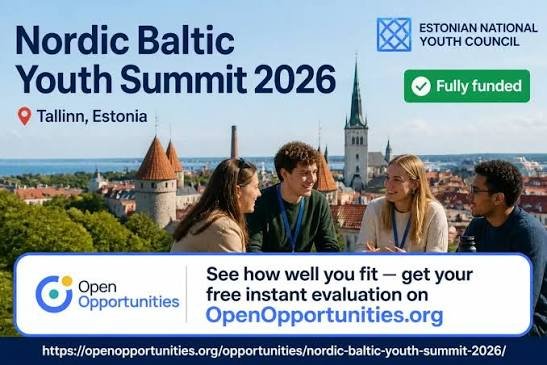
Applications are open for the Nordic Baltic Youth Summit 2026, a regional youth leadership and policy making opportunity bringing together young people from across the Nordic and Baltic region. The summit will take place in Tallinn, Estonia, from December 4 to December 5, 2026, with official travel days on December 3 and December 6. The summit is designed to create a platform where young people can exchange ideas, challenge their perspectives, discuss issues affecting their generation and contribute to conversations about the future of the Nordic and Baltic region. Around 200 young people are expected to participate, while the official project information anticipates broader participation from youth councils and organisations across the region. Organised by the Estonian National Youth Council, the Nordic Baltic Youth Summit is funded and initiated by the Nordic Council of Ministers and NORDBUK. The programme places young people at the centre of discussions and encourages them to contribute directly to the development of ideas and policy recommendations for national decision makers. About the Summit The Nordic Baltic Youth Summit 2026 is a regional platform for youth participation, dialogue and cooperation. It brings together young people from Denmark, Estonia, the Faroe Islands, Finland, Greenland, Iceland, Latvia, Lithuania, Norway, Sweden and Åland. The summit builds on previous Nordic youth summits held in Oslo, Reykjavik, Vilnius and Helsinki. The 2026 edition represents an important step in strengthening cooperation between Nordic and Baltic youth by creating a dedicated platform for participants from both regions. The organisers aim to foster an open and inclusive environment where young people can express their views, develop a sense of responsibility and ownership, strengthen networks and contribute to discussions about their future. The summit also supports broader regional objectives around social inclusion, equality, democratic values, cooperation and sustainable development. Young participants are intended to be active contributors and co creators rather than passive attendees. Summit Benefits • Opportunity to participate in a major Nordic and Baltic youth summit. • Connect with around 200 young people from across the region. • Build an international network of young changemakers. • Exchange ideas and experiences with peers from different countries and territories. • Participate in discussions on important regional and global issues. • Explore artificial intelligence and its impact on society, education and work. • Discuss security, resilience and regional cooperation. • Engage in conversations about youth mental health and well being. • Strengthen understanding of youth participation in democratic processes. • Explore approaches to preventing radicalisation and strengthening inclusive communities. • Contribute ideas to policy discussions. • Work with other participants to develop policy recommendations for national decision makers. • Develop leadership, communication, collaboration and policy engagement experience. • Gain experience contributing to a regional youth cooperation platform. Summit Themes AI Leap Participants will examine how artificial intelligence is transforming society and what these developments mean for young people. Discussions will consider innovation, education, technology and the future of work. Security and Resilience This theme focuses on societal resilience, preparedness and regional cooperation in an increasingly complex environment. Young people will have an opportunity to contribute their perspectives on security related challenges. Mental Health Participants will discuss youth mental health and well being, including ways to build supportive communities and improve access to appropriate mental health support. Youth Participation in Democracy The summit will explore how young people can participate more meaningfully in democratic processes and ensure that their perspectives are represented in decision making. Radicalisation Participants will examine the drivers of radicalisation and consider how dialogue, youth engagement, inclusion and stronger communities can contribute to prevention. Eligibility Criteria Applicants should meet the following requirements: • Be between 18 and 30 years old. • Be 18 to 30 years old as of December 2, 2026. • Live in Denmark, Estonia, the Faroe Islands, Finland, Greenland, Iceland, Latvia, Lithuania, Norway, Sweden or Åland. • Be able to participate in the entire summit. • Be able to participate in English. • Have an interest in one or more of the summit themes. • Be willing to contribute ideas, experiences and perspectives. • Be interested in youth participation, regional cooperation and issues affecting young people. Applicants from outside the listed Nordic and Baltic countries and territories are not eligible under the stated residence requirements. Required Application Information Applicants should be prepared to provide information demonstrating: • Their eligibility based on age and residence. • Their ability to participate in the full summit in English. • Their interest in the summit themes. • Their motivation to participate. • Their perspectives and ideas on issues affecting young people. • Their willingness to contribute actively to discussions and collaborative activities. The application is submitted through the online application form provided by the organisers. How to Apply Review the eligibility requirements for the Nordic Baltic Youth Summit 2026. Confirm that you live in one of the eligible Nordic or Baltic countries or territories. Make sure you will be between 18 and 30 years old as required by the organisers. Review the five summit themes and identify the issues that most closely match your interests. Consider how your experiences, ideas and perspectives could contribute to discussions during the summit. Prepare your responses for the online application form. Complete the official Nordic Baltic Youth Summit application form. Review your application carefully and make sure the information provided is accurate and complete.
Digital Science Catalyst Grant 2026
Applications are open for the Digital Science Catalyst Grant 2026, an international funding opportunity supporting early stage innovation in software tools and technologies that can advance research and create meaningful change. This year’s programme focuses on Agentic Workflows You Can Trust, supporting new artificial intelligence tools, agents and platforms that can perform complex research tasks while maintaining strong standards of provenance, governance and accountability. The grant is offered by Digital Science and is open to individuals, startups and research teams from around the world. Applicants can submit an early stage concept, prototype or working product. A finished product, established revenue or complete business plan is not required. For 2026, Digital Science is particularly interested in artificial intelligence systems that can do more than respond to individual prompts. The programme seeks technologies capable of planning, executing and reviewing multiple steps within research workflows while remaining transparent and trustworthy. Potential applications can address different parts of the research lifecycle, including research writing, discovery, evidence synthesis, peer review, funding decisions, researcher identity and research integrity. The programme is particularly interested in solutions that provide audit trails, governance controls and clear provenance. About the Grant The Digital Science Catalyst Grant is a global initiative that has supported innovative software tools and technologies designed to advance research. Now in its sixteenth year, the programme provides early support to promising ideas that could improve the way research is conducted, communicated, evaluated or funded. The 2026 theme reflects the rapid development of artificial intelligence from systems that generate or analyse information into systems that can carry out complex sequences of tasks. Digital Science is looking for innovators developing agentic workflows that can operate across multiple stages of research. These systems should be useful to researchers, institutions, publishers, funders or other participants in the research ecosystem. Grant Benefits • Up to £25,000 in equity free funding. • Funding that can be split across more than one recipient. • Support for early stage research technology innovation. • Advice from professionals with extensive experience in research software and technology. • Introductions to relevant experts and potential collaborators. • Feedback that can help strengthen the proposed technology or business direction. • Opportunities to connect with innovators and previous Catalyst Grant winners. • Greater visibility within the research technology ecosystem. • Opportunity to develop tools that can improve research workflows. • Support for technologies that combine artificial intelligence with provenance, governance and accountability. Grant Focus Areas The 2026 Catalyst Grant focuses on trustworthy agentic artificial intelligence across the research lifecycle. • Trusted authorship and research writing. • Research discovery. • Evidence synthesis. • Enterprise research workflows. • Funding and institutional decision making. • Researcher identity and disambiguation. • Peer review. • Publication workflows. • Research integrity. • Citation and figure provenance. • Automated reviewer matching. • Conflict of interest screening. • Grant portfolio intelligence. • Autonomous research workflows with audit trails. Eligibility Criteria The Catalyst Grant is open internationally. • Individuals from anywhere in the world. • Startups developing early stage research technologies. • Research teams developing innovative technology. • Founders and innovators with early stage ideas. • Applicants with a well formed concept. • Applicants with a prototype. • Applicants with a working product. • Projects developing agentic workflows connected to research. • Teams working on technology that addresses a genuine problem in the research ecosystem. Project Requirements Applicants should propose technology that fits the 2026 theme of Agentic Workflows You Can Trust. The proposed solution should ideally: • Operate across multiple steps. • Plan, execute and review tasks. • Address a real problem within the research lifecycle. • Be embedded within workflows used by researchers, institutions, publishers, funders or related organisations. • Include appropriate approaches to provenance. • Consider governance and accountability. • Have potential to create meaningful improvements in research. • Demonstrate a credible path toward further development. Projects may be at the concept, prototype or working product stage. Application Proposal Applicants are required to submit a proposal of no more than 1,500 words. The proposal should provide enough information for the judges to understand the problem, proposed solution, team and potential impact. The application should address: • The problem being solved. • The proposed workflow and approach. • How trust, auditability and governance are addressed. • The team and relevant experience. • The current stage of development. • Alternatives and competitors. • The longer term vision. • The project’s fit with Digital Science. • The proposed budget and use of funding. Applicants with a demonstration, prototype or working product are encouraged to provide a link so that the judges can better understand the technology. Selection Criteria Applications are assessed across seven main areas. • Team. • Problem. • Solution. • Competitors. • Market. • Progress to date. • Fit with Digital Science. How to Apply Review the 2026 Catalyst Grant theme and confirm that your idea focuses on trustworthy agentic workflows for research. Identify the specific research problem your technology aims to solve. Explain how your proposed system can plan, execute and review multiple steps rather than simply respond to individual prompts. Describe how your solution will incorporate provenance, governance and accountability. Prepare your proposal of no more than 1,500 words using the required sections. Provide information about your team, current stage, competitors, longer term vision and fit with Digital Science. Prepare a realistic budget explaining how you would use up to £25,000. Include a link to a prototype, demonstration or working product if one is available. Review the application carefully and ensure that all required information has been provided. Submit the application through the official Digital Science Catalyst Grant application process before October 5, 2026 at 5:00 PM BST.
Amelia Earhart Fellowship 2027
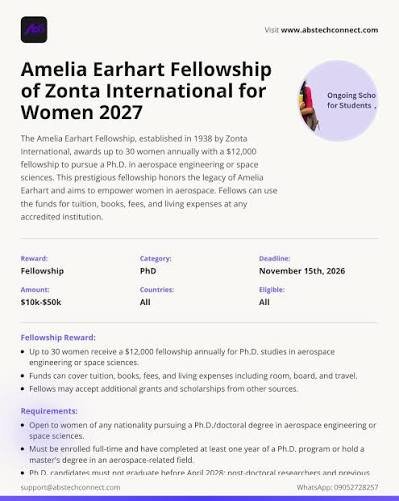
Amelia Earhart Fellowship 2027 Applications are open for the Amelia Earhart Fellowship 2027, an international fellowship programme supporting women pursuing advanced research and doctoral studies in aerospace engineering and space sciences. The fellowship is offered by Zonta International in honour of Amelia Earhart, the pioneering aviator and advocate for women in aviation and science. The fellowship provides US$12,000 to selected women pursuing PhD or doctoral degrees in aerospace engineering and space sciences. The award is intended to support women whose academic and research work contributes to fields connected with aviation, aerospace and space exploration. Since its establishment, the Amelia Earhart Fellowship has supported women pursuing advanced studies in areas where women have historically been underrepresented. The programme seeks applicants who demonstrate strong academic performance, a clear research focus and a commitment to completing doctoral work in aerospace related fields. About the Fellowship The Amelia Earhart Fellowship was established in 1938 in honour of Amelia Earhart, who was an internationally recognised aviator and an advocate for women entering aviation and other fields traditionally dominated by men. The fellowship continues her legacy by supporting women pursuing advanced education and research in aerospace related disciplines. The programme is specifically designed for women pursuing PhD or doctoral level studies in aerospace engineering and space sciences. Applicants are expected to demonstrate a strong academic record and meaningful progress toward their research objectives. The fellowship is particularly valuable for women whose research contributes to the development of knowledge, technology and innovation in aerospace and space related fields. Successful fellows become part of a global network of women scholars connected through Zonta International. Fellowship Benefits • US$12,000 fellowship award. • Financial support for doctoral level study and research. • International recognition as an Amelia Earhart Fellow. • Connection to a global network of women scholars. • Opportunity to strengthen an academic and professional profile in aerospace or space sciences. • Support for women pursuing advanced research in traditionally male dominated fields. • Association with Zonta International’s global network supporting women and girls. Fellowship Areas The Amelia Earhart Fellowship supports doctoral research in aerospace engineering and space sciences. • Aerospace engineering. • Aeronautical engineering. • Astronautics. • Space science. • Aviation technology. • Space technology. • Aerospace systems. • Aircraft and spacecraft engineering. • Propulsion and related aerospace technologies. • Other doctoral research areas directly connected to aerospace engineering or space sciences. Applicants should ensure that their research clearly falls within the fellowship’s eligible academic fields before applying. Eligibility Criteria Applicants must meet the academic and programme requirements established by Zonta International. • Be a woman of any nationality. • Be pursuing a PhD or doctoral degree. • Be enrolled in a programme related to aerospace engineering or space sciences. • Have completed at least one year of a doctoral programme at the time of application. • Have an academic record that demonstrates strong performance. • Have a clearly defined research programme. • Demonstrate relevance of the proposed research to aerospace engineering or space sciences. • Be able to demonstrate progress toward completing the doctoral programme. • Remain enrolled in the qualifying doctoral programme during the fellowship period. • Meet all application requirements and submit the application before the deadline. The fellowship is intended for women who are actively pursuing advanced doctoral research rather than applicants who are only planning to begin a doctoral programme in the future. Selection Criteria The Amelia Earhart Fellowship is competitive and applicants should demonstrate strong qualifications across several areas. Selection may consider: • Academic achievement. • Quality and relevance of the doctoral research. • Progress toward the doctoral degree. • Significance of the research in aerospace engineering or space sciences. • Clarity of research objectives. • Potential contribution to the applicant’s field. • Professional and academic experience. • Commitment to completing advanced research. • Overall strength and completeness of the application. Applicants should make sure that their research proposal clearly communicates why their work matters and how it contributes to aerospace engineering or space sciences. Required Application Information Applicants should prepare the information and supporting materials required by the official Zonta application system. These may include: • Academic information. • Details of the doctoral programme. • Research information. • Description of the proposed research. • Academic and professional background. • Information demonstrating doctoral progress. • Supporting documents required by the fellowship application. • References or recommendations where required. Applicants should carefully review the official application instructions because incomplete applications may not be considered. How to Apply Review the Amelia Earhart Fellowship eligibility requirements and confirm that your doctoral programme is related to aerospace engineering or space sciences. Confirm that you meet the doctoral study and academic requirements. Prepare a clear description of your research project, including its objectives, significance and expected contribution. Gather information about your academic background, doctoral programme and research progress. Prepare all supporting documents and references required by the official application system. Review your application carefully and ensure that your research clearly demonstrates relevance to aerospace engineering or space sciences. Complete the official Amelia Earhart Fellowship application.

Gates Cambridge Scholarships 2027 to 2028
Applications are open for the Gates Cambridge Scholarships 2027 to 2028, one of the most prestigious fully funded postgraduate scholarship programmes at the University of Cambridge in the United Kingdom. The programme is designed for outstanding international students who demonstrate exceptional intellectual ability, leadership potential and a commitment to improving the lives of others. The Gates Cambridge Scholarship provides around 70 full cost scholarships each year to outstanding applicants from countries outside the United Kingdom. Approximately two thirds of the awards are offered to PhD students, while the remaining scholarships support other eligible postgraduate programmes. The scholarship supports postgraduate study across a wide range of academic disciplines available at the University of Cambridge. It is not limited to one particular field, allowing successful applicants to pursue programmes that match their academic background, research interests and professional ambitions. Beyond financial support, Gates Cambridge places strong emphasis on developing a global community of scholars. The programme brings together talented people who share a commitment to positive social change and encourages collaboration, learning, international engagement, compassion and meaningful action. About the Scholarship The Gates Cambridge Scholarship was established to create a global community of future leaders who can contribute to improving the lives of others. Each year, the programme selects outstanding postgraduate students from outside the United Kingdom to study at Cambridge. Scholars become part of an international community made up of researchers, professionals and emerging leaders from different countries and academic backgrounds. The programme is highly competitive and seeks applicants who combine academic excellence with a strong sense of purpose. Successful candidates are expected to demonstrate why their chosen course is important to their future goals and how their work could contribute to wider society. Gates Cambridge scholarships cover the full cost of studying at Cambridge and also provide additional discretionary funding for certain academic, family, health and hardship related needs. Scholarship Benefits • Full payment of the University Composition Fee at the appropriate rate. • Maintenance allowance of £23,152 for 12 months at the 2026 to 2027 rate. • Maintenance support for PhD scholars for up to four years. • One economy class return airfare at the beginning and end of the course. • Inbound visa costs. • Immigration Health Surcharge costs. • Academic development funding of up to £4,000 depending on course length. • Dependent Children Allowance of up to £12,793 per year for one child. • Dependent Children Allowance of up to £18,244 per year for two or more children. • Support for approved fieldwork undertaken as part of a PhD. • Maternity and paternity funding where applicable. • Hardship funding for unforeseen financial difficulties. • Membership of an international community of Gates Cambridge Scholars and alumni. The scholarship is therefore substantially more than tuition funding. Its core award is designed to cover the main costs of studying and living in Cambridge, while additional support can be considered for eligible academic, family and personal circumstances. Eligible Study Areas Gates Cambridge scholarships can support postgraduate study across the broad range of eligible subjects available at the University of Cambridge. Applicants can pursue programmes in areas such as: • Arts and humanities. • Biological sciences. • Physical sciences. • Engineering. • Computer science. • Social sciences. • Economics and related disciplines. • Education. • Law. • Public policy. • Medicine and health related disciplines. • Environmental and sustainability related fields. • Other eligible postgraduate subjects offered by Cambridge. Applicants should check the specific Cambridge postgraduate course requirements because not every programme is eligible for Gates Cambridge funding. Eligibility Criteria Applicants must meet the Gates Cambridge eligibility requirements. • Be a citizen of any country outside the United Kingdom. • Apply to pursue an eligible postgraduate course at the University of Cambridge. • Demonstrate outstanding intellectual ability. • Have a strong reason for choosing the proposed Cambridge course. • Demonstrate a commitment to improving the lives of others. • Demonstrate leadership potential. Eligible study options include: • PhD, full time or part time under the programme’s current pilot arrangements. • MLitt, full time. • One year postgraduate courses, full time, subject to the programme’s exceptions. Applicants should carefully check whether their chosen Cambridge course qualifies for Gates Cambridge funding before completing their application. Selection Criteria The Gates Cambridge selection process is based on four principal criteria. • Outstanding intellectual ability. • Reasons for choosing the proposed course. • A commitment to improving the lives of others. • Leadership potential. The selection process considers the complete application rather than academic results alone. Candidates should demonstrate their strengths through their academic record, course choice, personal motivation, research interests, leadership experience and commitment to positive social impact. Application Requirements Applicants must apply for admission to their chosen Cambridge postgraduate course and complete the Gates Cambridge funding section as part of the University application process. The application includes information about: • Academic background and qualifications. • Proposed Cambridge course. • Research interests where applicable. • Reasons for choosing the course. • Motivation for applying for the Gates Cambridge Scholarship. • Commitment to improving the lives of others. • Leadership experience and potential. • Supporting information required by the chosen Cambridge course. How to Apply Explore eligible postgraduate programmes at the University of Cambridge and identify a course that matches your academic and professional goals. Review the admission requirements for your chosen Cambridge course. Prepare your academic documents, research information and other materials required for the University application. Complete the University of Cambridge postgraduate application. Complete the Gates Cambridge funding section within the application. Clearly explain why you have chosen your proposed course and how it fits your long term goals. Demonstrate your commitment to improving the lives of others through your academic, professional, community or leadership experience. Provide compelling evidence of your intellectual ability and leadership potential. Review the applicable Gates Cambridge and Cambridge University deadline for your course and applicant category. Submit the complete application before the relevant deadline.
Harris Social Impac-0821Qt Fellowship 2027 to 2028
Applications are open for the Harris Social Impact Fellowship 2027 to 2028 at the University of Chicago Harris School of Public Policy. The fellowship is a highly selective, full time, 11 month programme designed for recent graduates and early career professionals with strong STEM, quantitative or analytical skills and a passion for using evidence to create meaningful social change. The programme combines intensive academic training with practical experience at leading research centres and policy institutes. Fellows begin with eight weeks of faculty led coursework at the University of Chicago, where they develop skills in policy analysis, research methods, data analytics, economic analysis and analytical politics. This is followed by nine months of immersive work addressing important social and policy challenges. The fellowship is designed for people who want to apply technical and analytical skills to real world problems. Fellows may work on issues including educational equity, public safety, health equity, climate change and government efficiency. The programme concludes with a capstone project in which fellows apply their training to a real world social impact challenge in partnership with a mission driven organisation. About the Fellowship The Harris Social Impact Fellowship is offered by the University of Chicago Harris School of Public Policy. It was created for talented recent graduates and early career professionals who have the technical ability to work with evidence and data and want to use those skills to address pressing social challenges. The programme combines academic preparation with practical policy experience. Rather than focusing exclusively on classroom learning, fellows spend a substantial portion of the programme working with research centres and policy institutes. The first eight weeks provide an intensive foundation in research and analytical methods. Fellows then transition into a nine month placement where they can apply these skills to real policy questions. The programme also places strong emphasis on professional development. Participants receive mentorship, career coaching, workshops and opportunities to interact with senior faculty, alumni and civic leaders. Fellowship Benefits • $75,000 stipend for living and healthcare expenses. • $21,000 to fully cover the fellowship academic credential. • Eight weeks of intensive academic coursework at the University of Chicago. • Nine months of immersive experience with research centres and policy institutes. • Training in policy analysis and research methods. • Training in data analytics and economic analysis. • Development of critical reasoning and analytical politics skills. • Professional development workshops. • Mentorship from policy leaders and experienced professionals. • Personalised career coaching. • Networking opportunities with faculty, alumni and civic leaders. • Practical experience addressing real world social challenges. • Opportunity to complete a capstone project demonstrating applied analytical skills. • Access to a lifelong fellowship community and annual alumni retreat. Programme Areas The fellowship combines technical training, policy research and practical social impact work. • Policy analysis. • Research methods. • Data analytics. • Economic analysis. • Analytical politics. • Critical reasoning. • Educational equity. • Public safety. • Health equity. • Climate action. • Government efficiency. • Social impact research. • Evidence based policymaking. • Quantitative analysis. Eligibility Criteria Applicants must demonstrate the academic and professional background required to succeed in the fellowship. • Be a recent college graduate or early career professional. • Have a bachelor’s degree conferred before the start of the fellowship. • Demonstrate strong technical, quantitative or analytical ability. • Demonstrate this ability through academic coursework, research, professional experience or a combination of these. • Have a strong interest in evidence based social change. • Be able to commit to the full time 11 month fellowship. • Be prepared to participate in academic coursework, professional development and the practical placement. • Be able to work in the United States under the applicable programme requirements. Selection Focus The Harris Social Impact Fellowship is highly selective. The inaugural cohort was selected from nearly 800 applicants, with an acceptance rate of just under two percent. Applicants should therefore present a strong combination of technical ability, academic preparation, professional potential and commitment to evidence based social impact. The application should demonstrate: • Strong quantitative, technical or analytical ability. • Evidence of rigorous academic or professional work. • Clear motivation for pursuing social impact. • Ability to work with complex information and evidence. • Interest in applying analytical skills to real world policy challenges. • Strong communication and reasoning abilities. • Potential to contribute meaningfully to the fellowship community. Required Application Materials Applicants must submit the following materials: • Motivation Statement. • Technical Experience Statement. • Resume. • One Letter of Recommendation. • Academic Transcripts. The Technical Experience Statement should demonstrate the applicant’s ability to undertake serious technical, quantitative or analytical work. Applicants should use specific examples from coursework, research, employment or other relevant experiences. The Motivation Statement should explain why the applicant is interested in the fellowship and how the programme fits their professional goals. How to Apply Review the Harris Social Impact Fellowship eligibility requirements and confirm that you meet the academic and professional criteria. Assess your technical, quantitative and analytical experience and identify the strongest examples to include in your application. Prepare your Motivation Statement explaining your interest in evidence based social impact and the fellowship. Prepare your Technical Experience Statement demonstrating your analytical and technical capabilities. Update your resume to highlight relevant academic, research and professional experience. Request one strong letter of recommendation from an appropriate academic or professional referee. Obtain your academic transcripts. Complete the online application through the University of Chicago Harris School of Public Policy. Review all application materials carefully and ensure that each required document has been submitted.

ATRIUM Summer School 2027
Applications are open for the ATRIUM Summer School 2027: Artificial Intelligence for the Humanities, an intensive academic programme designed for students and researchers interested in applying Artificial Intelligence to the humanities and social sciences. The summer school will take place from July 12 to July 23, 2027 at Charles University in Czechia. The programme responds to the growing importance of Artificial Intelligence and computational methods across academic disciplines. It introduces participants to the technological foundations of Artificial Intelligence in an accessible way while giving them practical skills for working with data and applying AI methods to real world research problems. A particular emphasis is placed on text analysis, data processing and the use of the R programming system. Participants will learn how to work with data from different humanities and social science disciplines, explore technical literature independently and prepare for experiments involving Artificial Intelligence and neural networks. The summer school is hosted by the Institute of Formal and Applied Linguistics at Charles University and is supported through the ATRIUM project and its Transnational Access scheme. The programme is designed to help participants develop both theoretical understanding and practical computational skills that can be applied to their own academic research. About the Summer School The ATRIUM Summer School 2027 focuses on the intersection of Artificial Intelligence, data analysis and the humanities. Artificial Intelligence is increasingly being used to analyse large collections of historical, cultural, linguistic and social data. However, researchers in the humanities and social sciences may not always have access to the technical training required to use these methods effectively. The summer school aims to address this gap by presenting AI concepts and computational techniques in a way that is accessible to researchers and students from humanities and social science backgrounds. Participants will explore the foundations of Artificial Intelligence and learn how computational approaches can be used to investigate research questions. The programme combines theoretical learning with practical work, enabling participants to experiment with data and AI methods rather than simply studying them conceptually. The programme is particularly relevant for participants interested in digital humanities, computational humanities, linguistics, cultural research, social science research, text analysis and data driven scholarship. Summer School Benefits • Free participation in the summer school. • Reimbursement of individual accommodation expenses up to 2,000 Kč per day. • Reimbursement of economy class travel expenses up to €600. • Daily per diem of 933 Kč for meals. • Practical training in Artificial Intelligence methods. • Training in the R programming system. • Skills in systematic data processing and statistical analysis. • Practical experience with text analysis. • Opportunities to work with data from humanities and social science disciplines. • Training in navigating technical literature independently. • Exposure to Artificial Intelligence methods including neural networks. • Opportunity to develop computational skills relevant to academic research. Programme Areas The ATRIUM Summer School focuses on several connected areas of Artificial Intelligence and digital research. • Artificial Intelligence for the humanities. • Artificial Intelligence for the social sciences. • Text analysis. • Data processing. • R programming. • Statistical analysis. • Systematic data analysis. • Neural networks. • Computational humanities. • Digital humanities. • Research data analysis. • Application of AI to humanities and social science research. Eligibility Criteria The summer school is intended for students and researchers who are interested in applying Artificial Intelligence and computational methods to humanities and social science research. Applicants should: • Be motivated to experiment with Artificial Intelligence. • Have an interest in Artificial Intelligence methods including neural networks. • Have basic proficiency in the R programming system. • Have elementary knowledge of systematic data processing. • Have elementary knowledge of statistical analysis. • Be interested in applying computational methods to humanities or social science research. • Be prepared to participate actively throughout the summer school. The programme is particularly suitable for students and researchers who want to develop practical computational skills while maintaining a focus on humanities or social science research. Application Requirements Applicants should demonstrate that they have the academic or research interest necessary to benefit from the programme. The application should communicate: • Your academic or research background. • Your interest in Artificial Intelligence. • Your interest in humanities or social science research. • Your experience with the R programming system. • Your knowledge of data processing and statistical analysis. • Your motivation for participating in the summer school. • How Artificial Intelligence could support your academic or research interests. Applicants should ensure that the information submitted accurately reflects their current technical experience and academic interests. Selection Criteria The programme is intended for motivated participants who can benefit from practical training in Artificial Intelligence and computational research methods. Selection is expected to consider factors such as: • Motivation to experiment with Artificial Intelligence. • Interest in applying AI to humanities or social science research. • Basic R programming proficiency. • Knowledge of systematic data processing. • Understanding of statistical analysis. • Academic or research relevance of the programme to the applicant. • Potential to apply the skills gained during the summer school in future research. How to Apply Review the ATRIUM Summer School 2027 eligibility requirements and confirm that you have the required basic knowledge of R, data processing and statistical analysis. Consider how Artificial Intelligence and computational methods relate to your academic or research interests. Prepare the information requested through the official online application form. Clearly explain your motivation for joining the summer school and your interest in Artificial Intelligence for humanities or social science research. Highlight relevant experience with R, data analysis, statistics or related computational methods.

Mathematics in Africa Grant 2026
Applications are open for the London Mathematical Society Mathematics in Africa Grant 2026, which provides partial financial support for mathematical activities taking place in Africa. The grant is designed to support mathematicians involved in conferences, workshops and research collaborations that contribute to the development and exchange of mathematical knowledge across the continent. The scheme is offered by the London Mathematical Society and is open to mathematicians based anywhere in the world. However, the activity supported by the grant must take place in Africa. This makes the opportunity particularly relevant for mathematicians, academic institutions and research collaborators planning mathematical activities within African countries. The grant can support participation in mathematical conferences and workshops, the organisation of mathematical conferences and workshops, and mathematical research collaborations. Funding can contribute toward travel, accommodation and subsistence expenses, while caring costs for attendees with dependents can also be included. Visa costs are considered part of normal travel expenses. The maximum award is £2,000. This is an upper limit rather than a guaranteed award, and applicants should request only the amount needed for eligible expenses associated with their proposed activity. About the Grant The Mathematics in Africa Grant aims to provide financial support for mathematical activities based in Africa. The programme recognises the importance of conferences, workshops and research collaborations in strengthening mathematical research, education and professional networks. Supported activities can involve mathematicians from different institutions or countries and may provide opportunities for researchers to share ideas, develop collaborations and participate in mathematical events. The grant is not restricted to mathematicians who are based in Africa. Applicants may be based anywhere in the world, provided that the activity for which funding is requested takes place in Africa. The London Mathematical Society encourages potential applicants who are unsure whether their proposed activity is suitable for the scheme to contact the Society’s Grants Administrator or the Chair of the Research Grants Committee for informal advice before submitting an application. Grant Benefits • Funding of up to £2,000 for eligible mathematical activities. • Partial support for attendance at mathematical conferences. • Partial support for participation in mathematical workshops. • Support for organising mathematical conferences and workshops. • Support for mathematical research collaborations. • Contribution toward travel expenses. • Contribution toward accommodation expenses. • Contribution toward subsistence expenses. • Visa costs may be covered as part of normal travel expenses. • Caring costs may be included for attendees who have dependents. • Opportunity to strengthen mathematical research and professional collaboration in Africa. Eligible Activities The Mathematics in Africa Grant can support several types of mathematical activities taking place in Africa. • Attendance at mathematical conferences. • Attendance at mathematical workshops. • Organisation of mathematical conferences. • Organisation of mathematical workshops. • Mathematical research collaborations. • Activities that facilitate mathematical knowledge exchange and collaboration. Eligibility Criteria Applicants must meet the requirements of the London Mathematical Society Mathematics in Africa scheme. • Be a mathematician based anywhere in the world. • Propose a mathematical activity that will take place in Africa. • Ensure that the proposed activity is related to mathematics. • Apply for eligible expenses connected to the proposed activity. • Submit the application before the relevant deadline. • Provide sufficient information about the proposed activity and its financial requirements. • Be able to arrange payment of the grant through a university or other eligible institution. Eligible Grant Expenses The grant may contribute toward several costs associated with approved mathematical activities. • Travel expenses. • Accommodation. • Subsistence expenses. • Visa costs. • Caring costs for attendees with dependents. Application Requirements Applicants should provide information that allows the London Mathematical Society to assess the mathematical value and feasibility of the proposed activity. The application should clearly explain: • The mathematical activity being proposed. • The location where the activity will take place. • The purpose and objectives of the activity. • The mathematical value of the proposed activity. • The expected participants or collaborators. • The planned dates and programme where relevant. • The costs associated with the activity. • The amount of financial support being requested. • Other sources of financial support where applicable. Selection Criteria The London Mathematical Society assesses applications according to the suitability of the proposed mathematical activity and whether it meets the objectives of the scheme. Applicants should demonstrate: • A clear mathematical purpose. • A well defined activity taking place in Africa. • A strong rationale for the proposed conference, workshop or collaboration. • Appropriate use of the requested funds. • A realistic and clearly explained budget. • Potential to contribute to mathematical research, collaboration or knowledge exchange. Conference and workshop organisers are also encouraged to consider diversity when developing their activities. How to Apply Review the Mathematics in Africa Grant eligibility requirements and confirm that your proposed activity will take place in Africa. Determine whether you are applying for support to attend a conference or workshop, organise a mathematical event or undertake a research collaboration. Develop a clear description of the proposed activity, including its mathematical objectives and expected outcomes. Prepare a detailed budget covering eligible expenses such as travel, accommodation, subsistence and visa costs. Consider whether caring costs for participants with dependents should be included in the funding request. Complete the official Mathematics in Africa Grant application form provided by the London Mathematical Society. Review the application carefully and ensure that all required information is included. Submit the application before the relevant deadline.
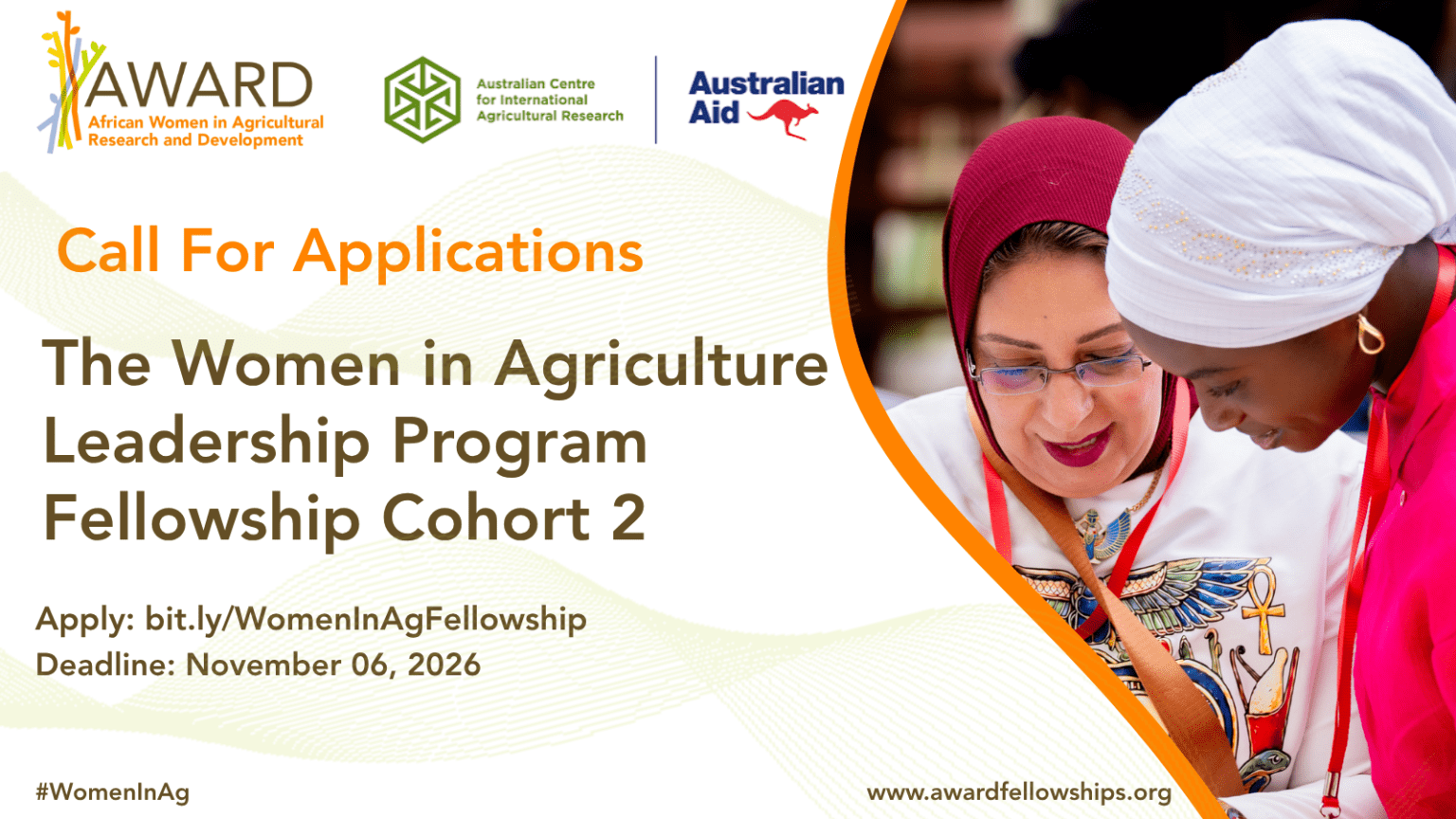
AWARD Women in Agriculture Leadership Program Fellowship 2026 Cohort 2
Applications are open for the AWARD Women in Agriculture Leadership Program Fellowship 2026 Cohort 2, a two year, non residential leadership development programme designed to strengthen the capabilities, confidence and influence of African women scientists working in agriculture. The fellowship focuses particularly on helping women lead and contribute to climate responsive agricultural research and more resilient agrifood systems. The programme is implemented by African Women in Agricultural Research and Development (AWARD) under the Africa Australia Partnership for Climate Responsive Agriculture, supported by the Australian Centre for International Agricultural Research and delivered in collaboration with the Department of Foreign Affairs and Trade. The fellowship is specifically intended for mid career women researchers from Egypt, Ghana, Morocco, Nigeria, Senegal and Sierra Leone. Participants may be working in national agricultural research institutions, government ministries, universities, international research organisations, nongovernmental organisations or the private sector, provided their work is relevant to climate change and smallholder agriculture. Through mentoring, leadership development and specialised training, the fellowship seeks to help women agricultural scientists strengthen their professional influence and contribute more effectively to research, policy and practice. Fellows will also develop skills related to negotiation, gender integration, climate adaptation, science communication and research proposal development. About the Fellowship The AWARD Women in Agriculture Leadership Program Fellowship is a professional development programme focused on strengthening the leadership of African women scientists in agriculture. The second cohort will run for two years and is non residential, allowing fellows to continue their professional responsibilities while participating in fellowship activities. The programme is designed around the understanding that stronger representation of women in agricultural research and decision making can contribute to more practical, inclusive and effective agricultural solutions. The fellowship particularly emphasises climate responsive agriculture. Fellows will develop their capacity to understand and respond to challenges affecting agricultural systems, including climate change and the needs of smallholder farmers. Fellowship Benefits • Two year non residential fellowship experience. • Leadership development focused on strengthening professional confidence and influence. • Individual mentoring and opportunities to work with experienced professionals. • Training in leadership and negotiation skills. • Training on gender integration in climate adaptation. • Capacity building in science communication. • Training in research proposal writing. • Opportunities to strengthen professional networks across African agricultural research and development. • Greater capacity to contribute to climate responsive agricultural research. • Opportunities to strengthen leadership within agricultural research, policy and practice. Fellowship Areas The programme focuses on agricultural research and leadership areas connected to climate resilience and sustainable agrifood systems. • Climate responsive agriculture. • Climate adaptation. • Smallholder agriculture. • Agricultural research. • Agrifood systems. • Gender integration in agricultural development. • Leadership and professional influence. • Negotiation and decision making. • Science communication. • Research proposal development. • Agricultural policy and practice. • Gender responsive agricultural research. Eligibility Criteria Applicants must meet the fellowship’s professional, academic and geographic requirements. • Be an African woman agricultural scientist. • Be a national of Egypt, Ghana, Morocco, Nigeria, Senegal or Sierra Leone. • Hold at least a master’s degree in a relevant discipline. • Have at least seven years of professional experience related to agriculture, agrifood systems, gender or climate related work. • Be actively engaged in research, policy or practice relevant to climate change and smallholder agriculture. • Work in a national agricultural research institution, government agency, academic institution, nongovernmental organisation, international research organisation or private sector organisation. • Reside in Africa throughout the fellowship period. • Demonstrate professional experience and potential for leadership in agricultural research or related areas. • Have proficiency in English or French. • Be able to participate actively in the fellowship activities throughout the two year programme. Selection Criteria The fellowship seeks women researchers who demonstrate strong professional experience, leadership potential and commitment to climate responsive agricultural research. Applicants should be able to demonstrate: • Relevant academic qualifications. • At least seven years of professional experience in relevant agricultural or related fields. • Active engagement in agricultural research, policy or practice. • Experience addressing climate change or smallholder agriculture issues. • Potential to strengthen leadership and professional influence. • Commitment to gender responsive approaches in agricultural research and development. • Interest in contributing to climate resilient agrifood systems. • Ability to communicate and collaborate effectively. • Commitment to participating fully throughout the fellowship. How to Apply Review the fellowship eligibility requirements and confirm that you are a mid career African woman researcher from one of the six eligible countries. Confirm that you hold at least a master’s degree in a relevant field and have at least seven years of relevant professional experience. Review your professional experience in agriculture, agrifood systems, climate change, gender or smallholder agriculture and identify the areas most relevant to the fellowship. Prepare the information and supporting materials requested through the official application portal. Clearly demonstrate your experience in agricultural research, policy or practice and your potential for leadership. Explain your interest in climate responsive agriculture and how the fellowship could strengthen your professional contribution. Select the appropriate application route for your language, with applications available for English and French speaking candidates. Complete and submit the online application before November 6, 2026 at 23:59 East Africa Time. Monitor your email for communication from AWARD regarding the selection process and subsequent fellowship activities.
Global Changemaker Fellowship 2026
Applications are open for the Global Changemaker Fellowship 2026, a six month virtual leadership programme designed to connect and develop a pipeline of social change leaders who are committed to addressing challenges in their local communities. The fellowship supports young entrepreneurs, founders and organisational leaders who are working on initiatives designed to create meaningful social impact. The programme provides participants with an opportunity to continue developing and implementing their initiatives while taking part in immersive workshops, expert training, mentorship and consultations. Fellows gain access to knowledge, practical tools, networks and a global community that can help them become more effective leaders and collaborators. The fellowship is designed for changemakers from villages, towns and cities and welcomes participants nationally and internationally. It provides a platform for young leaders to strengthen their ability to understand complex challenges, communicate their vision, collaborate with others and develop solutions that can create lasting change. About the Fellowship The Global Changemaker Fellowship is a six month virtual advancement programme for people already leading initiatives or organisations and seeking to strengthen their capacity as social change leaders. Throughout the programme, fellows continue working on their initiatives while participating in learning and development activities. Rather than separating leadership development from practical action, the fellowship allows participants to apply what they learn directly to the challenges they are addressing. The programme focuses on helping fellows understand complex systems, communicate ideas effectively, navigate competing priorities and collaborate with different stakeholders. These skills are particularly important for changemakers working on social, economic, environmental or community challenges where sustainable progress requires cooperation among multiple groups. The fellowship also creates opportunities for participants to connect with people from different countries and backgrounds. Through global networking, fellows can exchange experiences, learn from other approaches and potentially develop collaborations beyond their local communities. Fellowship Benefits • Expert led masterclasses focused on leadership and social change. • Mentorship from experienced professionals and changemakers. • Consultations to support participants and their initiatives. • Global networking opportunities with other social change leaders. • Access to practical knowledge, tools and resources. • Opportunities to strengthen leadership and collaboration skills. • Support for developing and implementing social impact initiatives. • Exposure to different perspectives and approaches to solving community challenges. • A global community of entrepreneurs, founders and organisational leaders. Fellowship Focus Areas The Global Changemaker Fellowship focuses on four major leadership and change making areas. • Systems Thinking: Understanding challenges from a systems perspective and designing solutions that consider different stakeholders and interconnected factors. • Thought Leadership: Building the ability to articulate a clear vision, communicate across differences and inspire others to take action. • Polarities Management: Developing the capacity to lead when opposing but interdependent values, priorities or perspectives are in tension. • Adaptive and Collaborative Leadership: Learning how to embrace change, work with others and catalyse solutions through collaboration. These areas are intended to help participants become more effective leaders while strengthening the initiatives they are already working to advance. Eligibility Criteria The fellowship is open to young people who are already taking leadership roles in social change initiatives. • Entrepreneurs, founders or individuals leading an organisation. • Applicants between 13 and 35 years of age. • Individuals who are studying or working professionally. • Applicants from villages, towns and cities. • Participants from different countries and regions around the world. • Young leaders working to address challenges in their local communities. • Applicants who are interested in strengthening their leadership and social impact capabilities. • Individuals willing to participate in a virtual programme and engage actively throughout the fellowship. The programme is designed for people who are already taking action and want to improve their effectiveness as changemakers. Applicants should therefore be able to demonstrate an initiative, organisation or area of work that reflects their commitment to creating positive change. Who Can Apply The fellowship welcomes young social innovators working across different sectors and communities. Applicants do not need to come from one particular academic or professional background. Entrepreneurs may apply with businesses or ventures that have a clear social impact dimension. Founders and organisational leaders can also apply if they are leading initiatives that respond to challenges within their communities. The international nature of the programme also means that participants can learn from experiences beyond their own countries. This creates an opportunity to develop a broader understanding of social change while remaining focused on practical local action. How to Apply Review the fellowship requirements and confirm that you fit the target applicant profile. Identify the initiative, organisation or social change work you are currently leading. Consider how your work addresses a challenge within your community and the change you hope to create. Prepare your application information and clearly communicate your leadership experience and motivation. Explain the challenges your initiative addresses and how participating in the fellowship could strengthen your work. Submit the completed application through the official Global Changemaker Fellowship application process. Monitor your communication channels for updates from the selection team about the progress of your application.
Clooney Foundation for Justice CFJ Fellowship 2027
Applications are open for the Clooney Foundation for Justice CFJ Fellowship 2027, a professional development and legal advocacy opportunity for early career African women lawyers committed to advancing justice for women and children. The programme provides fellows with practical legal experience, specialised training, mentorship and opportunities to work directly with organisations addressing human rights violations and violence against women and children. The fellowship is administered by the Clooney Foundation for Justice in partnership with the Legal Empowerment Fund at the Fund for Global Human Rights. For the 2027 class, ten early career women lawyers will be placed with human rights and justice organisations in Kenya, Malawi, South Africa and The Gambia. Host institutions include legal aid providers, selected university legal aid clinics and government prosecution services. Fellows will provide legal services to women and children at different stages of the justice process. The programme places particular emphasis on addressing child marriage and violence against women and children through legal representation, strategic litigation, legal research, advocacy and innovative approaches to improving access to justice. About the Fellowship The Clooney Foundation for Justice Fellowship is designed to support the next generation of African women lawyers working to advance human rights and justice. The programme provides an immersive professional placement in a host organisation where fellows can develop their legal skills through practical work. Rather than focusing only on classroom learning, fellows will work on real legal and human rights matters involving women and children. Depending on their host organisation, fellows may conduct legal research, prepare legal documents, support clients, contribute to advocacy activities and participate in court representation. They will also receive guidance from supervisors and experienced human rights practitioners. The fellowship is particularly relevant for lawyers who want to build careers in human rights law, women’s rights, strategic litigation, legal empowerment, access to justice and advocacy. Fellowship Benefits • Paid work placement with a human rights organisation, university legal aid clinic or government legal institution. • Practical experience in legal research, drafting, client support and legal representation. • Training in strategic litigation and advocacy for women and children. • Mentorship from the Justice for Women and Children Programme Director. • Guidance from host organisation supervisors and regional human rights experts. • At least one in person gathering with other fellows, supervisors and senior CFJ leadership. • Monthly online training led by human rights experts. • Exposure to innovative technology that can improve access to justice. • Access to a global network of lawyers, judges, activists, academics and human rights experts. • Continued support, knowledge sharing and collaboration through the CFJ Fellowship Alumni Programme after completion. Fellowship Areas The fellowship focuses on practical legal and advocacy work related to justice for women and children. • Human rights law. • Women’s rights. • Children’s rights. • Legal representation and legal aid. • Strategic litigation. • Violence against women and children. • Child marriage. • Access to justice. • Legal advocacy. • Legal empowerment. • Technology and access to justice. • Support for survivors and vulnerable communities. Eligibility Criteria Applicants must meet the fellowship’s professional and geographic requirements. • Be an early career woman lawyer from Africa. • Hold a law degree from a recognised academic institution. • Be admitted to practice as a lawyer in the country of the selected host organisation. • Have up to five years of legal experience following graduation from law school or qualification as a lawyer in the relevant jurisdiction. • Have the legal right to work in Kenya, Malawi, South Africa or The Gambia, depending on the selected host organisation. • Be committed to justice and human rights. • Demonstrate an interest in advancing the rights of women and children. • Have strong legal research, writing and verbal communication skills. • Demonstrate the ability to conduct complex legal analysis and fact finding. • Be able to work independently while also collaborating effectively with others. • Be willing to travel when required. • Have fluency in English. • Additional experience working with women, children, survivors or other vulnerable individuals is an advantage. • Experience in women’s rights or human rights organisations is preferred. Applicants should note that the programme does not support international relocation costs or the costs of obtaining work authorisation. Candidates therefore need to already have the right to work in the relevant host country. Selection Focus The selection process will consider applicants’ professional qualifications, relevant experience, commitment to human rights and potential to contribute to justice for women and children. Particular attention will be given to: • Legal education and professional qualification. • Relevant legal experience. • Commitment to human rights and justice. • Experience or interest in women’s rights and children’s rights. • Legal research and analytical ability. • Written and verbal communication skills. • Ability to work with vulnerable individuals and affected communities. • Creativity in developing legal and advocacy strategies. • Teamwork and interpersonal skills. • Alignment with the mission of CFJ and the prospective host organisation. How to Apply Review the eligibility requirements and confirm that you meet the legal qualification and work authorisation requirements. Consider the host countries and identify where your existing right to practise and work makes you eligible. Prepare information demonstrating your legal education and professional experience. Highlight your experience or commitment to human rights, women’s rights, children’s rights, legal aid, strategic litigation or related areas. Demonstrate your ability to conduct legal research, analyse complex issues and communicate effectively. Explain your motivation for joining the CFJ Fellowship and how the opportunity fits your professional goals.