
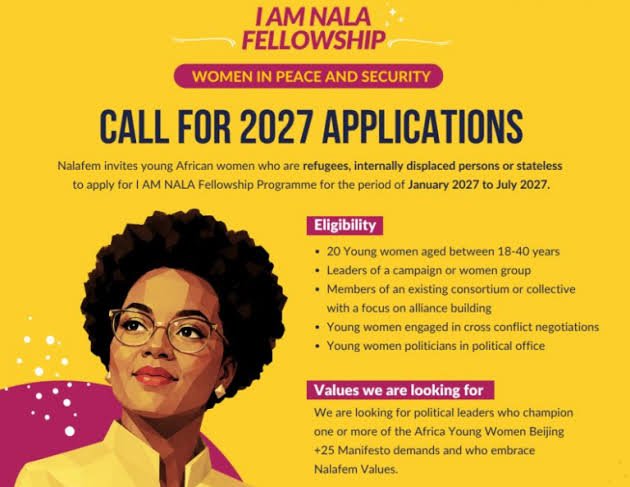
Applications are open for the I AM NALA Fellowship 2027, a leadership and political empowerment programme by Nalafem for young African women who are refugees, internally displaced persons, stateless or otherwise affected by displacement. The fellowship will run from January 2027 to July 2027 and is designed for women who are actively contributing to peace, justice, political leadership and social change. The I AM NALA Fellowship is particularly focused on supporting women who can play meaningful roles in negotiations, decision making, democratic transitions, reconciliation and peacebuilding in their countries of origin or host countries. Through capacity building, technical support, mentorship, solidarity and access to networks, the programme seeks to strengthen the ability of young women leaders to influence decisions affecting their communities and countries. Nalafem is a Pan African platform of women politicians and activists working toward the liberation and advancement of African women and girls. The organisation launched the I AM NALA Fellowship in 2023 as part of its wider work to strengthen women’s political leadership and feminist movements across Africa. About the Fellowship The I AM NALA Fellowship is a Women, Peace and Security focused leadership programme for young African women who are already contributing to political, peacebuilding or community processes or who are positioned to take on greater leadership responsibilities. The programme recognises the importance of including women affected by conflict, displacement and political instability in decision making processes. Fellows will be supported to strengthen their leadership capacities, develop practical skills and build solidarity with other women leaders across Africa. The fellowship will include bi monthly online sessions featuring training, masterclasses and dialogues with mentors who bring experience from different institutions and organisations. These sessions are intended to provide practical knowledge while creating space for fellows to learn directly from established leaders. The programme is also connected to Nalafem’s broader leadership ecosystem. The organisation’s previous fellowship cohorts have supported young women leaders working on peace, security, gender equality and political change. Fellowship Benefits • Capacity and technical support for leadership development. • Mentorship from experienced experts and senior leaders. • Participation in online trainings and masterclasses. • Opportunities to engage in meaningful dialogues with established women leaders. • Solidarity and peer learning with other young African women leaders. • Access to networks connected to women’s political leadership, peacebuilding and social justice. • Opportunities to strengthen skills relevant to negotiations, decision making and peacebuilding. • Greater exposure to African feminist political leadership and Women, Peace and Security issues. • Potential opportunities for in person engagement during the fellowship. Fellowship Areas The I AM NALA Fellowship focuses on areas connected to women’s leadership, peace and political participation. • Women, Peace and Security. • Political leadership and participation. • Peacebuilding and reconciliation. • Conflict prevention and cross conflict negotiations. • Democratic transitions and decision making. • Feminist leadership and solidarity. • Social justice and gender equality. • Alliance building and collective action. • Advocacy and movement building. • Leadership of campaigns and women’s groups. Eligibility Criteria Applicants should meet the requirements outlined for the 2027 fellowship. • Be a young African woman aged between 18 and 40 years. • Be a refugee, internally displaced person, stateless person or displaced woman leader. • Be actively involved in leadership, advocacy, peacebuilding, political work or related community efforts. • Be a leader of a campaign or women’s group. • Be a member of an existing consortium or collective with a focus on alliance building. • Be engaged in cross conflict negotiations or related peacebuilding processes. • Be a young woman politician currently serving in political office. • Demonstrate an interest or commitment to political leadership, peace, justice, women’s rights or social change. • Align with Nalafem values including solidarity, social justice, dignity, equity and decolonial feminist Pan Africanism. Selection Criteria The fellowship is particularly suited to applicants who can demonstrate meaningful leadership and a clear commitment to advancing women, peace, justice and political change. Applicants are expected to show: • Existing or emerging leadership in their community, organisation, political environment or movement. • Commitment to peacebuilding, political participation or social justice. • Experience leading or contributing to campaigns, women’s groups, collectives or advocacy initiatives. • Interest in strengthening women’s participation in decision making. • Ability to work collaboratively and build alliances. • Alignment with Nalafem’s values of solidarity, dignity, equity, social justice and decolonial feminist Pan Africanism. • A clear commitment to using the fellowship experience to contribute to positive change. How to Apply Review the eligibility requirements and confirm that you fit the fellowship’s target applicant profile. Consider your leadership experience, particularly your work in politics, peacebuilding, advocacy, organising, women’s rights or community development. Prepare the information requested through the official fellowship application. Clearly demonstrate how your experience and leadership align with Women, Peace and Security and Nalafem’s values. Explain how participating in the fellowship could strengthen your ability to influence peace, justice, political participation or decision making.
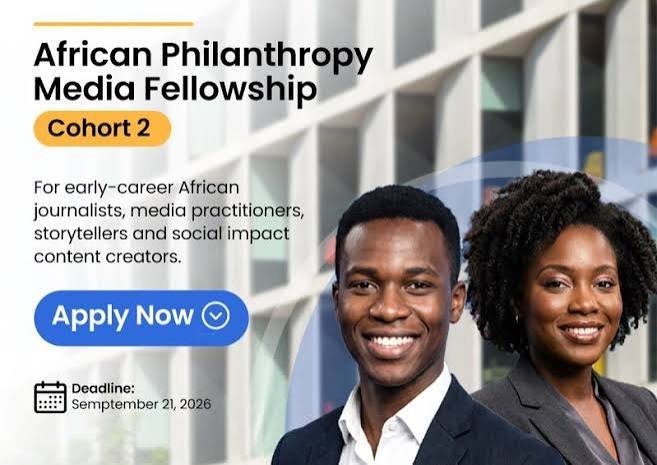
African Philanthropy Media Fellowship Cohort 2
Applications are now open for the African Philanthropy Media Fellowship Cohort 2, a six week virtual fellowship designed to equip emerging African journalists, media practitioners, storytellers, and social impact content creators with the knowledge, skills, and networks needed to report accurately and compellingly on African led philanthropy and development. The fellowship is organized by Philanthropy Circuit, an organization focused on shaping narratives and catalyzing action around African philanthropy and development. The programme responds to the need for stronger African led narratives that move beyond conventional portrayals of development and instead highlight African actors, solutions, communities, institutions, and forms of giving. Through the fellowship, participants will strengthen their understanding of Africa’s philanthropy ecosystem while developing practical skills in storytelling, data driven reporting, ethical journalism, and impact communication. Fellows will work with experienced facilitators and practitioners and receive guidance as they develop stories that can contribute to a broader understanding of African philanthropy. About the Fellowship The African Philanthropy Media Fellowship is built around the theme “Beyond Aid: Reporting African Led Philanthropy.” The programme encourages media professionals to look beyond traditional narratives about aid and development and examine the many ways Africans are already contributing resources, ideas, leadership, and solutions to social and economic challenges. The fellowship provides participants with a stronger understanding of Africa’s philanthropy ecosystem, including the actors, institutions, models, and narratives shaping giving and social impact across the continent. Fellows also learn how to identify meaningful stories and communicate them in ways that are accurate, engaging, ethical, and relevant to African audiences. A central part of the programme is practical storytelling. Participants are expected to apply the knowledge gained during the fellowship to produce stories that amplify African narratives, actors, and solutions. The programme therefore provides an opportunity to strengthen both professional knowledge and a practical media portfolio. The fellowship builds on the experience of its inaugural cohort, whose participants have gone on to produce stories exploring community philanthropy, dignity, climate action, development, and African approaches to social impact. Alumni have also continued to use their storytelling skills to highlight solutions and perspectives that are often overlooked in conventional development reporting. Fellowship Benefits Successful fellows will receive: • Six weeks of structured virtual training. • Practical training in African philanthropy and development reporting. • Mentorship from experienced media and philanthropy practitioners. • Editorial guidance and feedback on storytelling projects. • Training in practical storytelling techniques. • Training in data driven reporting. • Guidance on ethical reporting and responsible storytelling. • Opportunities to produce publishable stories. • Opportunities to have stories published through Philanthropy Circuit and partner platforms. • Exposure to African philanthropy actors, models, and narratives. • Opportunities to build professional connections across Africa’s philanthropy ecosystem. • A stronger portfolio of journalism, storytelling, or social impact communication work. • A network of fellow journalists, storytellers, media practitioners, and social impact communicators. Fellowship Areas The African Philanthropy Media Fellowship focuses on several areas related to media, philanthropy, and development communication, including: • African led philanthropy. • African philanthropy ecosystems. • Development reporting. • Impact storytelling. • Data driven reporting. • Ethical journalism. • Community philanthropy. • African narratives and representation. • Social impact communication. • Storytelling for development. • Research based journalism. • Solutions focused reporting. • Human centered storytelling. Participants will also explore how stories can challenge narrow representations of Africa and bring greater attention to African actors, communities, institutions, initiatives, and solutions. Eligibility Criteria Applicants for the African Philanthropy Media Fellowship Cohort 2 should meet the following requirements: • Applicants must be African. • Early career African journalists are encouraged to apply. • Media practitioners can apply. • Storytellers can apply. • Social impact content creators can apply. • Applicants should have a strong interest in African philanthropy and development. • Applicants should be interested in producing accurate and compelling stories about African led philanthropy. • Applicants should be willing to participate actively throughout the six week virtual programme. • Applicants should have an interest in strengthening their storytelling, reporting, or media skills. The fellowship is intended particularly for emerging professionals who want to develop stronger expertise at the intersection of African philanthropy, development, journalism, and storytelling. Required Application Information Applicants should be prepared to provide information about: • Personal and professional background. • Journalism, media, storytelling, or content creation experience. • Interest in African philanthropy and development. • Motivation for joining the fellowship. • Relevant previous storytelling or reporting work. • Areas of African philanthropy or social impact that they would like to explore. • Examples of previous work where requested in the application. Applicants are encouraged to demonstrate a clear interest in telling African stories with accuracy, context, dignity, and a focus on African agency. Selection Criteria Important considerations include: • Interest in African led philanthropy and development. • Potential to produce meaningful and compelling stories. • Experience or demonstrated interest in journalism, media, storytelling, or content creation. • Commitment to ethical and accurate reporting. • Interest in amplifying African voices, actors, and solutions. • Motivation to strengthen professional storytelling skills. • Willingness to participate actively in training, mentorship, and fellowship activities. Applicants with emerging experience are encouraged to apply because the programme is designed to help participants strengthen their skills and develop their capacity to report on African philanthropy more effectively. How to Apply Review the African Philanthropy Media Fellowship Cohort 2 requirements and confirm that your background and interests align with the programme. Consider your experience in journalism, media, storytelling, content creation, research, or social impact communication. Prepare information about your professional background and your interest in African philanthropy and development. Identify relevant examples of your previous storytelling, journalism, or content creation work. Complete the African Philanthropy Media Fellowship Cohort 2 online application form. Clearly explain your motivation for joining the fellowship and how the programme will strengthen your work. Review your application carefully and ensure that all required information and work samples have been provided.
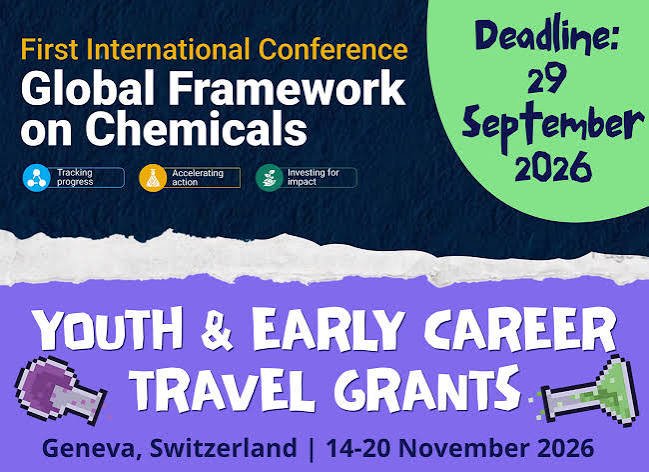
Youth Travel Grants to Attend GFC IC 1 2026
Applications are now open for Youth Travel Grants to attend the first International Conference of the Global Framework on Chemicals, GFC IC 1, taking place in Geneva, Switzerland, from November 16 to 20, 2026. The opportunity is designed to support meaningful participation of children and youth in global chemicals and waste governance. The travel grants are being coordinated through the Chemicals and Waste Youth Platform, CWYP, in collaboration with the United Nations Environment Programme, UNEP. Selected young delegates will have the opportunity to represent the children and youth constituency during an important international policy process addressing the safe management of chemicals and waste. The GFC IC 1 will be preceded by the fourth Global Youth Forum on Chemicals and Waste, taking place from November 14 to 16, 2026. Youth delegates participating through the grant programme can engage in the Youth Forum as well as the main conference, contribute to collective youth policy recommendations, and participate in discussions with governments and other stakeholders. About the Conference The first International Conference of the Global Framework on Chemicals will bring governments, civil society organizations, researchers, businesses, youth representatives, and other stakeholders together to advance international cooperation on chemicals and waste management. The Global Framework on Chemicals, formally known as the Global Framework on Chemicals: For a Planet Free of Harm from Chemicals and Waste, was adopted in September 2023 at the fifth International Conference on Chemicals Management. The framework addresses a broad range of issues related to chemical safety, including hazardous pesticides, endocrine disrupting chemicals, pharmaceutical pollutants, and other sources of chemical exposure. It builds on the earlier Strategic Approach to International Chemicals Management and provides a coordinated framework for governments and stakeholders to strengthen chemicals and waste management. The framework contains five strategic objectives and 28 targets, with most targets intended to be achieved between 2030 and 2035. Although the framework is voluntary rather than legally binding, it provides a common platform for strengthening international cooperation, mobilizing political support, and promoting safer management of chemicals throughout their life cycle. Travel Grant Benefits Successful applicants may receive support through one of three participation options: • Round trip international airfare for recipients of the fully funded travel grant. • Accommodation with breakfast for fully funded travel grant recipients. • Reimbursement of meals for fully funded travel grant recipients. • Transportation support for fully funded travel grant recipients. • Visa fee support for fully funded travel grant recipients. • Low cost airfare or train travel within Europe of up to CHF 150 round trip for partially funded grant recipients. • Accommodation with breakfast for partially funded grant recipients. • Conference accreditation and registration support for applicants receiving the non funded registration option. • Opportunity to participate in the fourth Global Youth Forum on Chemicals and Waste. • Opportunity to contribute to youth policy recommendations. • Opportunities to engage directly with country and stakeholder delegations. • Opportunity to deliver spoken and written interventions during the conference. • International networking with young people and stakeholders working on chemicals and waste governance. Participation Options Applicants can indicate the type of support for which they wish to be considered. Fully Funded Travel Grant The fully funded option is intended for children and youth from low and middle income countries, as well as Indigenous youth from any region. Selected participants receive international airfare, accommodation with breakfast, reimbursement of meals, transportation, and visa fee support. Partially Funded Travel Grant The partially funded option is available to children and youth from any country or region. Selected participants receive support for low cost airfare or train travel within Europe, up to CHF 150 round trip, together with accommodation including breakfast. Non Funded Registration Support Applicants who are able to cover their own travel and accommodation costs can apply for registration support. Successful applicants under this option will receive an accreditation letter and support with registration for GFC IC 1. Applicants selecting this option may be asked to provide additional information about how they intend to finance their travel and stay in Geneva. Eligibility Criteria Applicants for the GFC IC 1 Youth Travel Grants must meet the following requirements: • Applicants must be 35 years old or younger at the time of application. • Applicants must be available to travel and remain in Geneva from November 13 to 20, 2026. • Applicants must be committed to participating in the full duration of the programme. • Applicants must submit the completed application before the stated deadline. • Applicants for the fully funded option must be from a low or middle income country or be Indigenous youth from any region. • Applicants for the partially funded option can be from any country or region. • Applicants for registration support can be from any country or region. • Previous United Nations or policy experience is not required. • Applicants with experience or interest in chemicals and waste through advocacy, science, research, journalism, storytelling, education, or related fields are encouraged to apply. Required Application Information Applicants should be prepared to provide: • Personal information. • Date of birth. • Country and region of residence. • Information demonstrating eligibility for the selected funding option. • Information about their experience or interest in chemicals and waste issues. • Details about relevant advocacy, research, science, journalism, storytelling, education, or community engagement activities. • Information about their availability to participate in the Youth Forum and GFC IC 1. • Information required to assess their preferred travel grant category. Applicants should ensure that all information provided in the application is accurate and clearly demonstrates their interest in youth participation in global chemicals and waste governance. Selection Criteria Applications will be assessed to identify young people who can meaningfully contribute to the children and youth constituency at GFC IC 1. Important considerations include: • Eligibility under the relevant age and geographic requirements. • Availability for the full programme period. • Demonstrated interest in chemicals and waste issues. • Experience or potential in advocacy, science, research, journalism, storytelling, education, or related fields. • Ability

BBC Africa Correspondent 2026
Applications are open for the BBC Africa Correspondent position, an opportunity for an experienced journalist to join the BBC and provide specialist coverage and analysis of major news stories across South Africa and the wider African region. The Africa Correspondent will be responsible for producing accurate, impartial, engaging, and authoritative journalism for audiences across multiple BBC platforms. The role combines reporting, analysis, digital storytelling, radio, television, podcasts, social media, and video production, making it particularly suited to journalists with strong multimedia experience. The successful candidate will cover major national and regional stories, develop original story ideas, provide expert analysis of important political and social developments, and deliver content that gives audiences a broader understanding of events in Africa. The role also requires the ability to respond quickly to breaking news and deploy to major stories across South Africa and other parts of the region. The position places a strong emphasis on digital journalism. The successful candidate will regularly produce content for BBC Online, create digital video in both short and long formats, contribute to social platforms, participate in radio and television broadcasts, and contribute to podcasts. They will also be expected to experiment with new digital formats and identify innovative ways of reaching audiences. About the Position The BBC Africa Correspondent will provide specialist journalism focused on South Africa and developments across the wider African region. The role requires an understanding of the continent’s politics, culture, history, geopolitics, and major social and policy issues. The correspondent will report on major national stories and develop original journalism that provides audiences with context, insight, and authentic voices. Depending on the story, this may involve writing a lead news report, producing a digital video, preparing a live page, contributing a radio report, creating a television package, or developing content for podcasts and social media. The position also requires journalists to work effectively under pressure. The successful candidate must be capable of analysing important developments at short notice and responding quickly when major stories break. Position Benefits Successful candidates will receive: • Fair pay appropriate to their location and contract type. • Flexible benefits based on the location and nature of the contract. • Professional development opportunities. • Support throughout their working life. • Experience working within a major international public service broadcaster. • Opportunities to produce journalism across digital, radio, television, podcast, social media, and video platforms. • Opportunities to cover major African and international news stories. • Opportunities to develop specialist expertise in African politics, culture, geopolitics, and current affairs. • Exposure to a wide range of audiences and international journalism platforms. The role offers an opportunity to work within a values based organisation where editorial quality, public service, and professional standards are central to the work. Key Responsibilities The Africa Correspondent will be expected to: • Uphold BBC Editorial Standards and BBC Editorial Guidelines. • Produce fast, accurate, fair, and engaging journalism. • Provide specialist coverage and analysis across a range of subjects. • Generate original story ideas connected to national and global news agendas. • Report on major stories across South Africa and the wider African region. • Explain important social, political, cultural, and geopolitical developments. • Produce content for BBC Online. • Create radio reports and contribute to television programming. • Contribute to podcasts and live broadcasts. • Produce digital video in both short form and long form. • Develop field reports and digital video explainers. • Produce content for social media and other digital platforms. • Respond quickly to breaking news. • Develop content strategies that reach younger and female audiences. • Experiment with new digital formats and approaches to audience engagement. • Travel throughout Africa and participate in major BBC news deployments when required. Eligibility Criteria Applicants for the BBC Africa Correspondent position should meet the following requirements: • Extensive recent journalism experience covering South Africa. • Strong knowledge of South African culture, politics, geopolitics, and history. • Experience producing journalism for global news or current affairs media. • Strong editorial judgement. • Excellent English writing skills. • Ability to write quickly, clearly, accurately, and engagingly. • Experience sub editing and adapting scripts for different platforms. • A proven record of producing original journalism for the public good. • Strong experience working in digital production environments. • Experience with social media engagement and interactive digital content. • Knowledge of digital video production and optimisation. • Ability to report authoritatively across radio, online, and social platforms. • Ability to participate in live radio and television broadcasts during breaking news. • Understanding of audience needs and the ability to create compelling content in different formats. • Ability to prepare television packages for major news stories. • Willingness to work throughout Africa. • Willingness to participate in major BBC news deployments at short notice, including assignments in hostile environments. Required Application Materials Applicants are required to prepare: • An updated CV. • Completed application questions. • Three examples of previous journalism work in English. The three examples should include: • A text or broadcast report covering a breaking news story. • An example of original journalism in text, broadcast, or digital video format. • An example of geopolitical analysis in text, digital, or radio format. Applicants should select work samples that demonstrate their reporting ability, originality, analytical skills, editorial judgement, and ability to communicate effectively with audiences. Selection Criteria The successful candidate will be expected to demonstrate strong journalism experience and the ability to operate across multiple media platforms. The selection process is likely to place particular importance on: • Recent experience covering South Africa. • Knowledge of African politics, culture, history, and geopolitics. • Strong editorial judgement. • Accuracy, fairness, and impartiality. • Ability to generate original journalism. • Strong English writing and reporting skills. • Digital journalism experience. • Social media and audience engagement expertise. • Digital video production skills. • Ability to work across radio, television, online, podcasts, and social platforms. • Ability to respond quickly to breaking news. • Ability to provide insightful geopolitical analysis.

LeadGreen Fellowship Cohort 4
Applications are now open for the LeadGreen Fellowship Cohort 4, a free 12 week online fellowship designed to equip young Africans with the knowledge, practical skills, mentorship, and community needed to take meaningful environmental action. The LeadGreen Fellowship supports emerging environmental changemakers across Africa who want to understand the environmental challenges affecting their communities and develop practical responses to those challenges. The programme combines environmental education, expert conversations, peer learning, leadership development, and hands on community action. Through the fellowship, participants move beyond simply learning about climate and environmental issues. They are encouraged to identify challenges within their communities, develop practical solutions, complete structured environmental action missions, document their work, and demonstrate measurable impact. The programme is designed to help young people turn environmental awareness into action. About the Fellowship The LeadGreen Fellowship is a pan African leadership initiative focused on developing the next generation of environmental leaders. The programme brings together young changemakers from across Africa and provides them with a structured pathway from environmental awareness to practical community action. Participants explore environmental challenges including plastic pollution, unmanaged waste, deforestation, biodiversity loss, flooding, climate change, and other issues affecting African communities. They also learn about practical approaches such as recycling, waste management, afforestation, sustainable living, climate action, and green technology. The fellowship places strong emphasis on learning through action. Fellows complete practical LeadGreen Missions within their own communities and document their activities and results. This approach allows participants to develop practical experience while contributing to environmental improvement in their communities. The programme also provides opportunities for peer learning and interaction with environmental practitioners. Fellows become part of a growing network of young African environmental changemakers that extends beyond the fellowship itself. LeadGreen reports a network spanning 54 African countries, with more than 2,000 fellows and 500 unique projects. Fellowship Benefits Successful fellows will receive: • Free participation in the 12 week fellowship. • Practical environmental and sustainability training. • Live masterclasses with environmental experts. • Dedicated mentorship and peer learning opportunities. • Practical leadership development. • Opportunities to complete community based environmental action missions. • Experience designing and documenting environmental projects. • Access to a pan African network of young environmental changemakers. • Opportunities to collaborate with other young people working on environmental challenges. • A platform to develop practical community impact. • Opportunities to build relationships with environmental practitioners and fellow changemakers. • Continued connection with the LeadGreen community beyond the fellowship. The core fellowship is 100 percent free of charge, with the programme designed to reduce financial barriers for young changemakers from marginalized communities. Fellowship Areas Participants will develop knowledge and skills in several environmental and leadership areas, including: • Climate action. • Environmental awareness. • Plastic pollution. • Waste management. • Recycling. • Deforestation and afforestation. • Biodiversity conservation. • Flooding and environmental resilience. • Sustainable living. • Green technology. • Community development. • Environmental leadership. • Project development. • Community based environmental action. • Measuring and documenting impact. The fellowship combines these areas with practical missions that encourage participants to apply what they learn to environmental challenges within their own communities. Eligibility Criteria Applicants for the LeadGreen Fellowship Cohort 4 must meet the following requirements: • Applicants must be between 18 and 29 years old. • Applicants must be African. • Applicants must be enrolled in university or have recently graduated from university. • Applicants should come from a limited income or first generation background. • Applicants should demonstrate a strong interest in creating positive environmental or community impact. • Previous leadership experience is not required. • Applicants should be willing to participate actively throughout the fellowship. • Applicants should be able to dedicate approximately three hours each week to the programme. Required Application Information Applicants should be prepared to provide information about: • Personal and educational background. • University enrolment or recent graduation. • Community and environmental interests. • Background information relevant to the eligibility requirements. • Motivation for joining the LeadGreen Fellowship. • Interest in environmental action and community development. • Any existing environmental or community activities. The official LeadGreen website indicates that the application takes approximately 10 minutes to complete. Applicants should provide accurate information and clearly demonstrate their interest in environmental action and community impact. Selection Criteria The fellowship is designed for young people who demonstrate the motivation to learn, act, and contribute to a greener Africa. Important considerations include: • Eligibility based on age, education, and background. • Genuine interest in environmental and climate issues. • Motivation to create positive change. • Willingness to learn and participate in peer activities. • Commitment to completing practical environmental missions. • Potential to contribute positively to a community. • Openness to collaboration and learning from other young Africans. Prior leadership experience is not a strict requirement. The programme specifically emphasizes drive, potential, and willingness to take action. How to Apply Review the LeadGreen Fellowship Cohort 4 eligibility requirements and confirm that you meet the age, education, nationality, and background criteria. Consider your interest in environmental challenges and identify the community issues you would like to address through the fellowship. Prepare the personal and educational information required for the application. Complete the online LeadGreen Fellowship application form. Explain your motivation for joining the fellowship and your interest in creating environmental or community impact. Review your application carefully and ensure that all required information is accurate and complete.
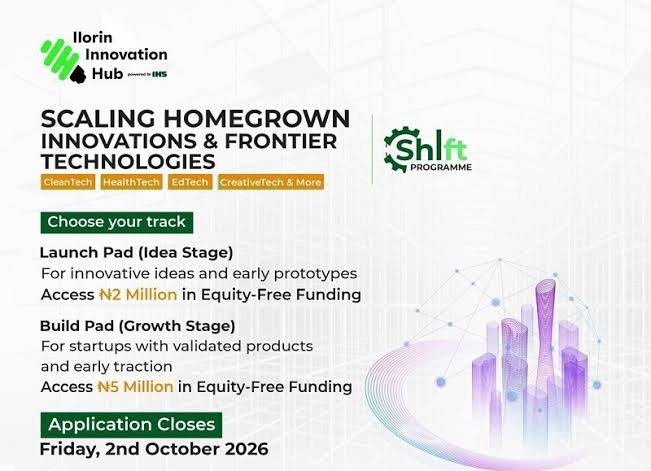
IIH SHIFT Programme 2026
Applications are now open for the IIH SHIFT Programme 2026, a 12 week commercialisation programme designed to identify, train, fund, and support Nigerian entrepreneurs developing deep technology and frontier technology solutions. The programme is organised by the Ilorin Innovation Hub, delivered with Co creation HUB, and backed by the Kwara State Government and IHS Towers Nigeria. SHIFT, which stands for Scaling Homegrown Innovations and Frontier Technologies, is designed to move promising technical ideas beyond the early development stage and toward commercialisation. The programme focuses on founders building defensible technology solutions that can address important challenges and contribute to Africa’s future. The programme is suitable for student and research innovators, early stage startups, and local small and medium sized enterprises seeking to develop, launch, digitise, or scale technology driven solutions. Applicants can enter with an idea or prototype, while more established startups with working products, early users, or revenue can also apply through the appropriate programme track. Selected participants will receive structured training, mentorship, technical resources, ecosystem connections, workspace opportunities, and access to funding. Depending on the stage of the venture, successful applicants can receive up to ₦5 million in equity free funding. The programme will also provide opportunities to connect with investors, corporates, universities, and government institutions. About the Programme The IIH SHIFT Programme is a venture creation and commercialisation initiative focused on homegrown innovation. Rather than concentrating only on conventional software applications, SHIFT seeks technical founders developing technology solutions with the potential to solve real problems and create sustainable businesses. The programme is structured to support ventures at different stages of development. Idea stage teams can receive assistance to validate their problem, strengthen their prototype, and prepare for market development. Startups with working products and early traction can receive more advanced support focused on commercialisation, growth, customers, partnerships, and investment readiness. The 12 week programme combines entrepreneurship education with practical support. Participants will take part in masterclasses, workshops, mentorship, technical activities, and opportunities to engage with organisations that can help move their solutions toward wider adoption. The programme will culminate in a Demo Day where participating founders can showcase their ventures and pursue opportunities for pilots, partnerships, investment, and additional funding. Programme Benefits Successful participants will receive: • Up to ₦2 million in equity free funding for qualifying idea stage teams. • Up to ₦5 million in equity free funding for qualifying startups with working products and early traction. • Structured masterclasses in entrepreneurship and innovation. • Practical workshops focused on commercialisation and venture development. • Mentorship from experienced entrepreneurs and innovation professionals. • Grants or stipends and other programme resources. • Access to co working space. • Access to the IIH demo lab. • Connections to investors and corporate organisations. • Opportunities to connect with universities and government institutions. • Technical and innovation support. • Opportunities to pursue pilots and commercial partnerships. • A Demo Day platform for pitching ventures. • Opportunities to pursue additional funding and investment. Programme Areas The programme supports technology driven solutions across areas including: • CleanTech. • HealthTech. • EdTech. • CreativeTech. • Artificial intelligence. • Frontier technologies. • Digital transformation. • Technology solutions addressing real world challenges. The programme is particularly interested in solutions that can demonstrate technical potential, market relevance, and the ability to develop into sustainable ventures. Eligibility Criteria Applicants for the IIH SHIFT Programme 2026 should meet the following requirements: • Applicants should be Nigerian innovators, entrepreneurs, startups, or organisations developing technology driven solutions. • Student innovators and research innovators with technology driven ideas are eligible to apply. • Early stage startups seeking to launch or commercialise their products can apply. • Local small and medium sized enterprises seeking to digitise or adopt new technology can apply. • Applicants should have a technology driven idea, prototype, product, or solution. • Teams should generally consist of 2 to 4 members. • Teams should include at least one technical co founder. • Idea stage applicants should have a validated problem and demonstrate commitment to developing the solution. • Startup applicants should have a working product, initial users or revenue, and relevant operating experience where required for the more advanced track. • Applicants should be prepared to commit fully to the programme. The programme also encourages diverse teams. At least 30 percent of admitted teams are expected to include female founders or members from underserved communities. Required Application Information Applicants should be prepared to provide information about: • The founder or founding team. • The technology or innovation being developed. • The problem the solution addresses. • Evidence that the problem has been validated. • The current stage of the idea, prototype, or startup. • The team’s technical expertise. • Existing prototype or working product, where applicable. • Existing customers, users, or revenue, where applicable. • The commercial potential of the solution. • The commitment of the founding team. • Other information requested through the application form. Applicants should ensure that the information provided accurately represents the current stage of their innovation and clearly explains why the solution is relevant to the market. Selection Criteria The selection process is expected to focus on the strength and potential of the proposed technology solution and the ability of the founding team to develop it. Important considerations include: • Strength of the problem being addressed. • Technical potential of the proposed solution. • Evidence of problem validation. • Stage and development potential of the venture. • Technical capabilities of the founding team. • Commercial potential. • Potential for market adoption. • Commitment of the founders. • Potential for meaningful impact. • Ability to benefit from the programme’s mentorship, technical resources, and commercialisation support. Teams with diverse backgrounds and strong technical capabilities are encouraged to apply. How to Apply Review the IIH SHIFT Programme requirements and identify the programme track that best matches the current stage of your innovation. Develop a clear description of the problem your technology addresses and explain how your solution responds to that problem. Prepare information about your founding team, including
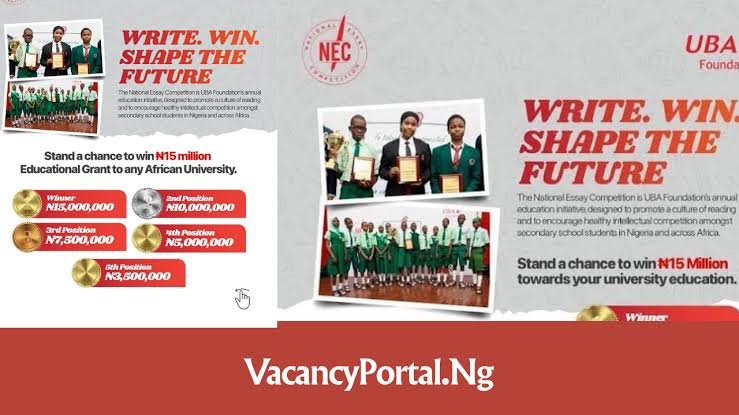
UBA National Essay Competition 2026
Applications are now open for the UBA National Essay Competition 2026, an annual writing competition organized by UBA Foundation for senior secondary school students in Nigeria. The competition is designed to promote reading, writing, creativity, critical thinking, and intellectual development among young people while providing educational support to outstanding students. Now in its 16th year, the National Essay Competition has become one of UBA Foundation’s major education initiatives. It provides Nigerian secondary school students with an opportunity to express their ideas on important national issues, demonstrate their writing abilities, and compete for educational grants that can support their university education. The 2026 competition focuses on one of Nigeria’s most important development challenges, food security. Applicants are required to respond to the essay topic: “No Nation Can Develop Without Food Security. How Can Nigeria Deal With This Problem?” Through this year’s competition, students are encouraged to think critically about Nigeria’s food production systems, access to food, agricultural development, sustainability, economic development, and possible solutions to food insecurity. The competition provides a platform for students to present practical ideas while strengthening their research, writing, and analytical abilities. The application deadline for the UBA National Essay Competition 2026 is October 23, 2026. Eligible students must submit a handwritten essay of no more than 750 words together with the required identification documents and passport photograph. About the Competition The UBA National Essay Competition is organized by UBA Foundation as part of its commitment to education and youth development. UBA Foundation describes the competition as a platform for developing the intellectual and writing abilities of senior secondary school students while supporting winners with educational grants for university study. The 2026 edition challenges students to consider the relationship between food security and national development. Participants are expected to develop thoughtful arguments around how Nigeria can address food security challenges and build a more sustainable future. The competition has two major stages. In the first stage, submitted essays are assessed and 20 of the best entries are selected. The shortlisted students then proceed to a final physical test, after which five winners are selected. The educational grants are intended to support university education at an African university of the winners’ choice. This makes the competition not only a platform for intellectual expression but also an opportunity for students to receive substantial financial support for their future studies. Competition Benefits Successful winners will receive: • First place educational grant of ₦15 million. • Second place educational grant of ₦10 million. • Third place educational grant of ₦7.5 million. • Fourth place educational grant of ₦5 million. • Fifth place educational grant of ₦3.5 million. • Financial support toward university education. • Opportunity to showcase writing and critical thinking abilities. • Recognition through one of UBA Foundation’s major education initiatives. • Opportunity to compete with talented senior secondary school students from across Nigeria. The five top prizes have a combined value of ₦41 million based on the prize amounts listed on UBA Foundation’s official competition page. Recent reporting from UBA Foundation puts the overall educational grant and prize package at ₦41.5 million. Essay Topic Applicants must write an essay on the following topic: “No Nation Can Develop Without Food Security. How Can Nigeria Deal With This Problem?”
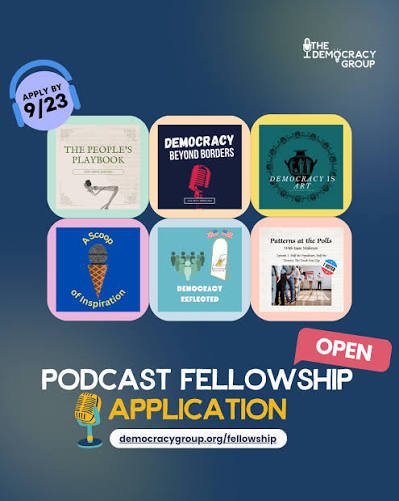
Democracy Group Podcast Fellowship 2026
Applications are now open for the Democracy Group Podcast Fellowship 2026, a six week remote program designed for young leaders who want to start a podcast, develop their civic voice, and build an audience around issues that can strengthen democracy. The fellowship is organized by The Democracy Group, a network of creators producing podcasts, videos, newsletters, and social media content focused on democracy, civic engagement, and civil discourse. The network works to encourage curiosity, empathy, informed discussion, and greater engagement with issues affecting democratic societies. Through the fellowship, participants will learn how to develop a podcast from an initial idea through production and launch. The program combines live workshops, specialized training, peer editing, mentorship, podcast production, audience development, and distribution support. Participants will also have opportunities to engage with experienced podcast hosts, journalists, academics, media specialists, and other professionals working in the democracy and podcasting space. The fellowship is particularly suited to students who have a strong interest in democracy, politics, civic engagement, media, journalism, storytelling, or public communication. Fellows will develop their own podcast concept while learning how to research topics, identify audiences, conduct interviews, record and edit episodes, publish content, and grow a community around their work. About the Fellowship The Democracy Group Podcast Fellowship is designed to help young people become effective communicators and creators in the democratic space. Over six weeks, fellows move from understanding the role of podcasting in democracy to developing their own podcast idea and preparing it for launch. The curriculum covers democracy and systems thinking, finding a podcast niche, understanding an audience, developing a personal voice and brand, creating consistent content, podcast infrastructure, recording, guest research, interviewing, editing, publishing, marketing, audience growth, and community building. The final stage focuses on podcast production and mentoring. Fellows create a trailer and their first two episodes with support from a mentor from The Democracy Group and prepare their podcast for launch. The program also emphasizes engaging diverse perspectives. Participants receive coaching and lessons from people working across the political spectrum and learn how to create content that encourages constructive discussion rather than contributing to political division. Fellowship Benefits Successful fellows will receive: • Specialized training from podcasting experts. • Live weekly workshops with fellows and The Democracy Group mentors. • Individual mentor matching through The Democracy Group network. • A community of students passionate about democracy and civic engagement. • Support to develop and launch a new podcast. • Access to distribution opportunities through The Democracy Group network. • A care package containing podcast equipment to support professional audio and visual production. • Practical experience in podcast research, recording, interviewing, editing, publishing, marketing, and audience development. • Guidance from experienced podcast hosts, journalists, academics, and media professionals. • Opportunities to develop a distinctive civic voice and communicate with diverse audiences. The fellowship is entirely free for students who are accepted into the program. Fellowship Areas Participants will develop skills in several areas of podcast creation and civic communication, including: • Podcast development and production. • Democracy and civic engagement. • Systems thinking and democratic challenges. • Audience research and niche development. • Personal voice and podcast branding. • Content planning and consistent publishing. • Podcast recording and production systems. • Guest research and outreach. • Interview preparation and storytelling. • Podcast editing. • Publishing and distribution. • Podcast marketing and growth. • Community building and audience engagement. • Bridging political and social divides. • Communicating diverse perspectives. • Civic storytelling and public communication. During the final two weeks, fellows work on producing their podcast trailer and first two episodes with guidance from a mentor. Eligibility Criteria Applicants for the Democracy Group Podcast Fellowship 2026 must meet the following requirements: • Applicants must be high school or college students in the United States. • Groups of students working together as a team may also apply. • Applicants should have an interest in democracy, civic engagement, politics, media, journalism, storytelling, or related areas. • Applicants should have an idea or interest that could be developed into a podcast. • Applicants must be able to participate in the six week remote program. • Applicants should be able to commit approximately five hours per week to workshops, mentoring, and podcast production. The fellowship is open to students at different stages of their education, with past fellows including high school students, undergraduate students, and graduate students. Required Application Information Applicants should be prepared to provide: • Basic demographic information. • Written responses to questions assessing their potential as a fellow. • Information about their interests and motivation for joining the fellowship. • A one minute audio recording demonstrating their passion for democracy. • Information that helps the selection team understand their podcast interests and potential. The application is designed to identify students who have a strong interest in democracy and the potential to use podcasting as a tool for civic communication and public engagement. Selection Criteria The fellowship looks for students who demonstrate genuine interest in democracy and a willingness to develop their communication and media skills. Applicants should be able to show: • Passion for democracy and civic engagement. • Interest in developing a podcast. • Potential to communicate ideas clearly and engagingly. • Willingness to learn podcast production and audience development. • Commitment to participating actively throughout the fellowship. • Interest in engaging diverse perspectives. • Potential to use their podcast to inform, connect, and engage audiences. The Democracy Group describes itself as a non partisan organization and states that its training is intended to help students become thinkers and leaders whose identity and impact extend beyond conventional political boundaries. How to Apply Review the Democracy Group Podcast Fellowship information and confirm that you meet the student eligibility requirements. Think about the podcast idea, topic, or civic issue you would like to explore during the fellowship. Prepare thoughtful responses to the application questions explaining your interests, motivation, and potential as a fellow. Prepare the required one minute audio recording demonstrating your passion for democracy. Complete the online
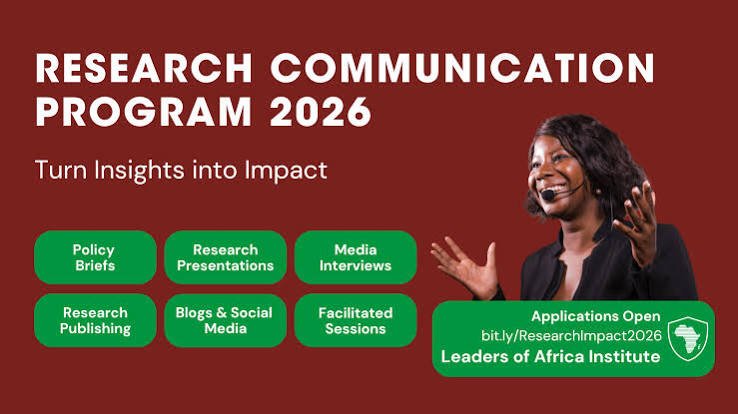
Leaders of Africa Institute Research Communication Program 2026
Applications are now open for the Leaders of Africa Institute Research Communication Program 2026, an advanced virtual program designed to equip researchers, faculty members, practitioners, communication strategists, and advocates with practical skills for communicating research clearly and effectively to different audiences. The program is designed for people working across all academic and professional fields. Participants will learn how to translate complex research findings into clear and compelling messages for academic peers, policymakers, media organizations, funders, practitioners, and the general public. The program places particular emphasis on helping researchers increase the visibility, reach, and influence of their work. The Research Communication Program will run from November 2026 to January 2027 through a live synchronous virtual classroom. Participants are expected to dedicate approximately three hours per week to the program. The program also provides opportunities for mentorship, international networking, and professional development through the Leaders of Africa Institute community. About the Program The Research Communication Program is a flagship program of the Leaders of Africa Institute focused on connecting research and communication. It recognizes that high quality research can have limited impact when findings are not communicated effectively to the people who can use them. Participants will learn how to identify different audiences, adapt messages to stakeholder needs, communicate complex information in accessible ways, and select appropriate communication channels. The training covers both traditional research communication and modern digital approaches. The program includes practical training in research articles, policy briefs, presentations, media engagement, webinars, blogs, social media content, multimedia production, research profiles, and visual communication. Participants will apply the skills to their own research and professional interests throughout the program. Program Benefits Successful applicants will receive: • An official Leaders of Africa Institute certificate. • An automatic Impact Scholarship worth approximately USD 3,700. • Reduced program tuition of approximately USD 250 to USD 350 after the Impact Scholarship. • Personal mentorship and a relationship with program instructors. • Access to an international professional and research network. • A professional research profile development opportunity. • A portfolio of research communication work. • Practical experience communicating research to academic, policy, media, and public audiences. • Opportunities to develop a Capstone Project and present it at the International Showcase. • Training in digital communication and multimedia tools. • A reference letter if required. The official program guide states that the total tuition is USD 4,000, while every accepted applicant receives an Impact Scholarship of approximately USD 3,700. The remaining fee is generally between USD 250 and USD 350. Eligibility Criteria Applicants for the Research Communication Program must meet the following requirements: • Applicants can come from any country internationally. • Applicants can be from any academic or professional field. • Researchers, faculty members, practitioners, communication strategists, and advocates are encouraged to apply. • Applicants should have research, thematic, or professional interests that can benefit from stronger communication skills. • Applicants should be prepared to participate in the live virtual program. • Applicants should demonstrate clear reasons for wanting to strengthen their research communication abilities. The program has a competitive admissions process. An Admission Committee reviews applications and selects prospective Scholars who demonstrate strong potential to benefit from the program and contribute to the cohort. Required Application Materials Applicants will need to prepare: • Curriculum vitae or resume in one PDF file of up to 5 MB. • Statement of Interest of no more than 500 words. The Statement of Interest should address: • Your research, thematic, and professional interests and relevant professional background. • What shaped your academic or professional interests. • What you hope to learn from the Research Communication Program. • How the program will help you achieve your career and educational goals. How to Apply Review the Research Communication Program information and confirm that your academic or professional interests align with the program. Prepare an updated curriculum vitae or resume and save it as one PDF file of no more than 5 MB. Write a Statement of Interest of no more than 500 words addressing your research and professional interests, what shaped those interests, what you hope to learn, and how the program will support your career and educational goals. Complete the online application form through the Leaders of Africa Institute application portal. Review your application carefully and ensure that all required information and documents are included.
The 50 Percent Storytelling Fellowship 2026
Applications are now open for The 50 Percent Storytelling Fellowship 2026, a free 10 week online fellowship designed to help young people develop communication, storytelling and advocacy skills for social impact. The programme is created for young changemakers who want to strengthen their voices, communicate their ideas more effectively and use storytelling as a tool for positive change. The fellowship brings together young people from diverse backgrounds, including climate activists, social justice advocates and members of social impact networks. Through guided discussions, mentorship and peer engagement, participants explore how stories influence the way people understand themselves, their communities and the wider systems around them. The programme combines storytelling with systems thinking, sustainability, social justice and community mobilisation. Fellows are encouraged to examine their own narratives and identities while learning how to create stories that build belonging, challenge harmful assumptions and communicate important social issues in accessible ways. About the Fellowship The 50 Percent Storytelling Fellowship is an online learning programme focused on empowering young people to communicate their ideas and experiences through compelling stories. The programme recognizes that effective storytelling can help changemakers build support, influence conversations and contribute to social and systemic change. The fellowship is delivered over 10 weeks and is completely free for selected participants. Fellows take part in guided discussions, dialogue exercises, mentorship, peer learning and practical storytelling activities. The programme begins by creating trust within the cohort through dialogue practice and active listening. Participants then explore personal narrative, identity and belonging before moving into practical storytelling production. The final phase focuses on peer teaching and applying the skills gained throughout the fellowship to new stories. Fellowship Benefits Successful fellows will receive: • Free participation in a 10 week online fellowship. • Training in communication, storytelling and advocacy. • Guided discussions, mentorship and peer engagement. • Hands on training in multimedia storytelling. • Practical experience creating short form video, blog posts and social media content. • Training in mobile filming, editing and social strategy. • Opportunities to strengthen dialogue and active listening skills. • Opportunities to develop confidence in using personal narratives. • Experience delivering a peer led mini lesson. • Opportunities to publish two final stories. • Connection to a community of like minded young changemakers. • An official programme certificate upon successful completion. Programme Areas The fellowship explores storytelling and social impact through several interconnected themes: • Systems thinking. • Sustainability. • Social injustice and social impact. • Community mobilisation. • Personal narrative and identity. • Belonging and inclusion. • Communication and advocacy. • Multimedia storytelling. • Social media strategy. • Dialogue and active listening. Eligibility Criteria The Storytelling Fellowship is open to young people who: • Are passionate about making a positive difference in the world. • Have an interest in storytelling, communication or advocacy. • Are interested in using their voice to contribute to social impact. • Are eager to learn, share and grow within a supportive community. • Are interested in issues such as climate action, social justice or community development. • Are members of or connected to social impact networks. • Come from diverse personal, professional, cultural or community backgrounds. The programme welcomes individuals who want to strengthen their communication abilities while connecting with other young people working toward positive change. Required Application Information Applicants should be prepared to communicate their interest in storytelling, social impact and learning within a diverse community. The application should demonstrate: • Your interest in making a positive difference. • Your connection to social impact, climate action, social justice or community work where applicable. • Your motivation for developing storytelling and communication skills. • Your willingness to participate actively in discussions and peer learning. • Your interest in learning from other young changemakers. • Your readiness to develop and share stories throughout the programme. Programme Outcomes Participants who successfully complete the fellowship will have opportunities to: • Publish two final stories in a format of their choice. • Choose between a reel, blog post or social media carousel for their final stories. • Deliver a peer led mini lesson to the cohort. • Strengthen confidence in communication and facilitation. • Build practical multimedia storytelling skills. • Develop a stronger understanding of narrative and identity. • Connect with a wider community of young changemakers. • Receive an official programme certificate. How to Apply Review the details and eligibility requirements for The 50 Percent Storytelling Fellowship 2026. Consider how storytelling could strengthen your work, advocacy or contribution to social impact. Prepare information about your background, interests and motivation for joining the fellowship. Reflect on the social, environmental or community issues that you care about and want to communicate through storytelling. Complete the online application through The 50 Percent fellowship application platform. Review your responses carefully and ensure that they accurately communicate your voice, motivation and interest in the programme.