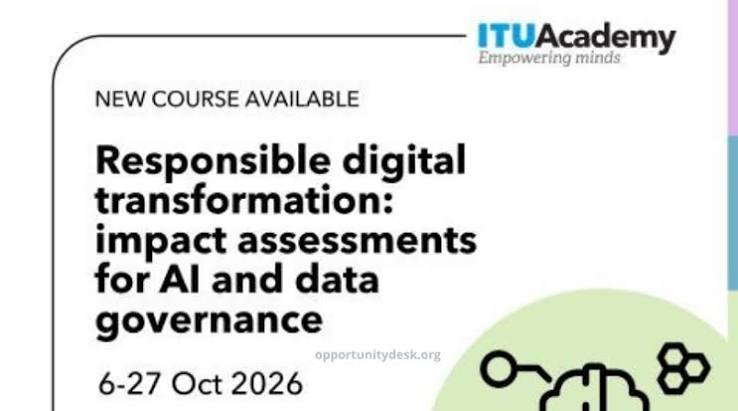
Applications are now open for the UNDP Responsible Digital Transformation: Impact Assessments for AI & Data Governance Course 2026. This fully funded four-week online programme is designed to equip government officials, policymakers, and development practitioners with practical skills to assess the impacts of artificial intelligence (AI) and data-driven systems in public governance. As governments around the world increasingly adopt AI, digital public infrastructure, and data-driven technologies to improve public services, ensuring these systems are transparent, fair, accountable, and inclusive has become a global priority. While AI has enormous potential to transform healthcare, education, justice, social protection, and public administration, it also presents significant challenges related to privacy, human rights, bias, accountability, and ethical governance. To address these challenges, the United Nations Development Programme (UNDP), in collaboration with the International Telecommunication Union (ITU) Academy and with support from the European Union’s Global Gateway Strategy, has developed this intermediate-level course to help participants move beyond theoretical discussions and apply practical impact assessment tools in real-world governance contexts. About the Course Responsible digital transformation goes beyond introducing new technologies into government systems. It requires ensuring that AI and digital innovations respect human rights, protect personal data, reduce discrimination, promote transparency, and strengthen public trust. This course builds on UNDP’s Human Rights Impact Assessment (HRIA) methodology and introduces participants to practical frameworks for identifying, assessing, and mitigating the risks associated with AI-enabled public services and digital governance initiatives. Rather than focusing solely on policy principles, participants will work through a structured process that helps them evaluate actual AI or data governance projects. They will learn how to identify affected stakeholders, recognize potential risks, analyze social and human rights impacts, and recommend practical governance measures to improve accountability and responsible implementation. Course Benefits Selected participants will receive: Free participation in the entire four-week programme. Live online sessions delivered by international experts. Practical training on AI and digital governance impact assessments. Access to UNDP’s Human Rights Impact Assessment (HRIA) methodology. Hands-on experience developing a real-world AI impact assessment. Interactive group exercises and case studies. Networking opportunities with policymakers and digital transformation professionals worldwide. Official ITU Academy certificate upon successful completion of the course requirements. Knowledge that can be directly applied to digital transformation initiatives within participants’ institutions. The course is funded through the European Union’s Global Gateway Strategy, allowing selected participants to attend at no cost. Eligibility Criteria The course is primarily intended for: Government officials. Policymakers. Development practitioners. Public sector professionals working on digital transformation. Professionals involved in AI governance or data governance. Officials working in digital public infrastructure initiatives. Staff from public service institutions, regulatory agencies, and National Human Rights Institutions. Applicants should also meet the following requirements: Have a basic understanding of digital systems and artificial intelligence. Ideally possess at least two years of experience in digital policy, ICT, governance, or digital transformation. Hold an undergraduate degree in a relevant field, or have at least three years of relevant professional experience if they do not possess a university degree. Demonstrate fluency in English. Show a strong interest in applying practical AI impact assessment tools within their organization. Government officials and policymakers from developing countries, particularly women, are strongly encouraged to apply. Required Application Materials Applicants should prepare: Completed online application questionnaire. Motivation letter. Updated Curriculum Vitae (CV). Selection Criteria Applications will be evaluated based on: Relevant professional experience. Motivation for participating. Current role in digital transformation, AI, or data governance. Potential to apply course knowledge within the applicant’s institution. Quality of the application questionnaire and motivation letter. How to Apply To apply: Visit the official ITU Academy course page. Create an ITU Academy account if you do not already have one. Complete the online application questionnaire. Upload your motivation letter and updated CV. Review your application carefully. Submit your application before the deadline.

Tara’s Circle 2026 for Women Entrepreneurs (Up to €20,000 in Grant Funding)
Applications are now open for Tara’s Circle 2026, a global grant programme designed to empower women entrepreneurs who are creating innovative solutions to today’s most pressing social, environmental, and economic challenges. More than just a funding opportunity, Tara’s Circle is a global initiative that seeks to recognize, finance, and accelerate women-led ventures with the potential to create meaningful and sustainable impact in communities around the world. The programme welcomes applications from women founders and co-founders leading projects that combine innovation with purpose. Whether your initiative focuses on climate action, education, healthcare, technology, or sustainable fashion, Tara’s Circle provides both financial support and international recognition to help your project grow. This year’s call will award a total of €100,000 in grant funding across five thematic categories. Each category will recognize three outstanding projects, giving entrepreneurs the financial resources they need to scale their ideas, expand their reach, and increase their impact. One of the unique features of Tara’s Circle is that it is open globally, meaning women from any country can apply provided they meet the eligibility requirements. About the Programme Tara’s Circle was established to support women who are using entrepreneurship as a tool for positive change. Across the world, women continue to face barriers in accessing startup capital, business networks, mentorship, and investment opportunities. Tara’s Circle seeks to address these challenges by investing in early-stage ventures that have the potential to improve lives while promoting sustainable development. Rather than supporting businesses based solely on profitability, the programme looks for projects capable of generating measurable social, environmental, or economic impact. Applicants are expected to demonstrate not only the viability of their business model but also the long-term value their initiative can create for communities and society. The programme is intended for projects that have progressed beyond the idea stage. Applicants should already have a Minimum Viable Product (MVP) or a functional MVP that demonstrates the feasibility of their solution. This ensures that funding is directed toward ventures ready to move into their next phase of growth. Grant Benefits Successful applicants will receive financial grants according to their thematic category. Each category offers: First Prize: €10,000 Second Prize: €6,000 Third Prize: €4,000 Each thematic area has a total funding allocation of €20,000. Across the five categories, fifteen winning projects will share a total grant pool of €100,000. Beyond financial support, selected entrepreneurs will benefit from: International recognition for their projects. Increased visibility within the global entrepreneurship ecosystem. Opportunities to accelerate the growth of their ventures. Access to a community of women entrepreneurs and innovators. Enhanced credibility that may help attract additional partners, investors, and collaborators. Eligibility Criteria Applicants must meet the following requirements: Be a woman aged 18 years or older at the time of application. Be the founder or co-founder of the project. Play an active leadership role within the venture. Lead a project with social, environmental, or economic impact. Have a project operating at the seed stage. Possess a defined or functional Minimum Viable Product (MVP). Demonstrate the project’s potential for scalability and long-term sustainability. Required Application Materials Applicants are required to submit their applications online through the official platform. The application package includes: A completed online application form. A Pitch Deck in PDF format presenting the project clearly and concisely. A two-minute Elevator Pitch. Any additional documents requested through the application platform for verification or clarification. Applications may be submitted in either English or Spanish. Selection Criteria Projects will be evaluated based on several factors, including: Innovation and originality. Social, environmental, or economic impact. Strength of the business model. Scalability and sustainability. Quality of the project presentation. Leadership demonstrated by the applicant. Overall potential for long-term success. How to Apply To apply for Tara’s Circle 2026: Visit the official Tara’s Circle application platform. Complete the online application form with accurate project information. Prepare a professional Pitch Deck in PDF format explaining your business model, impact, and growth strategy. Record a concise elevator pitch of no more than two minutes. Upload any additional supporting documents requested. Review your application carefully before submission. Submit your application before the deadline. Applicants are encouraged to start preparing their application materials early to ensure they have sufficient time to develop a compelling pitch and complete all required sections.
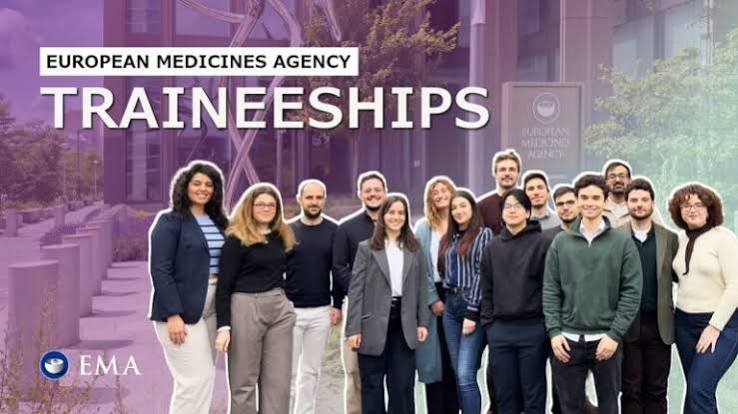
European Medicines Agency (EMA) Traineeship Programme 2026 (Paid Traineeship in Amsterdam)
Applications are now open for the European Medicines Agency (EMA) Traineeship Programme 2026. This prestigious paid traineeship provides recent graduates and university students with an excellent opportunity to gain professional experience at one of Europe’s leading regulatory agencies for medicines. Based in Amsterdam, the European Medicines Agency offers trainees the chance to work alongside experts responsible for evaluating, supervising, and monitoring medicines across the European Union and the European Economic Area (EEA). Participants will contribute to meaningful projects while developing professional skills in an international and multicultural working environment. The programme is designed to help talented young professionals bridge the gap between academic study and professional employment. During the ten-month traineeship, participants receive structured mentoring, professional development opportunities, practical work experience, and exposure to the European Union’s regulatory framework for medicines and public health. Whether your background is in life sciences, pharmacy, medicine, chemistry, law, communications, information technology, finance, or human resources, the EMA Traineeship Programme provides an excellent opportunity to gain first-hand experience within a respected European institution while building a strong foundation for an international career. About the Traineeship The European Medicines Agency believes that young professionals bring fresh perspectives, innovative ideas, and valuable energy to the organization. In return, trainees gain practical experience by working with highly experienced professionals on projects that have a direct impact on public health throughout Europe. Trainees are integrated into one of the Agency’s departments according to their educational background and the Agency’s operational needs. Throughout the programme, participants are assigned meaningful responsibilities rather than simply observing daily activities. They work closely with experienced staff members, attend meetings, contribute to ongoing projects, and develop practical skills that prepare them for future careers. Each trainee is assigned a dedicated mentor who helps establish individual learning objectives, provides regular feedback, monitors progress, and supports professional development throughout the programme. Participants also have access to workshops, internal learning activities, networking opportunities, and competency development programmes that enhance both technical and transferable skills. The traineeship begins either from 1 October to 31 July or from 1 March to 31 December, depending on the intake period. The programme can be completed on a full-time basis (40 hours per week) or, in certain cases, on a part-time basis for participants combining the traineeship with Erasmus+, doctoral studies, or similar academic programmes. Traineeship Benefits Successful applicants will receive: A paid ten-month traineeship at the European Medicines Agency in Amsterdam. Monthly stipend of €2,049.77 for full-time trainees (adjusted for part-time appointments). Travel contribution to support relocation to Amsterdam. Dedicated mentor throughout the traineeship. Individual learning and professional development plan. Hands-on work experience in a European Union agency. Opportunities to participate in meetings, workshops, and cross-departmental activities. Access to Agency-wide competency development programmes. Career guidance and mentoring from experienced professionals. Opportunity to develop an international professional network. Areas of Traineeship EMA offers traineeship opportunities across a wide range of professional disciplines, including: Medicine regulation. Life sciences. Pharmacy. Healthcare. Chemistry. Pharmaceutical sciences. Information technology. Data and digital services. Pharmaceutical law. Human resources. Finance and accounting. Communications. Public relations. Administration. Corporate services. Regulatory affairs. Available placements vary depending on the Agency’s recruitment needs during each application cycle. Eligibility Criteria To be eligible for the EMA Traineeship Programme, applicants must: Be a citizen of an EU Member State or a country within the European Economic Area (EEA). Be one of the following: A recent university graduate. A university student participating in Erasmus+ or a similar mobility programme. A Master’s student who has already completed a previous university degree. A PhD student. Demonstrate an excellent command of English (minimum C1 level). Have a good knowledge of another official language of the European Union (minimum B2 level). Applicants should also demonstrate: Interest in learning about European medicines regulation. Ability to work effectively in multicultural and international environments. Strong communication and teamwork skills. Motivation to contribute to the Agency’s mission of protecting public health. Required Application Materials Applicants should prepare: Completed online application form. Updated Curriculum Vitae (CV). Academic qualifications. Evidence of language proficiency where required. Supporting documentation requested for the selected traineeship vacancy. Specific document requirements may vary depending on the department and traineeship position. Selection Criteria Applications will be assessed based on: Academic qualifications. Relevance of educational background. Language proficiency. Motivation and interest in the Agency’s work. Communication and interpersonal skills. Suitability for the selected traineeship placement. Only shortlisted candidates will be contacted for subsequent stages of the recruitment process. How to Apply To apply: Visit the official EMA Careers portal. Browse the available traineeship vacancies. Select the traineeship that matches your qualifications and interests. Complete the online application form. Upload all required supporting documents. Review your application carefully before submission. Submit your application before the application deadline. Applicants are encouraged to review the programme rules and frequently asked questions before applying to ensure they meet all eligibility requirements.
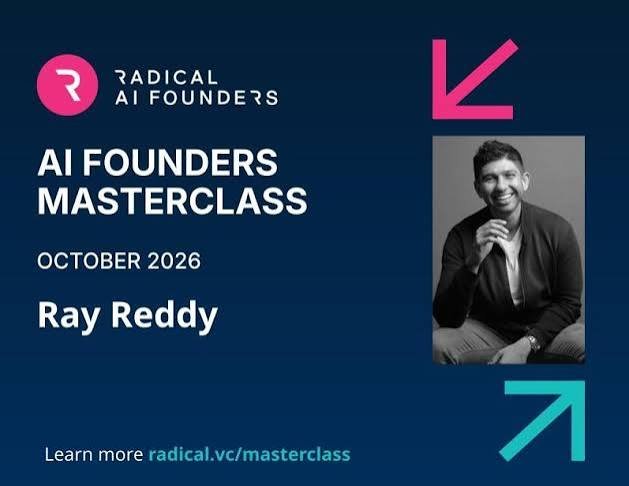
Radical AI Founders Masterclass 2026 (Free Virtual Programme for AI Researchers and Technical Founders)
Applications are now open for the Radical AI Founders Masterclass 2026. This exclusive four-week virtual programme is designed to help AI researchers, technical founders, and aspiring entrepreneurs transform innovative artificial intelligence ideas into scalable businesses through world-class mentorship, practical training, and access to an elite global community. Hosted by Radical Ventures, one of the world’s leading venture capital firms focused exclusively on artificial intelligence, the masterclass brings together leading AI researchers, successful founders, investors, and executives from some of the world’s top AI companies. Participants will gain practical insights into building AI products, launching startups, raising investment, and navigating the rapidly evolving AI ecosystem. The programme is completely free and delivered online, making it accessible to talented participants from around the world. In addition to expert-led sessions, participants will have the opportunity to join a vibrant international network of AI innovators from institutions such as Stanford University, MIT, Oxford, Cambridge, the University of California, Berkeley, Vector Institute, Mila, and the Allen Institute for AI. About the Masterclass The Radical AI Founders Masterclass was created to help bridge the gap between cutting-edge AI research and successful commercial innovation. While many researchers possess exceptional technical skills, transforming breakthrough research into a successful company requires expertise in product development, market strategy, fundraising, leadership, and business execution. Over four weeks, participants will attend virtual sessions led by internationally recognized AI pioneers, founders who have successfully built AI companies, venture capital investors, and executives working at leading AI organizations. These sessions combine technical knowledge with practical entrepreneurial guidance, giving participants the tools needed to build sustainable AI startups. The curriculum goes beyond theory by focusing on real-world challenges faced by AI founders. Participants will explore topics such as identifying market opportunities, validating ideas, designing AI-powered products, integrating AI into existing industries, building technical teams, attracting investors, and scaling AI businesses responsibly. Programme Benefits Participants selected for the Radical AI Founders Masterclass will receive: Free participation in the entire four-week virtual programme. Live sessions with globally recognized AI researchers and entrepreneurs. Practical workshops focused on AI product development and commercialization. Guidance from experienced venture capital investors. Networking opportunities with founders and researchers from leading institutions. Access to an international AI innovation community. Exposure to practical strategies for launching and scaling AI startups. Insights into fundraising, business development, and market expansion. Opportunities to collaborate with talented technical founders from around the world. One of the programme’s most valuable benefits is the opportunity to apply for the exclusive Compute Cohort Program after completing the masterclass. Selected startups may receive: Up to USD 350,000 in Google Cloud compute credits. Access to advanced H100 GPU and TPU computing infrastructure. Complimentary incorporation support. Legal office hours with experienced legal partners. Mentorship from leading AI experts and startup advisors. These resources are designed to help promising AI startups accelerate product development and prepare for long-term growth. Eligibility Criteria Applicants should: Be AI researchers, technical founders, engineers, or entrepreneurs. Have an interest in building AI-driven products or companies. Demonstrate technical expertise in artificial intelligence or related fields. Be committed to participating in the four-week virtual programme. Be able to communicate effectively in English. Required Application Materials Applicants should prepare: Completed online application form. Personal and professional information. Details about their technical background. Information about their startup or AI project, if applicable. Responses to programme application questions. Additional information may be requested during the selection process. Selection Criteria Applications will be evaluated based on: Technical background and expertise. Entrepreneurial potential. Quality and originality of AI ideas. Commitment to building AI solutions. Potential for long-term impact. Overall strength of the application. How to Apply To apply: Visit the official Radical AI Founders Masterclass application portal. Complete the online application form. Provide details about your technical background and AI experience. Describe your startup idea or current AI project, if applicable. Review your application carefully before submission. Submit your application before the application deadline. Early applications are encouraged, as the programme is highly competitive and places are limited.
Defra Research and Development Fellowship Programme 2026 (Paid UK Government Fellowship)
Applications are now open for the Defra Research and Development Fellowship Programme 2026. This prestigious UK Government fellowship offers scientists, researchers, engineers, and analysts from academia and industry the opportunity to work directly within government while contributing to evidence-based policymaking. Now in its fourth year, the programme enables external experts to experience how scientific research and analytical evidence are translated into policies that address some of the most pressing environmental, agricultural, and societal challenges facing the United Kingdom. Fellows will work alongside Defra’s scientists, analysts, and policy teams, helping to shape decisions that influence environmental protection, food security, biodiversity, climate resilience, animal health, sustainable farming, and rural development. The fellowship is ideal for professionals who want to broaden their career by gaining first-hand experience at the science-policy interface while making a tangible contribution to government decision-making. Participants will build valuable networks across government and the research community, gain insight into policy development processes, and strengthen their ability to communicate scientific evidence to decision-makers. About the Fellowship The Defra Research and Development Fellowship Programme is designed to bridge the gap between scientific research and public policy. While many researchers generate evidence that influences society, few have the opportunity to see how that evidence is used within government. This fellowship provides that unique experience. Throughout the fellowship, participants will be embedded within Defra teams, collaborating with policy professionals, economists, statisticians, social researchers, operational staff, and technical experts. Fellows will contribute their specialist knowledge to live government projects while learning how evidence is gathered, evaluated, and incorporated into national policy. Projects span a wide range of subjects, including climate adaptation, environmental conservation, food systems, fisheries, biosecurity, biodiversity, water management, agricultural innovation, and emerging technologies. Fellows may also contribute to research reviews, policy evaluations, horizon scanning, data analysis, and the development of innovative solutions to complex policy challenges. The programme is intended to foster long-term collaboration between government, academia, and industry, ensuring that public policy continues to benefit from cutting-edge scientific knowledge and analytical expertise. Fellowship Benefits Successful applicants will receive: A paid fellowship within the UK Government. Salary based on Civil Service grade and experience. Fellowship lasting between six and twelve months. Flexible working arrangements, including part-time and job-share opportunities where applicable. Practical experience working at the science-policy interface. Opportunities to influence national policy through research and evidence. Access to multidisciplinary teams of scientists, analysts, and policymakers. Professional development through government training and networking opportunities. Enhanced understanding of policymaking and public sector research. Opportunity to build lasting professional relationships across academia, government, and industry. Beyond financial support, the fellowship provides participants with valuable experience that can strengthen future careers in academia, government, consulting, research organizations, and international institutions. Areas of Work Depending on their expertise and assigned project, fellows may contribute to work involving: Environmental protection. Climate change adaptation. Sustainable agriculture. Food production and food security. Biodiversity conservation. Animal and plant health. Water resources. Fisheries and marine science. Rural development. Environmental economics. Scientific data analysis. Research evaluation. Emerging technologies. Evidence-based policymaking. Projects are designed to address real-world challenges and support government priorities through high-quality research and analysis. Eligibility Criteria Applicants should: Be scientists, researchers, engineers, or analytical professionals. Have relevant experience in research or research and development. Possess postgraduate qualifications, chartered status, or equivalent professional expertise in a relevant discipline. Demonstrate strong analytical and problem-solving abilities. Have experience delivering research or technical projects. Be able to communicate complex scientific information clearly to non-specialist audiences. Be interested in applying research to inform government policy. Meet the nationality and right-to-work requirements specified by the UK Civil Service. The programme is intended for professionals from academia, research institutions, and industry who wish to gain experience working within government. Ideal Candidates Defra is seeking applicants who can demonstrate: Strong scientific or analytical expertise. Experience conducting research that addresses practical challenges. Excellent communication and stakeholder engagement skills. Ability to work collaboratively across multidisciplinary teams. Interest in public policy and evidence-based decision-making. Adaptability and willingness to work in a fast-paced government environment. Commitment to delivering high-quality work with real-world impact. Required Application Materials Applicants should prepare: Completed online application form. Employment history. Academic and professional qualifications. A personal statement (approximately 500 words) outlining relevant experience, motivation, and suitability for the fellowship. Details of preferred policy area(s). Any additional information requested during the recruitment process. Selection Criteria Applications will be assessed based on: Relevant scientific or analytical expertise. Quality of previous research experience. Ability to communicate technical evidence effectively. Motivation for joining the programme. Alignment between the applicant’s expertise and Defra’s policy priorities. Strength of the personal statement. Overall suitability for working in a government policy environment. How to Apply To apply: Visit the official Defra Fellowship recruitment portal through Civil Service Careers. Review the available fellowship opportunities and policy areas. Complete the online application form. Upload or provide all required information, including your personal statement and employment history. Submit your application before the deadline.

George Washington Presidential Library Research Fellowships 2027–2028 (Fully Funded)
Applications are now open for the George Washington Presidential Library Research Fellowships 2027–2028. This prestigious residential fellowship provides scholars from around the world with the opportunity to conduct advanced research using the extensive collections of the George Washington Presidential Library, located at George Washington’s historic Mount Vernon estate in Virginia, approximately 15 miles south of Washington, D.C. The fellowship supports researchers studying the early American period, particularly the eighteenth and nineteenth centuries. Fellows are given uninterrupted time to conduct research while enjoying access to one of the leading collections of manuscripts, rare books, archives, and historical resources related to early American history. Whether you are an academic, graduate student, independent scholar, museum professional, or public historian, this fellowship offers a unique opportunity to deepen your research, collaborate with fellow scholars, and contribute to new knowledge about America’s founding era. In addition to generous stipends, successful applicants receive free on-campus housing and travel support, allowing them to focus entirely on their research during their residency. About the Fellowship The George Washington Presidential Library Research Fellowship is designed to encourage original scholarship by providing researchers with access to the Washington Library’s exceptional collections. The library houses thousands of rare books, manuscripts, maps, personal papers, historical documents, photographs, and archival materials covering numerous aspects of early American political, military, social, cultural, and economic history. Researchers are encouraged to explore the online catalogs before applying to determine how the library’s collections can strengthen their proposed projects. Fellows spend between one and six months conducting independent research while benefiting from the expertise of librarians, archivists, and subject specialists. Beyond providing access to valuable historical resources, the fellowship creates an intellectually stimulating environment where scholars can exchange ideas, attend library events, and engage with others working on related historical topics. The programme has become an important platform for advancing research on George Washington, the American Revolution, the Founding Era, and the broader history of early America. Fellowship Benefits Selected fellows will receive: Residential fellowship lasting one, three, or six months. Free housing on the Washington Library campus throughout the fellowship. Research stipend based on fellowship duration: USD 3,000 for one-month fellowships. USD 10,000 for three-month fellowships. USD 20,000 for six-month fellowships. Round-trip airfare or mileage reimbursement of up to USD 1,000. Full access to the George Washington Presidential Library collections. Assistance from experienced librarians and archival staff. Opportunity to conduct focused research in a world-class historical research environment. Networking opportunities with historians and researchers from different disciplines. The financial support enables fellows to dedicate their time to research without the burden of major living or travel expenses. Research Areas The fellowship supports projects related to the early American period, particularly topics connected to the eighteenth and nineteenth centuries. Research may include: George Washington and his legacy. The American Revolution. Colonial America. Early United States political history. Military history. Social and cultural history. Economic history. Slavery and freedom. Material culture. Decorative arts. Preservation studies. Public history. Early American literature and intellectual history. Museum and archival research. Interdisciplinary projects that make significant use of the library’s collections are also encouraged. Eligibility Criteria Applications are open to both U.S. citizens and international applicants. Eligible applicants include: University faculty members. Academic researchers. Public historians. Independent scholars. Curators. Museum professionals. Material culture specialists. Decorative arts professionals. Preservationists. Graduate students conducting advanced research. Applicants should propose a research project that will substantially benefit from the Washington Library’s collections and resources. Prior experience with archival research is advantageous but not mandatory. Required Application Materials Applicants must submit: A completed online application. A research proposal of no more than six double-spaced pages describing: The research project. The objectives of the fellowship. Expected research outcomes. How the library’s collections will support the project. Current Curriculum Vitae (CV) or résumé. Two letters of recommendation. Applicants are encouraged to prepare clear, well-organized proposals that demonstrate the scholarly importance of their project and explain why residency at the Washington Library is essential. Selection Criteria Applications will be evaluated based on: Scholarly quality of the proposed research. Originality and significance of the research project. Relevance of the proposal to the Washington Library’s collections. Feasibility of completing the proposed work during the fellowship period. Applicant’s academic or professional background. Strength of recommendation letters. Preference is given to projects that make substantial use of the library’s unique archival and manuscript collections. How to Apply To apply: Review the George Washington Presidential Library’s online research collections and catalogs. Prepare a detailed research proposal explaining your project and expected outcomes. Update your Curriculum Vitae or résumé. Arrange for two referees to submit letters of recommendation. Complete the online fellowship application before the deadline. Applicants are encouraged to begin preparing their materials early, particularly the research proposal and recommendation letters.
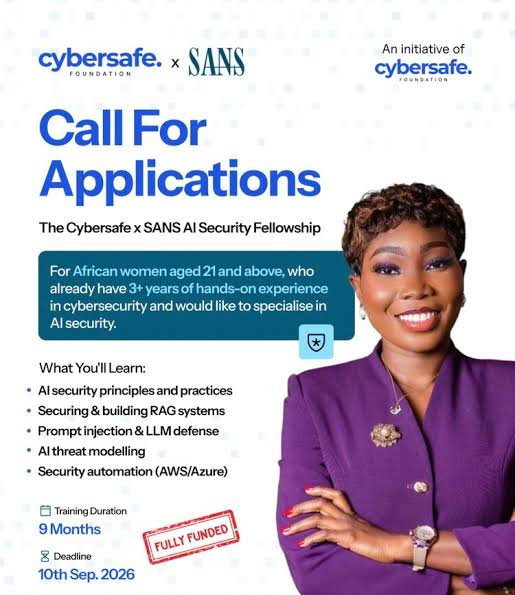
CyberSafe x SANS AI Security Fellowship 2026 (Fully Funded)
Applications are now open for the CyberSafe x SANS AI Security Fellowship 2026. This fully funded nine-month fellowship is designed to equip experienced African women in cybersecurity with specialized skills in artificial intelligence (AI) security, one of the fastest-growing and most in-demand fields in technology today. As organizations increasingly adopt generative AI, large language models (LLMs), autonomous systems, and AI-powered applications, the need for professionals who can secure these technologies has never been greater. The CyberSafe Foundation, in partnership with the globally renowned SANS Institute, has launched this fellowship to help bridge the growing AI security skills gap while increasing the representation of African women in advanced cybersecurity roles. The programme combines self-paced SANS OnDemand courses, practical laboratories, expert mentorship, certification preparation, and continuous learning support. By the end of the fellowship, participants will have gained practical experience in defending AI systems against emerging cyber threats and will be well prepared for globally recognized GIAC certifications. About the Fellowship The CyberSafe x SANS AI Security Fellowship is not an entry-level cybersecurity programme. Instead, it is intended for professionals who already possess practical cybersecurity experience and are looking to build expertise in AI security. Throughout the nine-month programme, fellows will follow a carefully structured learning pathway that begins with AI security fundamentals before progressing to more advanced topics such as securing Retrieval-Augmented Generation (RAG) systems, AI application security, threat modelling, and security automation. Participants will learn directly from experienced SANS instructors, AI security practitioners, and cybersecurity researchers while gaining exposure to real-world attack scenarios and practical defense strategies. The programme emphasizes hands-on learning through laboratories and practical exercises that mirror the security challenges organizations currently face when deploying AI technologies. Fellowship Benefits Successful applicants will receive: Fully funded participation with no tuition fees. Nine months of advanced AI security training. Access to premium SANS OnDemand learning resources. Practical, hands-on AI security laboratories. Preparation for the GIAC AI Platform Security (GAIPS) certification. Preparation for the GIAC AI Security Automation Engineer (GASAE) certification. Mentorship from experienced cybersecurity and AI security professionals. Continuous academic and technical support throughout the fellowship. Exposure to globally recognized cybersecurity best practices. Enhanced career opportunities in one of the fastest-growing cybersecurity specialties. What Participants Will Learn Throughout the fellowship, participants will develop practical skills in: AI security principles. Large Language Model (LLM) security. Prompt injection attacks. Jailbreak prevention techniques. AI attack surfaces. Retrieval-Augmented Generation (RAG) security. Context-aware AI application security. Agentic AI systems. AI threat modelling. Security automation. Cloud security using AWS and Microsoft Azure. Infrastructure as Code (IaC). AI-driven detection and incident response. Building secure AI applications. The programme emphasizes real-world implementation rather than theory alone, ensuring fellows gain practical expertise that can immediately be applied in professional environments. Eligibility Criteria Applicants must satisfy all of the following requirements: Be a woman aged 21 years or older. Be an African citizen. Currently reside in an African country. Be able to communicate effectively in English. Have at least three years of hands-on cybersecurity experience. Demonstrate a genuine interest in AI security. Be willing to complete the prerequisite AI security course during the application process. Be able to commit to the entire nine-month fellowship, including certification preparation activities. Previous AI experience is not required. However, applicants should already possess a solid cybersecurity foundation before joining the programme. Who Should Apply? The fellowship is ideal for professionals such as: Security Analysts. Security Engineers. SOC Analysts. Penetration Testers. Cloud Security Engineers. Application Security Specialists. Incident Responders. Cybersecurity Consultants. Governance, Risk, and Compliance (GRC) Professionals. Digital Security Professionals seeking to transition into AI security. If you already have cybersecurity experience and are looking to specialize in securing AI technologies, this fellowship provides an excellent pathway into one of the most sought-after areas in cybersecurity. Required Application Materials Applicants should prepare: Completed online application form. Personal and professional information. Details of relevant cybersecurity experience. Responses to application questions. Completion of the required prerequisite AI security course. Any additional information requested during the recruitment process. Selection Criteria Applications will be evaluated based on: Relevant cybersecurity experience. Demonstrated technical competence. Commitment to AI security. Readiness to complete the entire fellowship. Quality of the application responses. Overall suitability for the programme. Applications are reviewed on a rolling basis, so early submission is strongly encouraged. How to Apply To apply: Visit the official CyberSafe Foundation application portal. Carefully read the fellowship application guide. Complete the online application form. Provide accurate information about your cybersecurity experience. Complete the prerequisite AI security course. Submit your application before the deadline. Applicants are advised to write all responses in their own words, as applications containing substantially AI-generated responses may be disqualified.
Tech Policy Press Fellowship Program 2027 ($10,000 Stipend)
Applications are now open for the Tech Policy Press Fellowship Program 2027. The year-long, part-time fellowship supports journalists, researchers, lawyers, and public policy professionals interested in exploring critical issues at the intersection of technology, democracy, and society. Since its launch in 2023, the fellowship has supported professionals from around the world in producing high-quality reporting and policy analysis on topics such as artificial intelligence governance, digital rights, technology regulation, online platforms, and the relationship between technology and democratic institutions. Each selected fellow will receive a USD 10,000 stipend, editorial mentorship, and the opportunity to publish original work with Tech Policy Press. About the Fellowship The Tech Policy Press Fellowship is designed to support independent reporting and analysis that informs public debate and policymaking on emerging technology issues. Fellows work remotely while pursuing a clearly defined area of focus throughout the year. Participants become part of an international cohort that meets regularly for peer learning, editorial feedback, and professional development. Throughout the fellowship, fellows receive guidance from the Tech Policy Press editorial team while contributing original reporting, commentary, or policy analysis for publication. Fellowship Benefits Selected fellows will receive: USD 10,000 fellowship stipend, paid quarterly. One year of editorial guidance from the Tech Policy Press editorial team. Membership in an international cohort of journalists and policy professionals. Monthly learning and peer exchange sessions. Opportunities to publish original reporting and analysis. Promotion of published work through the Tech Policy Press website, newsletter, podcast, and events. Professional networking with experts working on technology policy and democracy worldwide. Eligibility Criteria Applicants should: Be journalists, researchers, lawyers, or public policy professionals. Demonstrate expertise in technology policy, digital rights, artificial intelligence, technology governance, or related fields. Have a strong interest in exploring how technology affects democracy and society. Be able to produce high-quality public-interest reporting or policy analysis. Be available to participate throughout the 12-month fellowship. Be able to communicate effectively in English. International applicants are encouraged to apply, including candidates from the Global Majority and underrepresented communities in media and public policy. Fellowship Expectations Successful fellows will: Publish original reporting or analysis at least once each month. Attend a mandatory one-hour monthly cohort meeting. Participate in monthly editorial check-in meetings. Collaborate with other fellows when appropriate. Meet agreed publication deadlines. Disclose any potential conflicts of interest. All fellowship outputs are expected to be published by Tech Policy Press, although fellows may subsequently republish their work where permitted. Areas of Interest Applicants may focus on topics including: Artificial intelligence governance. Technology regulation. Digital rights. Online platforms. Privacy and surveillance. Technology and democracy. Platform accountability. Internet governance. Emerging technologies and public policy. Regional or country-specific technology policy issues. Required Application Materials Applicants must submit: Curriculum Vitae (CV) or résumé. Cover letter (maximum two pages) describing the proposed area of focus and fellowship goals. Links to previously published work. Contact information for two professional references. Selection Criteria Applications will be evaluated based on: Demonstrated expertise in technology policy or a related field. Quality of previous publications. Strength and originality of the proposed fellowship focus. Potential to contribute meaningful reporting or policy analysis. Commitment to public-interest journalism and informed policy discussions. How to Apply To apply: Prepare your CV or résumé. Write a cover letter outlining the technology policy issue you intend to explore and why you are well positioned to cover it. Gather links to your published work. Provide contact details for two professional references. Complete and submit the online application before the deadline. Shortlisted applicants may be invited to participate in an online interview during the selection process. Successful applicants are expected to be notified by early December 2026.
African Investigative Journalism Conference (AIJC) Fellowship 2026 for French-Speaking Journalists
Applications are now open for the African Investigative Journalism Conference (AIJC) Fellowship 2026 for French-speaking journalists. The fellowship provides an opportunity for investigative journalists and media professionals from Francophone African countries to attend the African Investigative Journalism Conference (AIJC), one of the continent’s leading gatherings for investigative journalism. The fellowship covers major travel expenses, accommodation, conference registration, local transportation, and meals, enabling participants to engage with fellow journalists, editors, media experts, and investigators while strengthening their investigative reporting skills and expanding their professional networks. About the Fellowship The AIJC Fellowship aims to strengthen investigative journalism across Francophone Africa by supporting journalists who are committed to producing impactful public-interest reporting. The 2026 conference will bring together journalists, media organizations, academics, and experts from across Africa and beyond to discuss investigative techniques, digital tools, data journalism, media freedom, corruption, accountability, environmental reporting, and other issues affecting journalism on the continent. Fellows are expected to actively participate in conference sessions and apply the knowledge gained to produce investigative stories after the event. Fellowship Benefits Selected fellows will receive: Return airfare from their home country to Nairobi, Kenya. Airport transfers and local transportation. Accommodation during the conference. Conference registration fees. Meals throughout the conference. Access to keynote sessions, workshops, and panel discussions. Networking opportunities with leading investigative journalists and media professionals from around the world. Eligibility Criteria Applicants must: Be investigative journalists or media professionals. Be citizens of a French-speaking African country. Hold a valid passport with at least six months’ validity beyond the conference dates. Be able to attend the African Investigative Journalism Conference in Nairobi from November 10–12, 2026. Commit to producing at least one investigative journalism story inspired by the conference within three months after the event. Freelance journalists are encouraged to apply. Eligible Countries Applications are invited from journalists in Francophone African countries, including: Benin Burkina Faso Burundi Cameroon Central African Republic Chad Comoros Côte d’Ivoire Democratic Republic of the Congo Djibouti Equatorial Guinea Gabon Guinea Madagascar Mali Niger Republic of the Congo Rwanda Senegal Seychelles Togo Fellowship Requirements Successful fellows must: Attend the full conference programme. Produce at least one investigative report (online, print, broadcast, or multimedia) inspired by information gathered during the conference. Publish the story within three months after the conference concludes. Required Application Materials Applicants should prepare: A completed online application form. A valid passport or proof of identity. An updated Curriculum Vitae (CV). Examples of previously published investigative journalism work. Any additional information requested during the application process. Selection Criteria Applications will be assessed based on: Demonstrated experience in investigative journalism. Quality of previously published work. Commitment to public-interest reporting. Potential to apply knowledge gained from the conference. Overall strength of the application. How to Apply To apply: Complete the official online application form. Upload your CV and supporting documents. Provide evidence of your published investigative journalism work. Ensure your passport is valid for at least six months after the conference. Submit your application before the deadline. Only shortlisted applicants will be contacted regarding the next stage of the selection process.
Berenson Fellowship 2027–2028 (Fully Funded)
Applications are now open for the Berenson Fellowship 2027–2028. Funded by The Lila Wallace–Reader’s Digest Fund, the fellowship supports scholars whose research explores “Italy in the World” by examining the transnational connections between Italy and other regions during the Renaissance, broadly defined as the period from the 14th to the 17th century. Hosted by Villa I Tatti, Harvard University’s Center for Italian Renaissance Studies in Florence, the fellowship provides scholars with dedicated time, financial support, and access to world-class research resources to advance significant research projects. Up to four Berenson Fellowships are awarded each year. About the Fellowship Named after renowned art historian Bernard Berenson, the fellowship encourages innovative research that examines the Renaissance through a global lens rather than a purely European perspective. Applicants are expected to investigate historical exchanges between Italy and regions such as Africa, Asia, the Mediterranean, Latin America, and other parts of the world. Fellows become part of the vibrant scholarly community at Villa I Tatti, participating in lectures, conferences, concerts, and academic discussions while enjoying uninterrupted time to focus on their research. Fellowship Benefits Successful applicants will receive: Monthly stipend of USD 5,200. One-time relocation allowance of up to USD 1,800. Residential fellowship lasting either four or six months. Rent-free accommodation when available (utilities excluded). Housing subsidy if on-site accommodation is unavailable. Full access to the Biblioteca Berenson and other Harvard research resources. Dedicated workspace within the library. Opportunities to participate in seminars, lectures, conferences, and concerts. Membership in an international community of Renaissance scholars. Research Areas Applicants may conduct research in disciplines supported by Villa I Tatti, including: Art history. Architecture. History. Philosophy. Literature. Music. History of science. Renaissance studies. Interdisciplinary studies exploring Italy’s relationships with Africa, Asia, the Mediterranean, Latin America, and other world regions during the Renaissance. Eligibility Criteria Applicants must: Hold a PhD at the time of application. Not be enrolled in a second PhD programme. Propose an original research project related to “Italy in the World.” Conduct the fellowship exclusively on the proposed project. Be proficient in English. Have familiarity with Italian. Be able to conduct the majority of their research in Florence. Priority is given to early- and mid-career scholars. Scholars from all nationalities are encouraged to apply, with special consideration for applicants who do not have regular access to research facilities in Italy. Fellowship Requirements Selected fellows are expected to: Live in the Florence area throughout the fellowship. Spend at least three days each week at Villa I Tatti. Participate actively in the academic life of the Center. Attend designated lectures, conferences, and scholarly events. Required Application Materials Applicants should prepare: Completed online application form. Research proposal. Curriculum Vitae (CV). PhD certificate. Two letters of recommendation. Any additional documents requested through the application portal. Selection Criteria Applications will be assessed based on: Originality and scholarly quality of the proposed research. Relevance to the fellowship theme, “Italy in the World.” Academic achievements. Feasibility of completing the project during the fellowship. Potential contribution to Renaissance scholarship. How to Apply To apply: Prepare your research proposal and supporting documents. Complete the online application through the Villa I Tatti fellowship portal. Arrange for two referees to submit recommendation letters. Submit your application before the deadline. Applications may be submitted in either English or Italian. Applicants may apply for only one type of Villa I Tatti fellowship during each academic year.